
From Desktop Prints to Production-Ready Parts
The jump from hobbyist printing to industrial output is bigger than most people expect
Anyone who has spent time designing and printing their own models knows a desktop machine’s limitations well. Layer lines show up where they shouldn’t, certain geometries need constant supports, and materials that work fine for a display piece often fail the moment real mechanical load gets involved. That gap between a home setup and something that can survive daily use is exactly where industrial 3D printing services like Prototal come in, offering makers and small businesses a way to take a design that started on a hobbyist printer and produce it with the tolerances and material properties an actual product needs.
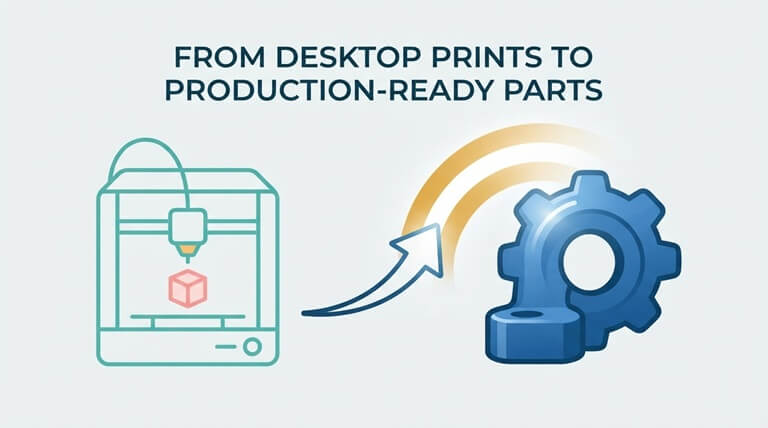
Industrial-scale technologies aren’t just scaled-up desktop printers. Selective laser sintering or multi jet fusion systems produce parts with uniform wall thickness and strength that is difficult to achieve with a filament printer, thanks to fine powder materials and precise thermal control. If the part has to get the job done, not just look good, and you’ve reached the limits of your own setup, it’s not really a choice whether you want to move to a service provider or not.
Then there’s the downside of things that everyone doesn’t consider until they’re in the thick of design: repeatability. It is easy to print one good part from the desktop printer. If you print the part fifty or five hundred times with the same dimensions, it’s a whole new ballgame, which is why small production runs are increasingly outsourced instead of done at home. That’s what the consistency of the industrial machines is built upon, and that’s why a design can go from an initial test print to production without having to be retoleranced from scratch.
This doesn’t do the same level of work as a prototype on a desktop printer. Fast, low-cost iterations are still the best way to catch design defects early, before a full production run. Where does a design cross the line from a prototype to an industrial part or product? Whether it is due to the materials involved, the number of parts in the design, or simply the desire to create something that looks and feels like a finished part or product, what is the criterion for making the change?
Choosing between printing and casting depends on what stage a project is at
When a design is validated and is ready for the next step, the manufacturing method typically is dictated by volume and the amount of potential changes to the part. This is where many independent creators stall, as the choices seem to be the same at first glance but address completely different problems.
Vacuum casting relies on silicone molds, which means that if a design is still in the early stages and may change after user feedback or testing, you can produce a small number of parts with production-like quality without investing in hard tooling. This process is designed for that kind of uncertainty because silicone molds can be produced much cheaper and faster than metal tooling, and their lower cost makes it easier to justify committing to a final design before a large run.
Another surprise for many first-time buyers is that they have to wait a while to receive their parts. The ability of industrial 3D printing to deliver polymer parts within a couple of working days can often mean the difference between a project being off to a successful start and a deadlock. That velocity is most critical at the beginning of the project when it’s possible to test out a new design fairly rapidly and save weeks later.
Often people think that building materials are a minor choice, but that is not the case. If you want to use a filament that would last for outdoor use in the sun, resist chemicals or withstanding heavy mechanical use, then you will need a material profile that most desktop filaments do not provide. Unlike trying to figure out what parts are available for home printers, working through those requirements with a vendor that offers a wide selection of materials usually saves a lot of trial and error when a part goes from concept to actual use.
Popular on OTW Right Now!



About The Author

Gagan Bhangu
Founder of otechworld.com and managing editor. He is a tech geek, web-developer, and blogger. He holds a master's degree in computer applications and making money online since 2015.