
Why Some Online Stores Refuse Card Payments, and What That Tells You
When an online store does not accept Visa or Mastercard, many shoppers immediately become cautious. Card payments are so common that seeing only Bitcoin or bank transfer at checkout can make a business seem unusual.
But the absence of card payments does not automatically tell you whether an online store is trustworthy. For some smaller European businesses, the decision comes down to payment-processing restrictions, transaction costs, dispute-related expenses, and the way payment providers manage merchant accounts.
Instead of judging a store by its payment logos alone, shoppers can look at several practical details that reveal much more about how the business operates.
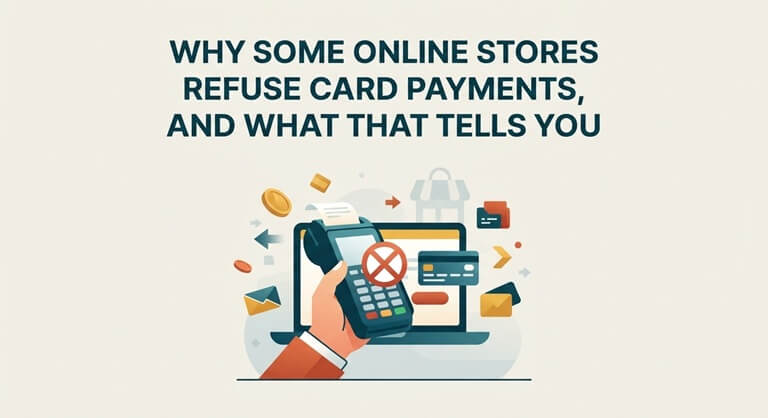
Why Processors Say No
Accepting card payments is not simply a matter of placing a Visa or Mastercard logo on a checkout page. A retailer needs a payment processor or acquiring bank that is willing to handle its business and the categories in which it operates.
Payment providers can restrict certain product categories or business models. Sometimes an entire category receives additional scrutiny or is not supported by a particular processor. This can leave a small retailer looking for alternative payment methods even when the business itself has been operating normally.
Payment processing also comes with fees. Every transaction can carry a cost, and the overall expense depends on factors such as transaction volume, location, business category, and the provider’s commercial terms.
There can also be reserve requirements. A payment provider may hold a portion of a merchant’s funds for a period of time to account for potential disputes or refunds. For a large company, having some working capital temporarily unavailable may be manageable. For a smaller retailer, it can have a much greater impact on day-to-day cash flow.
This is one reason a business may choose to offer direct payment methods instead of relying entirely on card processing.
What a Chargeback Costs a Small Store
Chargebacks are another consideration for online retailers.
A chargeback happens when a card transaction is disputed through the customer’s card issuer. The merchant may then have to respond to the dispute and provide relevant evidence showing information about the transaction and fulfillment.
The financial cost can extend beyond the original order. Depending on the payment provider, a merchant can face a chargeback fee while also losing the disputed transaction amount.
For a small store with a relatively limited number of orders, several disputes can represent a meaningful expense. There may also be administrative work involved in responding to those disputes and maintaining the documentation required by the payment provider.
This does not mean that card payments are undesirable for shoppers. Card-based consumer protections can be valuable. The point is simply that merchants have costs and risks associated with accepting cards that customers may not see from the checkout page.
Why a Bitcoin Discount Can Be Simple Business Math
A discount for Bitcoin payment can also have a straightforward financial explanation.
Different payment methods have different costs. If a retailer determines that accepting a particular payment method reduces some of its transaction expenses, it may choose to pass part of that difference on to the customer.
In that situation, a Bitcoin discount is not necessarily just a marketing technique. It can be a way of sharing a lower payment cost.
What matters to the customer is transparency.
The normal price should be clear, and any discounted price should be understandable before payment. If Bitcoin is being used, the checkout should also show the exact amount required rather than leaving the customer to calculate it independently.
NeuroPeak, an EU-based online store, is one example: it takes Bitcoin, shows the euro price and the exact BTC amount before payment, and gives 20% off for it.
The store also provides independent lab test results per batch, tracked shipping from an EU warehouse, and plain packaging. These are characteristics of how the store presents and fulfills orders, rather than claims about what its products do.
Looking at those operational details gives shoppers more useful information than simply asking whether a particular payment logo appears on the checkout page.
Four Checks That Matter More Than the Payment Logo
Whether a store accepts cards is only one part of the buying experience. Before placing an order, shoppers can check four basic things.
1. Is the Full Price Shown Before Payment?
A clear checkout should show the customer what they are expected to pay before the transaction is completed.
Look for the product price, shipping charges, applicable taxes or other costs, and the final amount. If the store offers cryptocurrency payment, the checkout should clearly display the relevant cryptocurrency amount as well.
Unexpected fees appearing at the final stage are more concerning than the simple absence of card payments.
Price transparency makes it easier for customers to understand exactly what they are agreeing to purchase.
2. Can You Actually Read the Refund Policy?
A refund policy should not be hidden behind vague language.
Before ordering, check whether the store clearly explains its refund or return conditions. The policy should be accessible and written in language that an ordinary customer can understand.
Pay attention to what the business says about situations such as an order that cannot be fulfilled, a damaged shipment, or another issue covered by its stated policy.
The important point is not whether every store has identical terms. It is whether the customer can find and understand the terms before paying.
3. Is Shipping Tracked?
For physical online orders, shipping information is another useful detail to examine.
A store should explain how orders are dispatched and, where applicable, provide tracking information after shipment.
Tracked shipping creates a record of the delivery process and gives the customer a way to follow the package after it leaves the warehouse.
For example, NeuroPeak describes tracked shipping from an EU warehouse as part of its order process. This kind of operational information can be more useful to a shopper than the payment methods displayed at checkout.
4. Does Someone Actually Answer?
A functioning contact channel is one of the simplest things to test before ordering.
Customers can send a straightforward question about an order, shipping, payment, or another matter relevant to the purchase. The quality and responsiveness of the reply can provide useful information about how the business communicates with customers.
If emails repeatedly go unanswered or the available contact methods do not appear to work, that deserves attention.
A responsive business can explain its policies and answer questions regardless of whether it accepts cards, bank transfers, or Bitcoin.
Look at the Store, Not Just the Payment Method
Payment methods can tell you something about a retailer’s business model, but they do not tell the whole story.
A store can accept every major card and still provide poor information about shipping, refunds, pricing, or customer support. Conversely, a smaller European retailer that does not process cards may have a practical reason for using other payment methods.
The better approach is to examine the complete customer experience.
Is the full price visible before payment? Are refund terms easy to locate? Is shipping tracked? Does the business provide a genuine way to get in touch? Are important business and order details clearly presented?
These questions provide a stronger basis for evaluating an online store.
Why Store Transparency Matters
Transparency becomes particularly important when a retailer uses less familiar payment methods.
A customer should not have to guess how much an order costs, where it will be shipped from, what happens if there is an issue with an order, or how to contact the business.
For example, a retailer can make its checkout easier to understand by showing the standard euro price alongside the exact cryptocurrency amount. It can also provide information about its warehouse location, shipping process, packaging, and available documentation.
NeuroPeak presents several of these details directly as part of its online store experience, including full pricing before payment, tracked EU-warehouse shipping, plain packaging, and independent lab test results for each batch.
Those details do not depend on whether the customer chooses a card or another payment method. They simply make the purchasing process easier to evaluate.
The Bottom Line
An online store that refuses card payments is not automatically suspicious.
Small European retailers may avoid card processing because of category restrictions, transaction costs, chargeback expenses, or reserve requirements imposed by payment providers. In some cases, offering Bitcoin or bank transfer can simply be a different way of managing payment costs.
For shoppers, the more useful question is not “Does this store accept my card?” but “How transparent is this store?”
Check the full price before payment, read the refund policy, look for tracked shipping, and make sure there is a contact channel that actually works.
Those four checks can tell you considerably more about an online retailer than the payment logos displayed on its checkout page.
Popular on OTW Right Now!



About The Author

Gagan Bhangu
Founder of otechworld.com and managing editor. He is a tech geek, web-developer, and blogger. He holds a master's degree in computer applications and making money online since 2015.