
Why Your Security Operations Are Creating Blind Spots in Threat Response
How are your security operations creating blind spots in the response to threats? Most firms separate physical security operations from their cybersecurity.
There are building guards. There are security teams who watch networks.
They communicate little, leaving a perilous gap. Incident information that might have prevented a breach is held within incident reports, paper files that never reach the threat detection systems in the first place—a much bigger issue than just faulty communication.
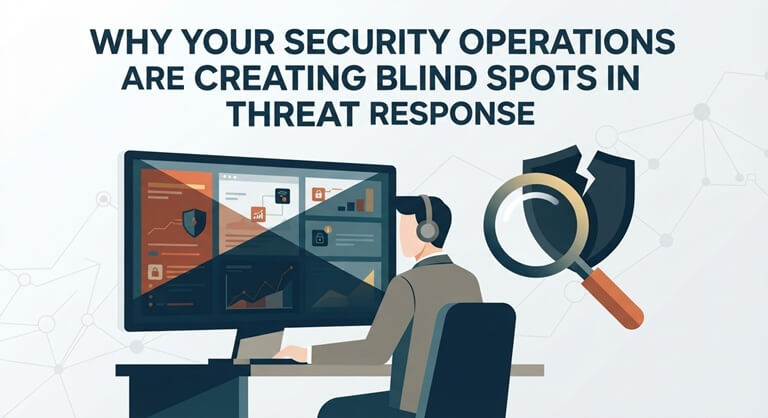
It’s logistical. When the safety of security guards is based on relaying pieces of information from unconnected systems to a manual log, no one consulting network logs can see the big picture.
A break-in that could have started with theft at the loading dock, suspicious vehicles in the parking garage, or unusual activity in the evenings can be lost on threat analysts who monitor only network logs. End.
A fractured picture of security operations data gives avoidable blind spots in incident detection and response time. Real-time visibility from physical security allows faster threat identification and escalation.
Integrating security operations data with security guard safety while on patrol can improve an organization’s effectiveness by reducing incident response times and lowering the number of breaches.
A centralized incident tracking system takes patrol observations that are spread out and makes them available to security and cybersecurity teams as actionable intelligence.
Threats no longer announce themselves through a single channel. A complex attack can originate from physical reconnaissance or social engineering at a facility. It may start with a guard noticing a stranger taking pictures of the entrances to the server room.
Or in the patrol log, the report of three after-hours entry attempts on a side door. Or in the car seen cruising through the parking lot.
These observations, noted as they happen, are the first warning signs most organizations miss. How? Physical security operations and cyber threat detection are different worlds. Security teams write incident reports that appear in separate systems.
Cyber teams monitor network traffic and logs. No one ever asks the other team, “What did you see back then?” It is hours or days later before anyone puts the pieces together. The window for incident response has expired. The cost of operating with this disconnect is unbelievable.
The time to attack increases. False positives in network monitoring are not correlated against the physical entity. Threat escalation slows because the team investigating a suspected breach lacks access to real-time patrol data and access controls. The organization reacts rather than prevents.
The Real Cost of Fragmented Operations
Think about a typical security event in a multi-campus/enterprise organization. A network monitoring tool reports anomalous login activity from an unknown IP. Incident response is called out, but the team has no way to verify if physical security cameras captured unusual activity in the data center at that time. No way to retrieve records of personnel entering the building. No way to obtain realtime dispatch records. They make assumptions.
The investigation stalls. Response time lost to the black hole. At the same time, the security operations team has their own systems. They record incidents, send out guards, and generate reports, all of which do not get integrated into this overarching threat picture. One reports an incident of someone trying to tailgate into a restricted area.
It gets recorded. Nobody ever puts that information into the context of the network anomaly taking place at the same time. Each team is working on one piece of the puzzle. This fragmentation is not only about response time. It is a liability. When a breach finally occurs, both of those teams have questions to answer. Why was the physical security incident not escalated? Why did the network monitoring team not identify the access attempt? Why weren’t those systems talking to each other? The answer is invariably that they weren’t designed for that.
Different types of organizations have made security operations visibility part of their threat detection process. When an anomaly occurs at the network level, the incident response team instantly knows whether it reflects real-world behavior. A guard report has already alerted a nearby officer of an illegal intruder in a secured zone at 2: 47pm. Through the integration of the network, an access surge occurs at 2: 52pm from the exact same area. The link is self-evident. The reaction is swift.
Escalation takes place in minutes. It’s not conjecture. Everything you use to carry out your day-to-day tasks is available, live, and unplugged. When patrol guys see something, you capture it. When they mark it, you track it.
Dispatch knows exactly which patrol team was once where. The building knows who has been in and out. The incident reports hold the details. When all of those things go into one place and integrate into threat flow processing, the reality is made clear in real time. Real-time integration also shifts the nature of urgency of network alerts.
Not every network anomaly is a breach. But when a network alert coincides with a physical event, the level of certainty shifts sharply. A dispatch system that places a guard at a specific place at a specific time becomes evidence. An access-card log that is concurrent with a network login becomes corroboration. The data are no longer disjointed disturbances but a consistent narrative.
A Realistic Example
A business real estate company manages ten office buildings. One afternoon, a building security team logs an incident: a trespass occurred in a server closet at 3:15 PM, with the culprit using a stolen access card. The incident is recorded, and a guard is sent off. At the same time, at 3:22 PM, the company’s IT security department identifies a surge in data exfiltration from that very building’s network.
The network team kicks off an inquiry. The security team also starts probing. But they don’t coordinate.
Around six hours later, someone finally gets the picture. That building where the physical breach and cyber threat took place was the same, at practically the same moment, and in similar environments. By that time, a large amount of data had already been taken. The response was delayed by several hours instead of just a few minutes. Further evaluation showed that customer data was compromised. If both departments had seen the entire picture, then there is a good possibility that this breach could have been halted within just fifteen minutes.
Operational Integration as Prevention Strategy
The change from isolated to collaborative operations alters the overall security posture. It no longer simply reacts to threats. Instead, organizations go from incident management to prevention as part of their strategy. For example, a patrol unit notices an issue – the unauthorized vehicles are looping around the facility three times in a week. Through a central logging system, that anomaly gets tracked. Security operations pick it up and report it. Access Control logs reveal tailgating attempts, as the same person shows a pattern of visiting the building on weekends. The cybersecurity group receives information.
Collectively, they stop being perplexed and start taking s; steps in real time; real-time information helps with resolving another longstanding issue during the investigation of a breach. Multivariate factors such as limited resources, inadequate documentation, lost records, and incomplete evidence make it extremely difficult for most companies to figure out the sequence of events leading up to a breach discovered several weeks later. No one else will probably be willing to do a job that will require them to go back in time and reconstruct an event from scattered, incomplete, and possibly destroyed data. But threat investigators are able to see only where the data got out, but cannot figure out the way that was used by the cybercriminal to enter the system. Thanks to a single, integrated incident-tracking system that captures all teams’ inputs, you can have complete documentation of the operational timeline when needed.
Actionable Takeaways
Audit your incident tracking process to determine how your security operations information and cybersecurity monitoring are separate, and identify what incidents should be visible to both teams.
Develop a policy that automatically logs physical-level security incidents (intrusion, tailgating, perimeter breach) into a system that threat teams can monitor.
Make incident reporting immediate. Feed security operations data into centralized incident tracking in seconds instead of hours; include dispatch reports and patrol data in one chronologically ordered stream.
Fully train security operations and cybersecurity teams in cross-functional questioning during investigation and regularly review joint incident patterns. Select operational tools that have API level integration or direct data feeds to your central incident management system, and operational visibility does not rely on manual reporting.
Conduct a tabletop exercise that assumes a coordinated physical and cyber attack and determine where disjointed data costs time to respond.
The disconnect between traditional physical security and cyber threat detection can no longer be tolerated. Mechanisms that originate in physical reconnaissance or social engineering are moving into the cyber arena at an unprecedented pace.
Organizations that rely on isolated security operations data risk missing the earliest indicators of compromise.
Conversely, those who embed operational data into real-time threat detection processes will encounter current threats far more rapidly and contain breaches more thoroughly, ultimately avoiding the types of breaches that disjointed, traditional security systems never could.
The operational signals are there. The guards, the dispatch teams, and the security staff generate them every single day. It isn’t a matter of whether you’ve got early signals available. It’s a matter of whether your organization has chosen to let the teams that need them actually see those signals.
Popular on OTW Right Now!

About The Author

Gagan Bhangu
Founder of otechworld.com and managing editor. He is a tech geek, web-developer, and blogger. He holds a master's degree in computer applications and making money online since 2015.