
SaaS Scale-Up Bottlenecks: Fixing Hidden Workflow Debt
Every SaaS company has a version of the same meeting. Revenue is up, the board deck looks good, and then someone from customer success mentions, almost as an aside, that onboarding a new enterprise client now takes six weeks instead of two, and nobody in the room can fully explain why. The product didn’t get worse. The team didn’t get lazier. Somewhere in the space between “we’re a scrappy startup” and “we’re a real company,” a dozen small workarounds calcified into the way things actually get done, and nobody ever went back to check whether that way still made sense.
Growth Doesn’t Create Bottlenecks. It Reveals Them.
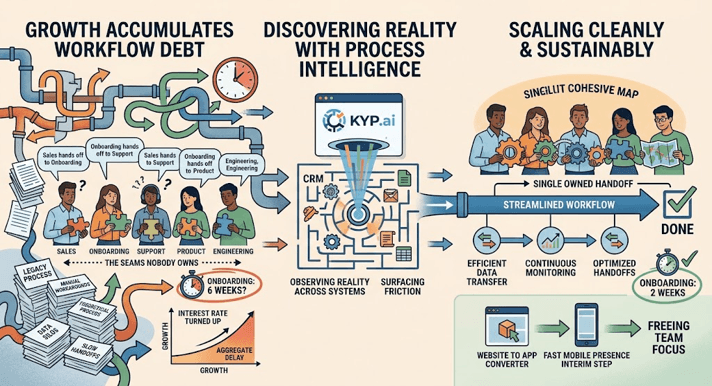
What the SaaS founders tell themselves is that bottlenecks are a growth problem – a nice problem to have. This isn’t entirely accurate. Often, growth was not the cause of most of the bottlenecks. They are developed in advance and quietly, by a two-person team with a deadline they needed to meet and without an occasion to go back to them. Debt is not a by-product of growth. It simply raises the interest rate until the payments are no longer ignored. Increasing the support handoff time from 10 minutes for fifty customers to an hour for five thousand extends the total delay by an hour or more per week.
This is where the trouble begins with SaaS workflow debt. It doesn’t usually appear as an isolated incident. It appears as if everybody is working a bit busier than they expected, a bit slower than the number of people would lead you to believe, and no single process is really failing, since the debt is spread over a dozen small handoffs instead of being focused in one obvious failure.
The Handoffs Nobody Owns
Give five people at a mid-size SaaS business a scenario in which a customer transitions from signed contract to full onboarding, and you’ll get five different answers – all true from their perspective and each missing as far as the rest of the world is concerned. Sales close/hand off to onboarding. Support is handed over at the end of onboarding. Support can also go back to product if a request is a feature gap and not a training problem. Every handoff has an owner, but not many times does someone own the handoff — the moment when the information, the context, or the urgency needs to be passed between systems and teams that aren’t always on the same page, or even the same system, let alone the same idea of what “done” means. These seams are where workflow debt exists, and that’s why it’s so difficult to see by examining each team’s work individually.
Seeing the Work Instead of Assuming It
When a process is slow, the typical remedy is to see where it’s slow and go there. They think onboarding takes forever because their implementation team is too small, so they add two more to the team and it’s just barely moving. The guess was adequate. It was also wrong: A legal review was part of the contract, and it turned into a week-long hold-up when contract volume reached a critical mass, without anyone on the outside knowing.
This is where the problem process intelligence is designed to solve, and it’s important to be accurate about it, since the word is used in a variety of ways. No, it is not an automation, nor is it a screen with charts and diagrams of how things should be done. It’s the discipline of observing how work actually moves through an organization’s real systems — the CRM, the ticketing tool, the contract platform, the half-dozen spreadsheets that quietly became load-bearing — and surfacing where time genuinely disappears, rather than where a process diagram assumes it should. KYP.ai Process Intelligence works from this perspective, recording actual activity throughout the tools that are used day-to-day and generating a visual map of where friction really focuses—where intuition says it probably does. Once the workflow is correctly identified, a company that decides that engineering is the problem may find that engineering wasn’t the problem at all; it was a manual data entry task between two systems that no one had ever thought to link.
Why the Obvious Fix Is Usually the Wrong One
So there’s this kind of expensive error that process intelligence is particularly good at avoiding: automating or hiring someone to fix the wrong part of a process (where it seems broken) when it isn’t. There is no point in automating a step that was never the bottleneck; it does not help, and in fact makes it more difficult to determine where the real problem is because now there’s a shiny new system and everyone feels it should be addressed. It’s about knowing the shape of the workflow before you get in between the lines and make a change that moves the needle versus one that just changes the look of progress.
Where Tooling Debt Hides in Plain Sight
Workflow debt isn’t only a process problem. It often takes the form of a tooling issue in process attire. A SaaS business that has created an experience for users on the web that was designed years ago, before mobile check-in was the norm, is faced with a similar challenge as a retail business – their product works fine on a phone, but it wasn’t designed to be that way! Rebuilding that experience as a full-fledged native app is the right long-term solution, but it’s a substantial engineering challenge, and sometimes a battle that’s too much trouble to take early for a company already battling internal workflow debt. A website-to-app converter offers a faster interim step here, wrapping the existing web app into something installable without a ground-up rebuild, buying time and mobile presence while the harder internal problems get addressed first. It is not the end of the world, but it carries at least the same flaws as the underlying web experience, and the sequence of execution is important; sometimes it’s the right thing to do to close the more pressing gap first and then go back to the remaining gaps when the team has a chance to build them correctly.
Fixing the Debt Without Creating New Debt
Once a company has identified a bottleneck, the next step is to view the process of “fixing” the bottleneck as a project, rather than a process. A new tool is introduced, a workflow is redesigned, and everyone moves on – and eighteen months later, there are their own subtle workarounds, as the team continued to grow and nobody continued to watch. Workflow debt is not a debt that is repaid once a company. It’s the same as having someone periodically check if the process is still the same as it was a year and a half ago, when it was designed, not as it is being used.
Process Intelligence can truly pay for itself as more of a continuous business practice than an ad hoc audit. Having a picture of the location of the friction last year only proves useful as a historical fact if the team, the tools, and the customer base have all evolved/shrunk. A company that isn’t seeing activity as it happens will never be able to prevent itself from taking on the same debt it paid off over the past few months again.
What Scaling Cleanly Actually Looks Like
It is not often that a SaaS company develops to a point where it is growing without causing significant disruption to its business. There is no heroic upside-down-onboarding process rescue. Even though they think they know how things are done, what they often have is a keen eye for seeing how it’s actually done, and the willingness to solve the problem between two teams that is not sexy, but is important, when the problem that gets the big board attention is sexy. It’s a less glamorous tale for investors and one that never really even comes into existence if the 6-week onboarding timeline is followed.
Frequently Asked Questions
How is process intelligence different from simply asking teams where the bottleneck is?
The team members might only be able to describe a portion of the process, so their answers are correct, but there are gaps. Process intelligence captures real processes on real systems and brings to light process bottlenecks that may be unnoticed by any individual team member.
Is a website-to-app converter a good fit for a SaaS company, not just e-commerce?
Yes, because it’s a quick, lower-cost way to create an installable mobile app from an existing web-based application, and it can be valuable for a SaaS company looking to improve internal processes instead of investing in a complete rebuild of their native app.
How often should a company revisit its workflow to check for new debt?
There’s no set time frame, but the biggest mistake is treating it as a one-off solution rather than a continuous process. Workflows are often dynamic, with teams, tools, and customer volumes evolving over time, so you need more frequent visibility than a single audit.
Popular on OTW Right Now!

About The Author

Gagan Bhangu
Founder of otechworld.com and managing editor. He is a tech geek, web-developer, and blogger. He holds a master's degree in computer applications and making money online since 2015.