
Best 3D Printer for Beginners in 2026: What First-Time Makers Should Know
3D printing is easier to approach in 2026. Much of the setup work, which made many people hesitant to try 3D printing in the first place, has been minimized through automatic bed leveling, guided calibration, easier slicer software, and more reliable desktop machines.
Choosing a 3D Printer for Beginners still requires planning. The top machine should be easy to set up, minimize potential setup mistakes, and provide enough flexibility for users to develop skills over time.
What Makes a 3D Printer Beginner-Friendly?
Beginner-friendliness is crucial for first-time makers, and it depends on how streamlined the maker-to-maker workflow is, from setup to the first print.
Easy Setup and Smart Automation
These can be very tedious for new users, especially when leveling the bed manually, making the first layer adjustment, and loading the filaments is complicated.
A beginner-friendly machine should have features that minimize the tedious setup, like automatic bed leveling, smart calibration, and easy filament insertion. When comparing a 3D Printer, beginners should prioritize repeatable results and reliable automation over headline speed alone.
Beginner-Friendly Software and User Experience
Learning to use the hardware is just part of the equation. Early print projects can be easier with clear menus, preset material profiles, and simple print controls.
Beginners can start with settings that work and then learn parameters like layer height, infill, supports, and temperature. The user-friendly software enhances the user’s time to print and reduces his time spent troubleshooting.
FDM 3D Printer vs Resin Printer: Which One Should Beginners Choose?
Once ease of use is considered, the next decision is choosing a printing technology that matches the user’s projects and workspace.
Why an FDM 3D Printer Is the Best Starting Option
The FDM printing technique involves melting thermoplastic filament and depositing it in layers to form objects. It’s convenient for many new users as the workflow is simple and post-processing is typically minimal.
An FDM 3D printer is suitable for organizers, school projects, toys, replacement parts, or decorative objects. PLA is generally a preferred printer filament for printing basic shapes and designs, and PETG gives the new printer makers some space to experiment with more challenging components.
When Resin Printers Make More Sense
Resin printers can come in handy where precision and a smooth surface are the primary focus. They could be miniatures, jewelry prototypes, or detailed display pieces.
But there is another part to resin printing, however, that requires washing, curing, careful material handling, and workspace. The FDM is a more straightforward approach for many students and home users.
Key Features to Consider When Choosing Your First 3D Printer
Once they decide on the printing process, buyers must compare the practical aspects that are used for everyday use rather than a single specification.
Print Quality and Reliability
While max speed is great, it is more important for the first printer to be consistent. These include stable motion, consistent extrusion, accurate first layers, and calibration tools, which can help minimize failed prints.
For a beginner, a machine that delivers repeatable results is often more useful than one that claims high speeds but needs constant fine-tuning to stay consistent.
Build Volume and Practical Usage
The volume you build should be the same as the projects you want to create. Many household items, models for education, hobbies, and simple but functional components can be created with a desktop-sized printer.
For cosplays, oversized prototypes or larger decorative items, larger machines are more appropriate. It is best that the beginner not spend more money on additional build space than will be required for his project.
Multi-Color 3D Printer: The Future of Creative Printing
Multi-color is more relevant in the world of users, who are stepping beyond the basic single-color projects into finished products that look more appealing.
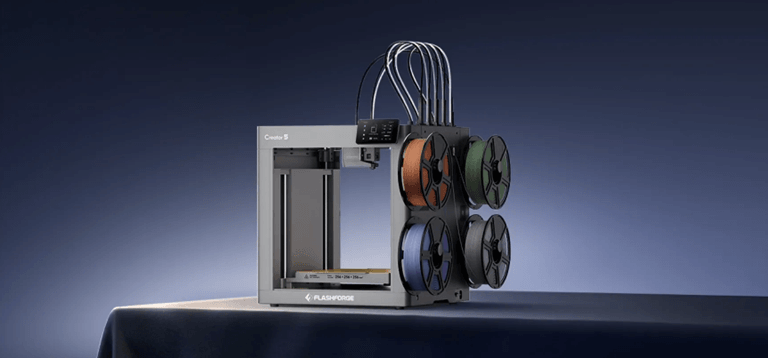
A Multi-Color 3D Printer can be useful for toys, labels, classroom models, display pieces, and personalized designs where different colors reduce the need for hand painting.
Flashforge’s solutions include multi-color options, including automated setup and greater creative freedom. These systems can be a practical pathway to users seeking more expressive projects but not yet in the professional workflow.
Common Mistakes First-Time 3D Printer Buyers Should Avoid
But even a good printer can be a bad fit if they aren’t the exact type the buyer is looking for, or if the budget is different than anticipated, or if the buyer doesn’t have the experience.
Don’t just go for the lowest price. If the machine requires frequent adjustments, it can become very expensive, even with a low-cost unit. A second factor is software – having a confusing slicer makes a capable printer more difficult to use.
Purchase of an excessive machine is another error. Not every newbie needs professional material support, very large build volumes, or, for that matter, systems using multiple materials. Long-term maintenance and filament needs should also be part of the long-term budget.
Conclusion
The best 3D Printer for Beginners in 2026 should make learning easier rather than adding unnecessary complexity. Things that are easy to set up, dependable to print, user-friendly to operate, and expandable are more important than the finest specifications.
Overall, the FDM is a good option for beginners who want to explore 3D printing for their home projects, educational purposes, or creating functional objects. Printing facilities can be used to create more colorful designs after mastering the fundamentals. Being able to select around actual project requirements means that novices will build up their confidence more quickly while gaining more benefit from their initial experience of 3D printing.
Popular on OTW Right Now!
About The Author

Gagan Bhangu
Founder of otechworld.com and managing editor. He is a tech geek, web-developer, and blogger. He holds a master's degree in computer applications and making money online since 2015.