
The Data Problem Wall Street Still Hasn’t Solved
Investment firms love claiming they run on comprehensive, cutting-edge market data. But here’s the real question: is that data actually current, complete, and trustworthy? More often than not, the honest answer is complicated. Integrating, validating, and acting on enormous data volumes in real time is brutally hard — even for institutions with deep pockets and armies of engineers.
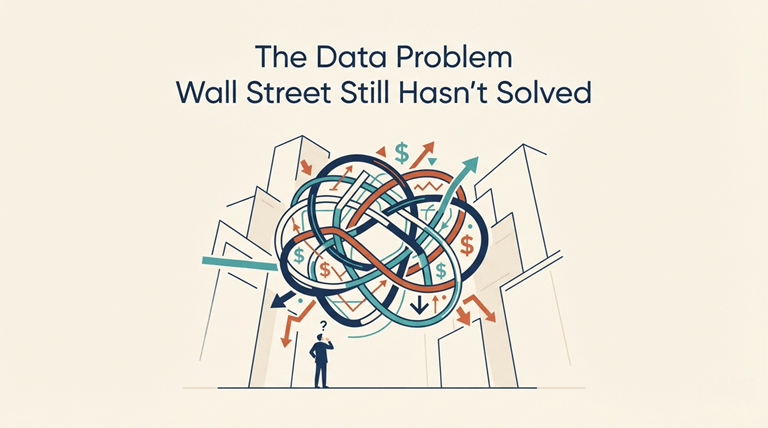
Data Fragmentation Across Multiple Sources
Dozens of vendors. Multiple exchanges. Countless internal systems. That’s the kind of shop that a typical Wall Street shop works with. All the sources operate independently – they refresh at their own pace, push data in their own format, and so on. Share prices from one source, bond prices from another, economic data from a third — and alternative data from a different source altogether. It’s a technical headache that never ends. Over time, the gaps and mismatches begin to accumulate and build up what is referred to as data silos by insiders. Equity feeds may be updated on a millisecond-by-millisecond basis, and credit ratings may be updated weekly. Work on creating a clear overview of the risks in real time based on that.
Validation and Quality Assurance Challenges
There are raw market feeds. Raw market feeds exist. All errors, duplicates, and anomalies appear, and they all need to be caught before a single analysis is run. It’s actually challenging to ensure the quality of billions of records per day. There are human entry errors, system glitches, transmission hiccups – each of them introduces inaccuracies that propagate down the line in the models. Data validation isn’t a one-and-done activity, Dechtman Wealth understands; it’s part of operating your business. Avoid the hard work of quality control; even the most advanced analytical models begin to spew garbage, and that’s what means bad investment calls.
Legacy System Integration Barriers
Let’s not forget about this one: many of the fundamental trading and risk systems used on Wall Street have been developed in the last 10 years or more. They were never intended to communicate with today’s data systems. Their retrofitting is problematic; several things don’t fit, and there are a lot of workarounds. Completely removing old platforms? Too disruptive. Too expensive. That’s not the case with parallel systems, where manual patches are keeping everything in place, and old and new systems exist side by side. Those patches increase maintenance costs. They provide security loopholes. They even force the most ambitious of institutions to stay within the limits of technologies chosen long before the advent of today’s markets.
Real-Time Processing Demands
Markets can change in a split second. Data processing? May be delayed by seconds or even minutes. High-frequency traders and algorithmic strategies aren’t patient about any stale feeds, as they need conditions to be reflected immediately. However, aggregating, validating, and distributing that much data in real time is a heavy load for most architectures. With such heavy data loads and thousands of analytical queries to process, a lot of computing power and specialized engineering skills are needed. Not many companies have both.
For professionals working in Denver investment management, navigating these constraints means being selective about partnerships — specifically, aligning with firms that have genuinely invested in modern data infrastructure rather than just talked about it. Yes, some of the processing load has been reduced with cloud-based solutions. But they come with their own challenges: security exposure, regulatory issues and vendor lock-in. One of the most intractable challenges in the industry is still the difference in speed between the market and the speed of data processing.
Regulatory Compliance and Data Governance
A lot of detail is desired in records by regulators. Audit trails. Evidence of transparency and defensibility of decision-making processes. That’s a ton of extra complexity added to a challenging data management issue. Companies should have the correct historical information, ensure that the right people have access to the right information, and maintain records of the flow of information. All of this slows down the pipeline – data is available to the analysts and traders after the usual time. Penalties can be significant, and investment will flow to those with better governance systems. That same investment takes innovation out of the budget. Speed versus compliance. This is a constant and an ongoing traded choice.
Conclusion
There isn’t a simple solution. The data issue on Wall Street is, of course, not one: it’s several, entangled. Speed versus accuracy. Old vs. new systems. The need for compliance and the need for agility. This problem will continue to hamper decision-making until there is a better tool for meaningful integration, validation, and governance in the industry. And it will continue to create opportunities for the companies savvy enough to control their information better than anybody else.
Popular on OTW Right Now!



About The Author

Gagan Bhangu
Founder of otechworld.com and managing editor. He is a tech geek, web-developer, and blogger. He holds a master's degree in computer applications and making money online since 2015.