
Why LLM Orchestration Matters in Enterprise AI Systems
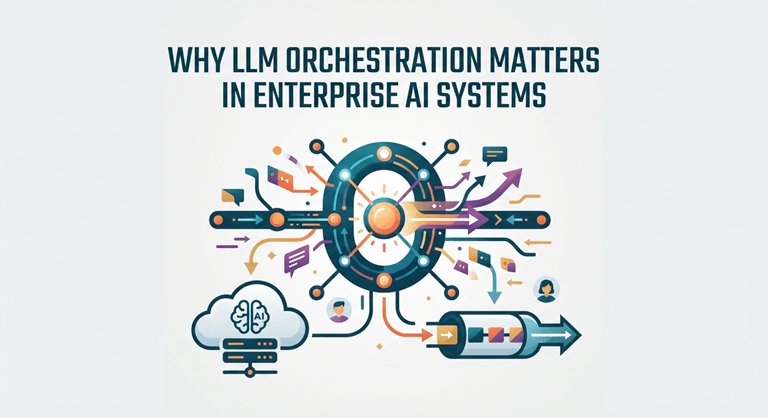
LLM orchestration coordinates language models, data sources, software tools, workflows, and governance controls within an AI application. Instead of sending every request directly to a single model, an orchestration layer determines how the request should be processed, which resources should be used, and what checks must occur before the result reaches a user or another system.
This approach becomes increasingly important as organizations move beyond experimental chatbots. Production AI systems may need to search internal documents, call business applications, select between different models, validate outputs, request human approval, and record each action for later review.
What Does LLM Orchestration Include?
A basic language-model application may consist of a prompt, a model, and a generated response. More advanced systems require additional components.
An orchestration layer can manage:
- Prompt and instruction templates.
- Model selection and routing.
- Retrieval from documents or databases.
- Calls to APIs and software tools.
- Multi-step workflows.
- Conversation and task state.
- Access permissions.
- Output validation.
- Human approvals.
- Error handling and retries.
- Logging and monitoring.
- Cost and latency controls.
The exact architecture depends on the application. A document assistant may rely heavily on retrieval and source citation, while an AI agent that updates a CRM requires stronger action controls, identity management, and transaction logging.
Orchestration should make these processes explicit and testable rather than allowing the model to control them through a single unstructured prompt.
Why One Model May Not Be Enough
Organizations sometimes assume one model should handle every task. In practice, different models can have different strengths, operating costs, response times, context limits, hosting options, and risk profiles.
A complex model may be justified for difficult reasoning or document analysis but unnecessarily expensive for classification or data extraction. A smaller model may complete routine tasks more quickly and at a lower cost.
Some workloads may also require models deployed in a particular environment because of privacy, latency, or regulatory constraints.
Model routing allows the application to select an appropriate model according to factors such as:
- Task type.
- Input length.
- Required response quality.
- Sensitivity of the data.
- Expected response time.
- Available budget.
- Model availability.
- Required output format.
Evaluate routing rules using real tasks. Selecting a cheaper model is only beneficial if it continues to meet the required quality standard.
Connecting Models to Organizational Knowledge
A language model’s general training does not include every organization’s current policies, customer records, product information, or internal procedures. Even when relevant information was present during training, it may be outdated or unsuitable for a specific business context.
Retrieval-augmented generation allows an application to search approved knowledge sources and provide relevant material to the model when it produces an answer.
An orchestration layer can manage the retrieval process by identifying the user’s intent, selecting the correct source, applying access permissions, ranking results, and assembling the context sent to the model.
The quality of retrieval depends on the underlying information. Documents may need to be cleaned, divided into meaningful sections, classified, and assigned accurate metadata.
The system should also distinguish between authoritative and secondary sources. An approved policy should normally take priority over an informal discussion containing similar terms.
For decisions that require verification, the final answer should include references to the source material used.
Coordinating Tools and Business Systems
Models become more useful when they can interact with organizational software. An AI application may need to search a CRM, create a support ticket, retrieve an invoice, schedule a meeting, or update a project-management system.
The orchestration layer defines which tools are available and under what conditions they can be used. It can validate parameters, enforce permissions, request approval, and confirm whether the action succeeded.
Limit tool access according to the principle of least privilege. An application that only needs to retrieve customer information should not receive permission to modify or delete records.
Sensitive actions may require additional controls, including:
- Authenticated user identity.
- Role-based authorization.
- Transaction limits.
- Confirmation of target records.
- Employee approval.
- Validation against business rules.
- Complete action logs.
- Rollback or correction procedures.
The model can interpret a user’s request, but deterministic software should enforce critical permissions and constraints.
Managing Multi-Step Workflows
There are tasks that can’t be executed in one step using a model response. They may need multiple steps that involve various information sources and software systems.
To process a customer request, it might need to classify the request, retrieve the account, examine the relevant policy, prepare a resolution, approve the resolution, update the support platform, and notify the customer.
These steps are orchestrated, and the state of the workflow is maintained. It also sets out what to do if information is missing, a tool fails, or the model is uncertain.
Probabilistic and deterministic elements can be used together in a workflow. AI can categorize an unstructured message or summarize a document, whereas traditional code can perform numerical calculations, validate identifiers, and ensure that formal eligibility conditions are met.
This division helps minimize risk when it comes to language modeling for exact and repeatable results.
Maintaining Context and State
For other uses, AI must be able to store data for multiple interactions. This can be the current step in a workflow, previous user choices, retrieved documents, or the output of previous function calls.
Crafting a state management system is a careful process. It can be costly and can add unnecessary information to the model if you pass the history of the entire process to the model each time you request one. Passing the entire history each time can be costly and add irrelevant information to the model.
It can summarize previous communications, keep only structured variables, or get the history if needed during orchestration. It should also establish the time period of storage and the access rights for information.
It is important to note that conversation memory is not to be used as a repository for personal or confidential information. Requirements for retention, deletion, and access should be determined before implementation.
Validating Model Outputs
Responses may be incomplete, lack support, or be incorrectly formatted and/or factually incorrect in relation to the language model. Checks can be added to outputs before they are used or accepted in a system by orchestration.
Validation methods may include:
- Enforcing structured response formats.
- Checking required fields.
- Verifying identifiers against source systems.
- Confirming that cited documents exist.
- Applying business rules.
- Detecting sensitive information.
- Comparing numerical outputs with deterministic calculations.
- Requesting a second review for high-risk cases.
- Routing uncertain results to employees.
Sometimes a second model will check an output, but not necessarily give correct results. Authoritative data and standard software rules should be used for validation, whenever possible.
The amount of checking should be proportional to the risk of an error. A draft internal review needs other controls than a system that changes a financial record or sends external communications.
Handling Failures and Uncertainty
Production systems need to assume some failure of individual components. A model may fail or the API may time out, a document search may return no useful results, or a response may not be in the correct format.
Retry limits, alternative models, timeouts, fallbacks, and escalation should be defined by the orchestration layer.
If a problem recurs, it may cost more and take longer to resolve. The system should distinguish between a genuine system failure and a legitimate request that could not be processed at that time because of insufficient information.
If there is a lack of confidence, the application should be able to seek clarification from it or transfer it to a person. No response should be the default “safe” answer if it is not confident.
Improving Security and Governance
Orchestration creates a single central location for applying security and governance policies for AI applications.
It can manage access to specific models, data sources and tools for specific users. It may also capture prompts, retrieved information, outputs, actions, approvals and errors as well, subject to appropriate privacy and retention controls.
To prevent tampering, organizations should safeguard systems against prompt injection and other attempts to alter model behavior through untrusted content. Any text from a document, email, or website must be treated as data, not necessarily instructions for the system to follow.
Identify sensitive information and treat it in line with organizational policy. The system might require data redaction, model restrictions, and the prohibition of specific content from leaving an approved environment.
Governance should also delegate responsibility. Named teams/employees are responsible for the ownership of the application, its data, permissions, evaluations, and Incident Response.
Monitoring Quality, Cost, and Performance
A production orchestration system should provide visibility into both technical behavior and business outcomes.
Useful operational measures include:
- Model response time.
- Tool and api failures.
- Retrieval success.
- Workflow completion rate.
- Fallback frequency.
- Token and infrastructure costs.
- Validation failures.
- Human escalation rates.
Examples of quality measures include accuracy, source support, correct tool selection, successful completion of representative tasks, and policy compliance.
It is important to monitor at the workflow level. Even if a model provides a well-written answer, the entire process might still fail if it doesn’t return the correct account or update the necessary system.
In addition to looking at cost, it is also worth considering cost per completed task, not per model call. Correcting this is a low-cost model that can be more costly than a more powerful model that can complete the workflow the first time.
Preventing Dependence on a Single Model
Reducing direct dependence on a specific model provider by separating the business workflows from model-specific interfaces through the use of an orchestration layer.
Not all models can be interchanged. Prompts, output quality, safety behavior, tool-use capability, and context handling may vary. Despite the change, some testing is still needed, and maybe some workflow adjustments.
But a modular design can ease evaluation and replacement. It can also provide fallback models in cases of the failure of the main service.
In small experiments, organizations should not get too abstract. Multi-model architecture is more useful when application requirements include resilience, cost, privacy and/or task-specific routing.
Implementing Orchestration Incrementally
It is not necessary for organizations to create a complicated orchestration platform before testing a use case.
A first implementation can have just one model, just one knowledge source, and just a small workflow. As requirements become clearer, the team can then add in routing, tools, validation, memory, and fallback mechanisms.
The more components added, the more complicated the operation will be. It needs to be tied down, checked, monitored, and maintained. Architecture should be developed based on demonstrated needs, not imagined ones.
During a controlled pilot, baseline quality, cost, latency, and employee involvement can be established. These measurements can help determine whether the value gained justifies further automation or additional models.
Conclusion
LLM orchestration serves as the orchestration layer that enables seamless coordination of calls between isolated models to create reliable business applications. It controls how models use knowledge, choose tools, prune workflows, handle faults, and comply with organizational controls.
It is designed to be simple, not the most complicated AI design possible. Effective orchestration uses the fewest models, tools, and workflow elements required to satisfy defined requirements.
By fusing model capabilities with deterministic rules, limited AI access, validation, monitoring, and human control, organizations can create more controllable, assessable, and optimizable AI systems.
Popular on OTW Right Now!




About The Author

Gagan Bhangu
Founder of otechworld.com and managing editor. He is a tech geek, web-developer, and blogger. He holds a master's degree in computer applications and making money online since 2015.