
Football Stadium LED Screens: Key Factors for Performance, Safety, and ROI
Procuring LED screens for a football stadium is both an engineering and commercial decision. The system should be readable in daylight, easy to operate when in camera use, resistant to outside elements while also keeping players safe, and serviceable throughout a busy event calendar. Therefore, the buyers must consider the following factors in conjunction: pixel pitch, brightness, refresh rate, protection of the enclosure, structural and electrical design, maintenance, and total cost of ownership.
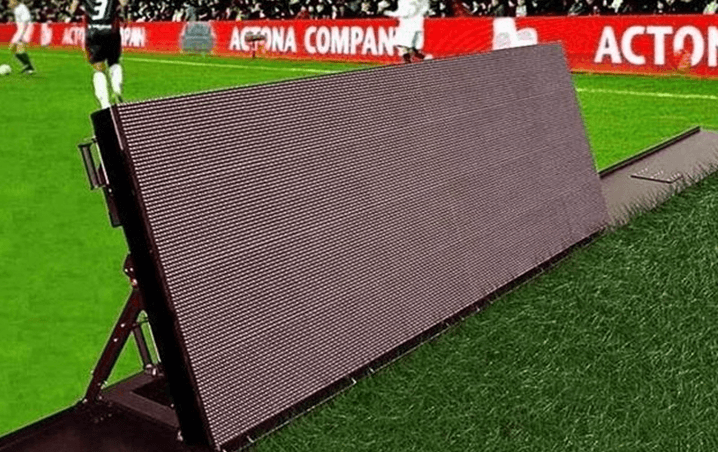
This guide condenses those factors into a practical procurement framework, including ROI calculations, acceptance checks, an RFQ checklist, and a public stadium-project benchmark.
At-a-Glance Procurement Matrix
| Decision area | What to specify | How to verify |
| Pixel pitch | Sightlines, screen size, content, camera use. | Pixel calculation + sample content test. |
| Brightness | Daylight readability + automatic/manual dimming. | Post-calibration luminance and day/night visual check. |
| Refresh / camera | Controller and camera-compatible configuration. | Record at planned frame, shutter and slow-motion settings. |
| Outdoor protection | IP by component, connectors, temperature and drainage. | IEC 60529 evidence + installation review. [3] |
| Safety/structure | Padding, anchorage, wind design, cable protection and clearances. | Engineering review + physical inspection. [2] |
| Power / EMC | Distribution, grounding, protection, redundancy and market compliance. | Schematics, reports and on-site tests. [4][5][6] |
| TCO / ROI / service | Installed cost, energy, spares, maintenance, support, downtime and revenue. | Common assumptions + service demo + ROI/payback model. |
Why Stadium LED Screens Matter to Venue Operations and Revenue
LED systems can be found in stadiums to display match information, match replays, stadium safety announcements, fan content and sponsor inventory. They are not just about the nominal specifications of the image but about uptime and visibility of the image. Video screens and pitch-side areas are also FIFA stadium systems, and should be designed taking into account operations, broadcasting and safety requirements. [1][2]
Fan Engagement and Match-Day Communication
All scores, player data, substitutions, replays, and operating messages must be presented in a clear way from the desired seating area. If multiple screens are being controlled from a single control platform, handover content synchronization and emergency messaging should be tested prior to handover.
Commercial Value of Stadium LED Displays
Perimeter and ribbon displays are used to program sponsor inventory which is displayed in the venue and can be broadcast. This means that the procurement process needs to ensure commercial delivery via reliable playback, camera compatibility, rapid failure recovery and transparency of content-control responsibility.
How Pixel Pitch Affects Viewing Quality and Cost
The distance between the neighboring pixels is called Pixel Pitch. A smaller pitch will make the pixels more dense and more expensive, but the better it looks will diminish as viewing distance increases. Not a ‘finest pitch is best’ dictate, but rather take into account screen size, nearest and farthest sightlines, content detail and camera use.
Choosing the Right Pixel Pitch for Stadium Applications
The current stadium-perimeter range offered by Longcheng is made up of P5, P6, P8, P10 and associated configurations. The following are product options, rather than universal recommendations. When considering which pitches to buy, a buyer should estimate the native resolution of the proposed pitch and select a few representative sponsor graphics to test at the actual or simulated viewing distance. [7]
Balancing Resolution with Budget Constraints
Evaluate the pitches of candidates, which have the same cabinet area and content. Give permission to the lowest resolution that will be legible and camera-friendly; otherwise, you are wasting money on the resolution that the audience can’t see.
Brightness, Refresh Rate, and Broadcast Performance
The sun and nighttime conditions are variable for outdoor screens. Set a goal for how many days it will be readable from the camera; specify how the camera is going to dim; set a target consistency of color; specify how the camera is going to be accepted. There is the potential for energy wastage and loss of comfort at night if it is too bright.
Use Published Brightness Figures as Product Evidence, Not Universal Rules
Brightness specification provided by Longcheng in their published stadium perimeter specs range from 5,000-7,000 nits, again depending on the model and type of pitch. Take these figures as first-party product evidence and do not use these numbers as a rule for all stadiums. Validation of final brightness should be done based on the orientation of the screen, the local daylight, viewing distance, and content. [7]
Color Accuracy, Refresh Rate, and Camera Acceptance
Longcheng offers a P8/P10 stadium enough page refreshes in the range of 1920 – 3840 Hz. A higher number can help with camera performance but will need to be assessed on the actual footage with the desired shutter, exposure, and frame rate and slow motion. [7]
Once installed, check that brightness and color uniformity are correct between cabinets. Discard calibration files and establish re-calibration procedure post module replacement.
Safety, Weather Resistance, and Serviceability
Perimeter boards are subject to handling, player impacts, moisture, and heat. Assess safety at system level, including cabinet, padding, support structure, anchorage, power distribution, connectors, drainage, cabling, access routes and how to do the job.
What IP65 Does—and Does Not—Mean
The classes of ingress protection are defined in IEC 60529. IP65 is water-resistant to dust and water jets, but is not necessarily a criterion to verify the safety of the entire installed LED system during heavy rain or snow. Other factors to be considered by procurement include connector rating, cable entry, drainage, working temperature, electrical protection, and installation conditions. [3]
Structural, Electrical, EMC, and Fire-Safety Boundaries
The wind load and the method of temporary or permanent installation should be considered in the design of the support frame and anchorage for the project. Electrical safety and EMC requirements shall be in accordance with the destination market and venue rules – IEC 62368-1 / CISPR 32/35 are relevant reference standards (if adopted). [4][5][6]
The local authority, venue and requirements of the competition should be checked for fire performance, the specification of the cable, access during an emergency and clearances around the pitch. The RFQ should make it clear who is to do the design calculations, certificates, site tests and final sign-off.
Maintenance and Match-Day Resilience
Identify replaceable modules, available power supplies and receiving cards, diagnostics, critical spares, and response time. At acceptance, have a representative module or replacement power component timed to demonstrate maintainability, not assume it at acceptance.
Budgeting for Total Cost of Ownership
Installed CAPEX, Structure cost, Transport, Commissioning, Electricity, spares, Maintenance, Software/support, and Downtime should be covered under the total cost of ownership. Make sure all bidders use the same assumptions in their bids.
ROI and Payback Calculation Framework
Annual net cash benefit is advertising/sponsorship event value minus electricity, maintenance, spares, software/support, etc. annual costs for screening. Apply the formulas below to each supplier option.
| Metric | Calculation |
| Annual net cash benefit | Incremental commercial value – recurring operating costs |
| Simple annual ROI | Annual net cash benefit / installed investment x 100% |
| Simple payback | Installed investment / annual net cash benefit |
| Multi-year simple ROI | (Cumulative net benefit – installed investment) / installed investment x 100% |
If the cash flow is uneven, the financing period is long, residual value, tax, etc., are significant, and the project is large, NPV or IRR may be added to the discounted cash flow measures used for financing.
Illustrative ROI Example (Hypothetical)
The following example is fictional and is intended to illustrate the approach only and does not represent a particular stadium or supplier project.
| Input | Illustrative value |
| Installed investment | $500,000 |
| Annual advertising/sponsorship value | $190,000 |
| Annual event/activation value | $30,000 |
| Annual electricity | $35,000 |
| Annual maintenance/spares | $20,000 |
| Annual software/support | $5,000 |
| Annual net cash benefit | $160,000 |
| Simple annual ROI | 32.0% |
| Simple payback | 3.1 years |
| Five-year simple cumulative ROI | 60.0% |
Simple annual ROI is 32% for $500,000 installed and $160,000 annual net cash benefit, with a simple payback of ~3.1 years. Cumulative net benefit after 5 years is $800,000, resulting in a 60% simple cumulative ROI, based on the initial investment.
Public Football-Stadium Project Benchmark
According to a Unilumin press release from January 2026, several LED configurations were identified for the stadium projects in Morocco. As per a press release from Unilumin published in January of 2026, various LED configurations were recognized for the stadium projects in Morocco. The examples published illustrate the reason for supporting multiple scales of the stadium, and that pitch, brightness, and refresh should follow the application. [8]
| Venue/zone | Published configuration | Procurement lesson |
| Prince Moulay Abdellah Stadium – ribbon | 1,100 m²; P10 UsportR | Long-distance ribbon use can justify coarser pitch. |
| Tangier Grand Stadium – ribbon | ~550 m²; UsportR 10 | Scale and sightlines matter as much as pitch. |
| Olympic Stadium of Rabat – outdoor | ~1,000 m²; 10,000+ nits; 7,840 Hz (supplier-reported) | Different zones can require different brightness/refresh. |
The information is provided based on supplier announcement and should only be used as a specification benchmark. When purchasing, ask for commissioning documentation, test results, and customer references (if available).
RFQ and Supplier Comparison Checklist
Issue the same RFQ schedule to every bidder and require evidence for each response. The checklist below is designed to make technical and commercial offers directly comparable.
| RFQ category | Data required | Acceptance evidence |
| Geometry | Dimensions, height, cabinet layout, viewing distances/angles. | Drawings, pixel count, sightline review. |
| Pixel/resolution | Pitch, module/cabinet resolution, total pixels, LED package. | Datasheet + sample/mock-up. |
| Brightness/color | Calibrated brightness, dimming, color temperature, uniformity. | Measurement + day/night acceptance. |
| Refresh/broadcast | Refresh, controller, gray scale, broadcast integration. | Recorded camera test at required settings. |
| Environment | IP by component, temperature/humidity, corrosion, drainage. | Exact-model evidence + design review. [3] |
| Safety/structure | Padding, clearances, cabinet mass, support, anchorage, wind inputs. | Site inspection + project structural calculation. [2] |
| Electrical / EMC | Power, grounding, protection, redundancy, applicable safety/EMC standards. | Schematics, reports and on-site tests. [4][5][6] |
| Service/warranty | Access method, replacement time, spares, diagnostics, warranty/response. | Timed service demo + spare/warranty schedule. |
| Commercial / evidence | Installed CAPEX, power assumptions, support fees, references and acceptance records. | Common TCO template + reference check. |
Partnering with an Experienced LED Integrator
The engineering, commissioning and support of the LED cabinets is as important as the performance itself. Review suppliers’ project design skills, product proof, broadcast testing, safety co-ordination, spare-parts planning, warranties and escalation processes.
Shenzhen Longcheng Photoelectric Technology Co., Ltd. publishes dedicated stadium LED products, including P5/P6/P8/P10 options and P8/P10 perimeter products with stated brightness, refresh rate, and IP65 specifications. The following claims are subject to verification before contract award, in accordance with the specific model and the documentation of the tests made. [7]
Key Takeaways for Professional Buyers
LED systems for football stadiums need to be purchased as a functional asset. It is important to orient pixel pitch to sight lines, brightness to the environment, test camera performance, inform of IP ratings within their limits, and make clear structural, electrical, EMC, maintenance, and safety responsibilities.
The most desirable option is not always the lowest cabinet price or the highest specification; it will be one that meets these terms of acceptance that has a justified lifecycle cost and has a credible revenue case.
Ready to Move from Specification to Procurement?
The following is an initial proposal: Screen Size/Location, Nearest and Farthest Viewing Distance, Mounting Method, Local Climate, Broadcast Requirements, Content Type, Availability of Power, Project Schedule, Budget Range, and Market/venue Standards. Request a supplier to provide a matrix, drawings, evidence documents, TCO assumptions, and an acceptance plan completed.
FAQs
1. What pixel pitch is recommended for large football stadiums?
No universal pitch is in use. For longer viewing distances, P8-P10 could be appropriate; for nearer applications, P5-P6 could be appropriate. Verify with screen size, sight lines, native resolution, material, and camera testing.
2. Is IP65 enough to guarantee reliable operation in heavy rain?
The rating No. IP65 is an enclosure rating according to IEC 60529. Connectors, cable entries, drainage, temperature limits, power protection, structure, and installation are other factors that contribute to reliable outdoor operation. [3]
3. What refresh rate should a broadcast stadium LED screen have?
Approximate refresh with the stated capability of the supplier and then approve the system with the desired broadcast settings using a camera test. Longcheng publishes the P8/P10 stadium-perimeter page with a frequency o1,920-0- 3,840 Hz. [7]
4. How do I calculate ROI for a stadium LED screen?
Determine the annual net cash benefit from incremental commercial value – recurring operating costs. Calculate simple annual ROI as a ratio of that benefit over installed investment, and simple payback as a ratio of investment over annual net benefit. If cash-flow timing is important, use NPV/IRR.
Sources and Standards Referenced
[1] FIFA Stadium Guidelines – Information Technology / Video Screens – publications.fifa.com [2] FIFA Stadium Guidelines – Pitch Dimensions and Surrounding Areas – inside.fifa.com [3] IEC 60529 – Degrees of protection provided by enclosures (IP Code) – IEC [4] IEC 62368-1:2023 – AV/ICT equipment safety requirements – IEC [5] CISPR 32:2015 – Multimedia equipment emission requirements – IEC [6] CISPR 35:2016 – Multimedia equipment immunity requirements – IEC [7] Shenzhen Longcheng Photoelectric Technology Co., Ltd. – Stadium Perimeter LED Display product pages [8] Unilumin – Morocco stadium LED project announcement, January 2026Sources checked 10 August 2026. Standards and regional compliance requirements should be reconfirmed for the destination market and contract date.
Popular on OTW Right Now!



About The Author

Gagan Bhangu
Founder of otechworld.com and managing editor. He is a tech geek, web-developer, and blogger. He holds a master's degree in computer applications and making money online since 2015.