
Why Vail Valley Businesses Lose Customers in Google Search
Search for almost any service in the Vail Valley, from web design to home repair, and look closely at who actually shows up. A lot of the results come from an unexpected source: Denver agencies, national lead generation sites, and directory pages—not Avon, Edwards, or Eagle businesses. The customer was doing a home search. The funds left the valley. This is not a coincidence, nor is it a matter of skill beyond that of the big companies. It’s because small mountain-market businesses are bidding for the local customer on Google with little of the signals that Google uses to determine who is the best bet.
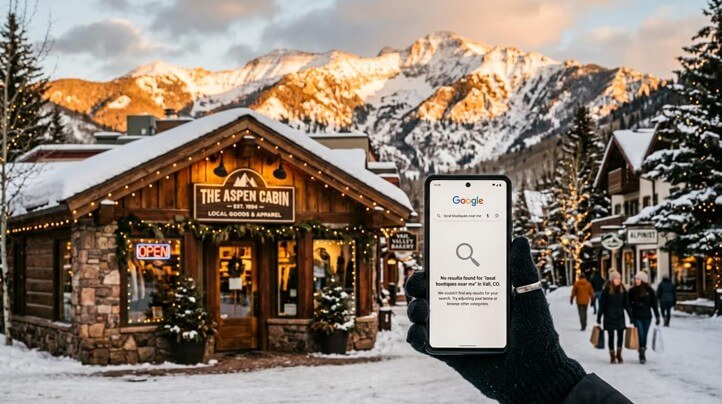
The problem is structural, not effort.
Most Vail Valley business owners do the obvious things. They have a website, Google Business Profile, possibly some reviews. They still rank in the top two spots, though a Denver-based company with no office within a hundred miles gets the click.
The reason is that Google assesses a small market. In a city, there are hundreds of competing businesses to get Google rich data to sort. The data is sparse in a valley of small towns that line the course of I-70, so Google relies more on the limited data available: How complete and active the Business Profile is, whether the website also mentions the actual towns it serves, and whether anyone else on the local web mentions the business. Wait long enough, and Google will fill in the blanks with whoever has the best overall domination. It’s typically an external provider.
Where the rankings actually leak
Three patterns show up repeatedly when you audit mountain-town businesses:
- One page trying to rank for six towns. The one ‘serving the Vail Valley’ home page can’t beat out Avon, Eagle, Edwards and Gypsum for all of those searches. Google matches pages to towns, and other companies create a page per town without ever stepping foot there.
- A Business Profile treated as a set-and-forget listing. Categories are not full, photos not updated since the profile was created, reviews are not responded to. Profile activity in a thin market has a much larger relative influence than in a city.
- No local footprint beyond the website. No advertisements in the local chamber directory, no local news about it, no links from other valley businesses. It’s almost like it doesn’t even exist as a business in its own community to Google.
All of these are inexpensive to repair. It is hardly surprising that they go uncorrected when the business owner is preoccupied with the day-to-day running of the business.
What fixing it looks like in practice.
While big city SEO may be quite different, so is the playbook for a small mountain market, and even if you outsource, it’s worth knowing.
First, there have to be real pages for every town that customers hail from and not a find-and-replace page. It is a good thing that Google has improved a lot at detecting the template version.
Secondly, the Business Profile should be considered a living asset – weekly photos or posts, answering all reviews filed, service areas, categories verified against customer search.
Thirdly, there must be internal references and mentions in the business’s market. The membership of the Chamber, local sponsorships, and coverage in valley publications. They’re something that a small market competitor is not likely to have, and thus they have a disproportionate impact on the game.
It’s this that local companies have begun to specialize in. One Vail SEO company, located in the valley itself, specializes in this issue, and it’s important because the dynamics of the resort markets differ significantly from the metro market, as do the seasonal demand fluctuations and low search volumes.
The seasonal wrinkle outside agencies miss
One more thing that is special to resort economies. The demand for search in the Vail Valley is not consistent, increasing during ski season and summer months, and decreasing during shoulder months. The majority of businesses that discontinue marketing campaigns in April and November are giving Google a few months of silence just before the next wave of marketing takes off. These are the businesses that continue to publish, post, and collect reviews throughout the quiet months of the year and are thus in the top ranking when December demand comes calling. An agency that has not been active in resort markets seldom plans the resort cycle at all.
Common questions from valley business owners
Can I do this myself without an agency?
Actually, the Business Profile work, yes, if you have the routine of doing it weekly. Town pages and Local link building are more time-consuming and challenging. Marketing is not an ability; it’s attention. If you’re not putting it at the bottom of your to-do list every week, then you’re not following a plan.
How long before rankings move?
In small markets, quicker than the regular response. If the competition is light, meaningful action on town-level searches can be seen in the next 2-4 months, but it will take longer with competitive Vail-proper terms. Anyone guaranteeing first page rankings in a matter of weeks is selling something other than a product.
Does it matter that my competitors are not doing SEO either?
This is the moment, the opportunity. This work is done nearly incorrectly by almost no one, so modest, consistent effort will yield rankings that would take years to get in Denver. The loser takes the difference.
Why do directory sites outrank actual local businesses?
Directories have tons of overall authority from millions of pages and links, and Google gives them a lot of weight if the local business doesn’t give off strong signals. Make your own signal stronger, and Google wants the real local signal, which it hard-codes into the way local search works.
The takeaway for valley businesses
Each month it continues to be unfixed, local customers who are looking for a valley company end up with an outside one. The mechanics are something that can be known; the fixes are something that can be done, and in a market this thin, the first business to do it right has the ranking for years. The worst case is taking it upon yourself or hiring a local expert such as Revstone to think that Google will eventually realize that you are the local choice. It will not, if you don’t say.
Popular on OTW Right Now!




About The Author

Gagan Bhangu
Founder of otechworld.com and managing editor. He is a tech geek, web-developer, and blogger. He holds a master's degree in computer applications and making money online since 2015.