
Tap-to-Review: How an NFC Google Review Card Actually Works
Ask any local business owner what they wish they had more of, and “Google reviews” lands near the top of the list. Reviews are social proof, and they are also a ranking signal. Yet the gap between a satisfied customer and a five-star review is surprisingly wide. The customer has to remember, pull out a phone, open an app, search the business name, scroll to the reviews section, and type. Most people never make it past step two.
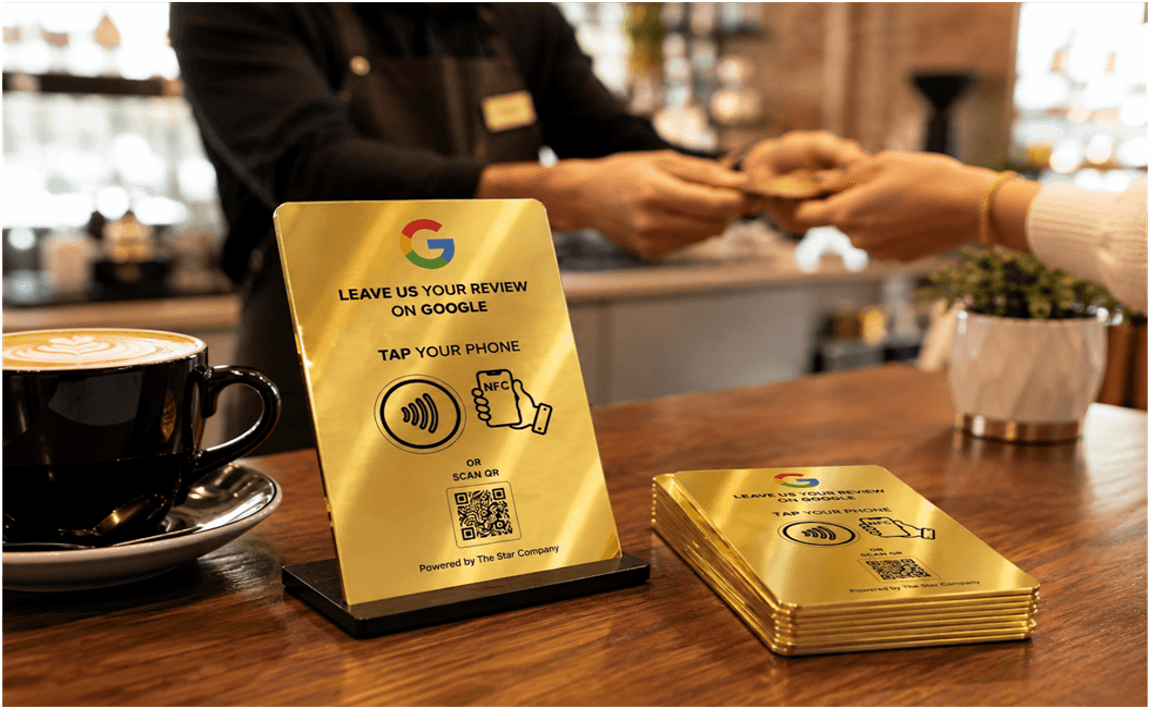
A small piece of hardware has quietly closed that gap: the tap-to-review card. If you have not looked closely at how one works, it is worth a few minutes, because the technology is elegantly simple and the results are measurable. Here is what happens when a customer taps an NFC Google review card against their phone.
What is inside the card
The card is roughly the size and shape of a credit card, but there is no battery, no chip to charge, and no app to install. Embedded inside the laminate is a passive NFC (Near Field Communication) tag: a tiny microchip connected to a thin coil of wire that acts as an antenna.
NFC is a low-frequency technology that transmits signals at 13.56 MHz and can only be received within a few centimeters. The tag does not contain any power source. As you approach a smartphone with its reader, it generates a small magnetic field, which has enough energy to stimulate the current in the coil to awaken the chip. As with contactless payments and transit cards, the reader sends enough energy to the tag to get the tag to respond, and the tag uses the power to send a response.
A small amount of data, in the form of an NDEF (NFC Data Exchange Format) record, is stored on the chip. That record for the review card is one URI – the direct link to the Google review window of the business. The payload is only a URL, so the chip has very little memory, and the entire transaction takes less than a second.
How a tap becomes a review
The flow that makes this work is native to the phone — no app required on the customer’s side:
- Customer places their phone close to the card. The NFC reader is running in the background on an iPhone (7 and newer) and is on by default on most modern Android phones.
- The phone decodes the NDEF record and identifies it as a web link, and displays a tap-to-open banner or notification.
- When you click on that banner, the browser will automatically be opened on the Google review page (with the star selector already displayed).
The point is that’s what it is. All of the actions a customer would typically give up on — finding the business, clicking to reviews, and then clicking the write-a-review link — get combined into one physical action. The business owner doesn’t need to tell the customer a URL or that they need to search for it. They pass the card from one side to the other of the counter.
The QR code backup
Not all phones support NFC, and a handful of the older phones don’t support it at all. If the cards are well designed, there is a QR code on the back that links to the same URL. The customer opens their camera, points it at the code, and they end up on the same review page. Either NFC or QR will bring the review screen to nearly any customer, whereas almost no one will be able to get to it the other way.
Why the hardware beats the manual ask
It’s possible, in theory, to accomplish the same thing with a printed link or a shout of “please leave us a review.” The practicality of the physical card is that it wins three times.
Friction. Compounds occur with each step removed. What sets an intention from an action are the six steps, and getting them down to one tap. The most important lever to review conversion is CONVENIENCE.
Timing. The card remains at the point of service – salon chair, restaurant table, checkout. Customers’ reviews written at the time of the experience tend to be more detailed and more positive, as compared to those the customer might have written later that night. A Google review card for business turns the natural handoff moment into the review moment.
Removing the awkwardness. Many staff members dislike asking their boss for feedback verbally, as they feel it comes across as begging. You can give a card a bit of a new lease on life, by turning it into a small courtesy, “tap here if you have a second”, which is much easier to do consistently.
The local SEO angle
Reviews don’t have to be just “gracious pictures. Reviews are not “gracious pictures”: A number of review signals can actually influence Google’s local ranking system, such as the number of reviews, the average rating, and the recency of the reviews. One of the only ranking factors that is directly controllable by a small business that does not involve any line of code is a steady stream of positive reviews.
A tap card increases the percentage of reviews on review requests, leading to a greater number and more recent reviews. That trickling trickle can help localize that compound over time, more than any one-time burst ever will.
Materials, durability, and reprogrammability
Review card is a hardware device, and it needs to be nice in a working environment of a wet salon station, busy kitchen, or a cluttered glove-box. Metal cards – 316L stainless steel or gold plated – last much longer than laminated paper over plastic, and they also convey a sense of quality when presented to the customer.
One not often mentioned feature: The payload is just an NDEF URL, which means that a good card is reprogrammable. The link can be rewritten without changing the hardware itself when the business moves to a new location, updates their Google profile, or wants to direct the card to a different location. If you assign any URL to the chip, it doesn’t matter.
Setting one up
Provisioning is quick. The owner types their Google review URL into the NFC chip through a free NFC-writer app on their phone, or requests a pre-loaded card, and it automatically works when they open the envelope. It normally takes just a couple of minutes to set up, and no monthly fees or charges for every tap – this is a card that will keep going and going.
Who gets the most out of it?
Any business that has a natural transition or handoff point will benefit: salons and barbershops, restaurants and cafes, dental and medical clinics, auto shops, real estate agents, home-service providers. Tap cards take that goodwill and turn it into a public review as long as there’s a moment in the transaction where the customer is pleased, and their telephone is in reach.
The takeaway
So, the ingenious aspect of a ‘Tap to Review’ card isn’t the chip; it’s the passive NFC tags, which are decades-old, well-understood technology. The genius lies in the application, which transforms something that’s usually a piece of contactless, uninteresting hardware into pointing it at the single biggest pain point in the reputation pipeline of a business. A tap on one of the buttons, and a page that opens at the exact right spot, and a review that wouldn’t have been written if it hadn’t been that way. The cost of the hardware is a few dollars, and there is no ongoing expense.
Popular on OTW Right Now!



About The Author

Gagan Bhangu
Founder of otechworld.com and managing editor. He is a tech geek, web-developer, and blogger. He holds a master's degree in computer applications and making money online since 2015.