
NetSuite For Construction Companies: How Better Job Costing And Billing Visibility Support Growth
Construction companies rarely start looking for better software because everything is running smoothly. The search usually starts after the cracks become too hard to ignore. Job cost reports take too long to pull, billing relies on too many manual steps, change orders are scattered across conversations, and leadership can’t get the full financial picture fast enough to act with confidence.
That’s where NetSuite starts to enter the conversation. For a deeper breakdown of how job costing, billing, and scalable construction operations work inside the platform, read BlueCollar’s guide to NetSuite for construction companies. The bigger point is simple: growing contractors need systems that connect financial activity, project status, approvals, and reporting before the business becomes too dependent on spreadsheets and workarounds.
NetSuite is not a shortcut around strong operations. It works best when a company already understands what needs to improve and wants a cleaner system to support it. The goal is not just better software. The goal is better control over the way money, work, and project decisions move through the business.
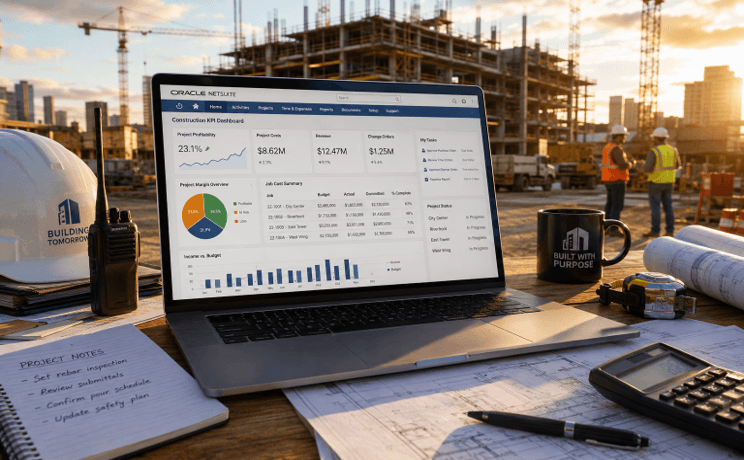
The Real Issue Is Late Visibility, Not Lack Of Effort
Most construction teams are not short on effort. Project managers are chasing updates, accounting teams are cleaning up the numbers, executives are asking for reports, and field teams are trying to keep jobs moving. The problem is that everyone may be working hard within systems that do not communicate well enough.
That creates a timing problem. The information exists somewhere, but it arrives too late to help the business make better decisions. A job cost report that shows trouble after the margin is already gone is not much of a management tool. A billing update that depends on someone manually checking emails, spreadsheets, approvals, and percent-complete notes will always be slower than the business needs it to be.
Late visibility creates familiar problems across construction teams:
- Project costs are reviewed after the damage is already done.
- Billing slows down because approvals and documentation are scattered.
- Leadership struggles to forecast cash flow from incomplete numbers.
- Accounting and project teams spend too much time reconciling instead of managing.
That friction does not always look dramatic at first. It shows up as delays, corrections, extra meetings, and quiet uncertainty around the numbers. Over time, those small issues become expensive.
What NetSuite Helps Construction Companies Bring Together
NetSuite helps construction companies connect financial and operational data inside a more centralized ERP structure. That matters because construction is full of moving pieces. Projects, budgets, vendors, labor, billing, change orders, purchase approvals, and leadership reports all need to align if the business wants clearer visibility.
A strong NetSuite setup can support several areas of the business at once. It can help teams manage job costing, billing workflows, project reporting, financial controls, procurement, approvals, and dashboards. The value comes from reducing the distance between what happens in the field, what accounting records, and what leadership sees.
For construction companies, useful ERP planning often centers on:
- Financial management.
- Job cost tracking.
- Project reporting.
- Billing workflows.
- Purchase approvals.
- Change order tracking.
- Leadership dashboards.
- Operational visibility across teams.
The system is only as strong as the workflow behind it. If cost codes are messy, approval paths are unclear, or teams do not use the system consistently, reports will still be weak. That is why implementation planning matters as much as the software itself.
Job Costing Needs To Work While The Job Is Still Moving
Job costing is one of the most important disciplines in construction because it tells the company whether a project is holding its margin. The challenge is that job costing must be sufficiently current to guide action. If the numbers only become reliable after the job is nearly finished, the company has already missed its best chance to correct course.
A stronger job costing workflow should help teams compare original budgets, committed costs, actual costs, and change order impacts while the job is still active. That visibility gives project managers and finance leaders a clearer view of where costs are drifting. It also supports better estimating because completed jobs can feed cleaner lessons back into future bids.
Weak job costing usually comes from weak inputs. Labor may be entered late. Vendor bills may be coded inconsistently. Materials may be assigned to the wrong project. Change order costs may sit outside the main workflow until someone updates them manually.
A better ERP structure does not just produce a nicer report. It creates a more disciplined process for feeding the report with accurate data. That is the difference between job costing as a monthly review and job costing as a real management tool.
Billing Should Not Feel Like A Weekly Fire Drill
Construction billing can become stressful fast because it depends on so many connected details. Progress billing, retainage, time-and-materials work, approved change orders, contract terms, and documentation all affect what can be invoiced and when. If those details live in separate systems, billing becomes a manual assembly process.
That is where delays creep in. Someone checks project progress in one place, contract rules in another, approval status in an email thread, and job cost details in a spreadsheet. The invoice may still get out, but the process is slower and more fragile than it should be.
A cleaner billing workflow helps teams connect the project structure to the financial process. Approved change orders can be easier to track. Retainage can be easier to monitor. Billing status can become easier for project managers and finance teams to review without endless back-and-forth.
Cleaner billing also supports cash flow. Contractors can have plenty of work on the books and still feel pressure if invoicing lags behind the pace of work. Faster, more accurate billing is not only an accounting benefit. It helps the business fund growth with less unnecessary friction.
Change Orders Need A Real Workflow
Change orders are one of the easiest places for margin to leak. The work may be real, the cost may be real, and the customer request may be valid, but if the process is informal, the business may still struggle to capture the value. Email threads, text messages, hallway conversations, and side spreadsheets are not enough once project volume starts growing.
A stronger change order workflow should make status clear. Teams need to know who requested the change, whether it has been priced, approved, and whether it is ready to bill. Without that visibility, change orders become a source of confusion between project teams, accounting, and leadership.
A good workflow should answer:
- Who requested the change?
- Has the work been priced?
- Has the change been approved?
- Is the cost tied to the correct job?
- Is the amount ready to bill?
- Has the margin impact been reviewed?
NetSuite can support cleaner change control when the workflow is designed properly. The goal is not more administrative work. The goal is fewer missed costs, fewer billing delays, and fewer surprises at the end of the job.
Accounting And Project Teams Need The Same Version Of The Truth
Construction businesses often feel tension between accounting and project teams. That tension usually is not about people. It is about timing, structure, and disconnected information. Accounting needs clean coding, approvals, documentation, and accurate financial records. Project managers need speed, flexibility, and real-time awareness of what is happening on the job.
If both sides are working from different systems, friction is almost guaranteed. Project managers may feel that accounting is slowing down the job. Accounting may feel like project teams are not giving them clean information. Leadership gets stuck in the middle, trying to determine which numbers are current and which still need review.
A connected ERP setup helps reduce that friction because the business can work from the same job structure, cost codes, approval logic, and reporting framework. Project managers can see cost and billing status more clearly. Accounting can close with more consistent inputs. Leadership can make decisions from cleaner information.
That shared structure becomes even more important as the company grows. The more projects, teams, and locations a construction business adds, the harder it becomes to rely on informal communication to keep everyone aligned.
Scaling Construction Operations Requires Standardization
Growth can expose every weak spot in a construction company’s systems. A process that worked for five active jobs may not work for twenty. A spreadsheet built by one employee may not support multiple teams. A reporting routine that once felt manageable may become a bottleneck once leadership needs faster visibility across several projects or entities.
Scaling requires standardization. That does not mean every project becomes identical. It means the business creates repeatable structures for project setup, cost coding, approvals, reporting, billing, and closeout. Those standards help teams move faster because they do not have to rebuild the process every time a new job starts.
NetSuite can support that kind of growth when it is configured with the future in mind. Consistent job structures and reporting logic can help leadership compare performance across projects. Cleaner workflows can reduce dependency on tribal knowledge. Standardized approvals can help the business control risk without slowing everything down.
The goal is not to make construction feel rigid. The goal is to give the company a stronger operating backbone so growth does not create more chaos than opportunity.
What To Map Before A NetSuite Implementation
A successful NetSuite implementation starts before configuration. Construction companies should map the workflows that move money, project information, approvals, and reporting through the business. If those workflows are not clearly understood, the system may be built around assumptions rather than reality.
The best place to start is with the processes that affect job costing, billing, and decision-making. Companies should identify where information starts, who owns each step, what data needs to be captured, and where the process commonly breaks down. That planning helps the implementation team build a system that fits the business instead of forcing the business into a generic setup.
Important workflows to map include:
- Purchase to pay.
- Time capture to job cost.
- Change order request to approval.
- Approved change order to billing.
- Project setup and closeout.
- Executive and project manager reporting.
- Vendor and subcontractor approval paths.
- Field-to-office documentation flow.
This mapping process also helps companies decide what belongs in phase one and what can wait. Not every feature needs to launch on day one. A focused foundation is often better than a crowded rollout that overwhelms the team.
Common Mistakes That Limit ERP Results
ERP projects usually run into trouble for predictable reasons. The issue is rarely that the platform cannot support the business. More often than not, the company has not clarified workflows, cleaned up data, assigned ownership, or trained users well enough to make the system stick.
One common mistake is treating ERP as an accounting-only project. Construction ERP touches finance, operations, project management, purchasing, billing, approvals, and leadership reporting. If project teams are not involved in planning, the system may miss the realities of how work actually gets done.
Another mistake is keeping change orders informal. A company cannot expect clean billing if change control stays scattered. The same applies to job costing. If labor, vendor costs, and committed costs are not captured consistently, reports will not earn trust.
Other mistakes include:
- Over-customizing before core processes are stable.
- Migrating messy data without cleanup.
- Training users too lightly.
- Ignoring field-to-office workflows.
- Choosing features before defining business outcomes.
- Waiting until after launch to think about adoption.
The best ERP results come from practical planning. Companies need to define what success looks like, who owns each process, and how the system should support daily work.
What Success Looks Like After Go-Live
A successful NetSuite rollout does not mean everything feels perfect on the first day. It means the business starts gaining control in the areas that used to create the most friction. Reports become more reliable. Billing starts moving with fewer delays. Job cost visibility improves. Project managers and accounting teams spend less time chasing each other for updates.
The first few reporting cycles are important because they show whether the workflow is holding up in real life. Teams may need to adjust dashboards, refine approvals, clean up coding habits, or provide extra training. That is normal. ERP success is a process, not a one-day event.
Over time, the value becomes more visible. Leadership gets cleaner margin information. Project teams can spot issues sooner. Finance has a stronger foundation for cash planning. The business can take on more work with less dependency on fragile manual systems.
That is what good ERP should do. It should help the company run with more confidence, not simply add another layer of software.
NetSuite Works Best When It Serves The Job
Construction companies need systems built around the way work actually happens. Jobs move fast. Costs change. Approvals matter. Billing needs discipline. Leadership needs visibility before problems become expensive. Disconnected tools can carry a business for a while, but they become harder to defend as the company grows.
NetSuite can serve as a strong operational backbone for construction companies when job structure, cost coding, change control, billing, and reporting are planned carefully. The platform can help connect finance and operations, but the real value comes from building workflows that people trust and actually use.
If your company is evaluating an ERP system, keep the focus on execution. Start with the processes that affect margin, cash flow, reporting, and project control. Get those right, and the system becomes more than software. It becomes a better way to run the business.
Frequently Asked Questions About NetSuite For Construction Companies
What Does NetSuite Help Construction Companies Manage?
NetSuite can help construction companies manage financials, job costing, billing, approvals, reporting, procurement, change orders, and operational visibility. The value comes from connecting information that often lives in separate tools or spreadsheets. When the system is configured around real construction workflows, teams can get a clearer view of costs, billing status, and project performance. That helps accounting, operations, and leadership work from a more consistent source of truth.
Is NetSuite Good For Construction Job Costing?
NetSuite can support strong construction job costing when the underlying workflow is set up correctly. Cost codes, labor entries, vendor bills, committed costs, and change orders all need to feed into the job cost picture consistently. If those inputs are late or messy, the report will still be weak. The strongest setup treats job costing as a live workflow, not just a financial report pulled after the fact.
Can NetSuite Help With Construction Billing?
NetSuite can help with construction billing when the project, contract, and approval structures are carefully built. Construction billing often includes progress billing, retainage, time-and-materials work, and approved change orders. If these pieces are disconnected, invoicing slows down, and cash flow can suffer. A cleaner ERP workflow helps teams connect billing to project activity, documentation, and financial rules more reliably.
Why Do Construction Companies Outgrow Basic Accounting Software?
Construction companies often outgrow basic accounting software when project volume, reporting needs, and operational complexity increase. A smaller business may be able to manage with spreadsheets and simple accounting tools for a while, but growth creates more pressure. Teams need better job-cost visibility, cleaner approvals, multi-project reporting, and stronger cash-flow forecasting. If leadership cannot get timely answers without manual cleanup, it may be time for a more connected system.
What Should A Construction Company Prepare Before Implementing NetSuite?
A construction company should prepare its job structure, cost codes, approval workflows, billing rules, change order process, and reporting goals before implementing NetSuite. Data cleanup is also important because old vendor, customer, item, and project records can create confusion if they are moved into the new system without review. Internal ownership matters too. Finance, operations, project management, and leadership should all help define what the system needs to support.
Does NetSuite Replace Every Construction Tool?
NetSuite does not always need to replace every construction tool. Some companies keep certain field, scheduling, or project management tools while using NetSuite as the financial and operational backbone. The best setup depends on how the company works, which tools teams already use well, and where the biggest reporting or workflow gaps exist. The goal is not to remove every system. The goal is to ensure the business has a single reliable structure for financial and project visibility.
How Long Does NetSuite Implementation Take For Construction Companies?
Implementation timing depends on scope, data quality, workflow complexity, integrations, and internal team availability. A focused first phase with clean data and clear priorities can move faster than a larger rollout involving multiple entities, custom workflows, and complex integrations. The best way to create a realistic timeline is to define what must be included at launch and what can wait for a later phase. Rushing the process often creates more rework later.
How Does NetSuite Help Construction Companies Scale?
NetSuite can help construction companies scale by creating more standardized workflows across jobs, teams, and locations. Consistent cost codes, project structures, approval paths, dashboards, and reporting logic make it easier to manage growth without relying on scattered spreadsheets or one-off processes. As the business adds more projects or entities, leadership needs faster visibility and stronger controls. A well-planned ERP setup provides the company with a stronger foundation for that growth.
Popular on OTW Right Now!




About The Author

Gagan Bhangu
Founder of otechworld.com and managing editor. He is a tech geek, web-developer, and blogger. He holds a master's degree in computer applications and making money online since 2015.