
How Can AI Face Swap Create More Powerful Cinematic Stories in 2026?
A recurring actor walking from a rain-soaked noir street into a neon sci-fi city can make a short drama feel far more ambitious than its budget suggests. With an AI face swap workflow, creators can preserve a recognizable identity while testing new costumes, eras, lighting styles, and locations. Directors can explore how a character belongs in a scene before committing to a full production.
Why Is Face Swap Video Useful for Short Dramas?
In a short-form story, the narrative moves quickly, but audiences need to identify the main character from one scene to the next. When creating a trailer, proof-of-concept scene, miniseries, or stylized character studies for the production, a face-swap video workflow can help ensure continuity.
Now imagine a shot of that same actor in three ways: a close-up in a quiet place, a shot of the same actor as a chase in a bustling market, and a shot of the same actor in a dream-like sequence, with surreal lighting. If the creator wants to create a new character, he works from an unauthorized character. This makes it easier to compare visual directions and decide which one should be further developed.
This can be particularly helpful in pre-visualization. Writers, directors, and actors have the opportunity to test out the concept for framing, mood, wardrobe, and character presence before it’s set in stone.
How Does a Responsible AI Face Changer Work?
The first step of a responsible AI face changer is to have an appropriate source image and the consent of the person depicted. Any actor, co-collaborator, or client who appears in an image provided by a creator must provide written consent before the creator creates new material based on that image. The reference is sharper with facial features visible, providing a better base for the system and facilitating its assessment.
Permission is not a checkbox to check and forget! The subject should be familiar with how the resulting image(s) or video will be used, where they will be published, and whether they will be used for business promotion. Do not use the likenesses of public figures, celebrities, minors,s or others without permission.
Step 1: Prepare the Authorized Source Images
Select 5-10 clear, high-quality pictures ofeach person’ss face that are taken from the front and do not show any objects or people in the background. Don’t use heavy filters, motion blur, extreme angles,s or sunglasses. Choose images that clearly depict the person and are appropriate for the character.
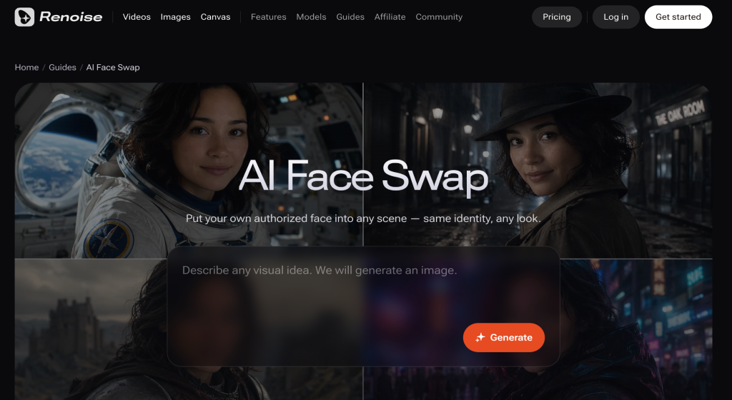
Step 2: Describe the Cinematic Scene
Describe the setting, camera angle, feeling of the lens, wardrobe, expression, lighting, color palette, and emotion. It’s a start, but “A detective in a rainy 1920s alley” adds some direction to the model, and a tight medium shot, wet pavement reflections, and high-contrast film-noir lighting “g” adds more.
Step 3: Generate, Compare, and Refine
Make the scene, look at the likeness of the faces, and compare them with variations. If it doesn’t feel connected to the result, try changing the framing or lighting before changing the source image. A still that works can serve as a visual reference for motion and additional stills. Renoise AI brings image and video generation, asset organization, and visual iteration into a single Canvas-based workspace.
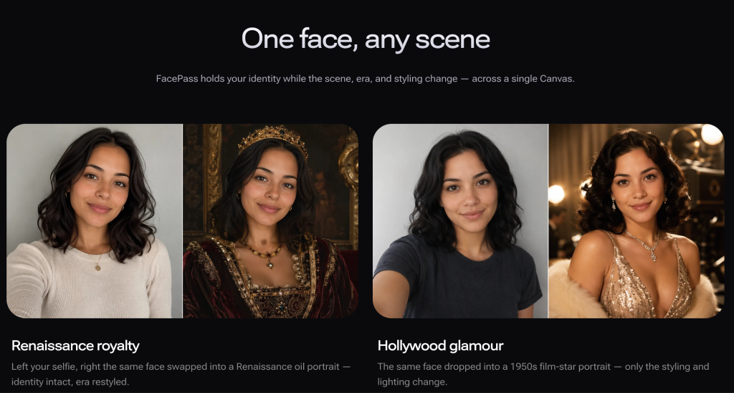
What Makes a Realistic Face Swap Believable?
A realistic face swap requires more than just facial similarity. The skin tone should contrast with the scene’s lighting. The angle of the head should be the same as the angle of the body. The hair, shadows, expression, depth of field, and image grain should appear as if they were part of the same shot.
To get more powerful results: maintain the visual logic. If the face reference is in soft daylight and the target scene is hard blue daylight, explain how the shapes of the light on the face should change. Medium shots will offer more context than the extreme close-ups. Repeat essential elements like lens style, color treatment,t and clothing in several shots.
The aim is not to conceal all the traces of generation. It is to establish a clear picture that reflects the story. When the selections are intentional, a stylized outcome can be a perfect fit.
How Do You Keep a Consistent AI Character Across Scenes?
Consistency of character is enhanced when creators treat identity, wardrobe, and cinematography as distinct controls. Repeat with the same identity of the approved source, but change one variable at a time. Test at a new spot before switching the costume,e and test the costume before radically new camera angle.
Describe reusable information in your prompts; a charcoal trench coat, a silver pendant, warm rim lighting, or a fictional scar. Keep good frames as “show pictures” for future shots. It is a discipline that minimizes random variation and provides a short drama with a sense of a recognizable visual language.
Check all outputs for likeness, extraneous artifacts, and context before publishing. Ask for final approval from the person whose face appears in the photo, and disclose synthetic media where necessary, as dictated by the platform, client, or intended use.
FAQ
Can AI Face Swap Work in Videos?
Yes. Even though it’s a still photo, a good photo can serve as a valuable visual starting point for a motion workflow. Try a dynamic pose in a good key frame before developing the idea into an action shot.
Is AI Face Swapping the Same as Creating a Deepfake?
The underlying techniques may be similar, but intent and consent are what count. An authorized creative work is created with permission from the person depicted and isn’t intended to fool the audience.
How Many Photos Are Needed for a Good Face Swap?
It’s better to have a few useful images captured from favorable angles than to have many edited or blurry photos. The references are consistent with lighting and clearly defined facial features.
Can the Same Face Appear in Different Cinematic Styles?
Yes. One authorized identity can be investigated in various genres, time periods, and visual styles. When using framing and lighting, it is best to keep them uniform.
Build the Character Before You Build the Set
Face swapping is most beneficial if it enhances planning and storytelling. Always begin with an approved ID, develop one believable scene, and then carefully work into new shots. When consent, character continuity, and the direction of the film are all considered part of the same process, a creator can get to a convincing rough cut sooner – and make better decisions to get to that point before they enter into full production.
Popular on OTW Right Now!



About The Author

Gagan Bhangu
Founder of otechworld.com and managing editor. He is a tech geek, web-developer, and blogger. He holds a master's degree in computer applications and making money online since 2015.