
Why AI Search Is Becoming a Core Feature of Modern Applications
How people search in apps. Whether searching for goods online, searching company documents, looking for movies, or requesting chatbot support, users need accurate answers in seconds. Since search technologies traditionally work based on keywords, they often create frustrating experiences for users, who may ask questions using different words.
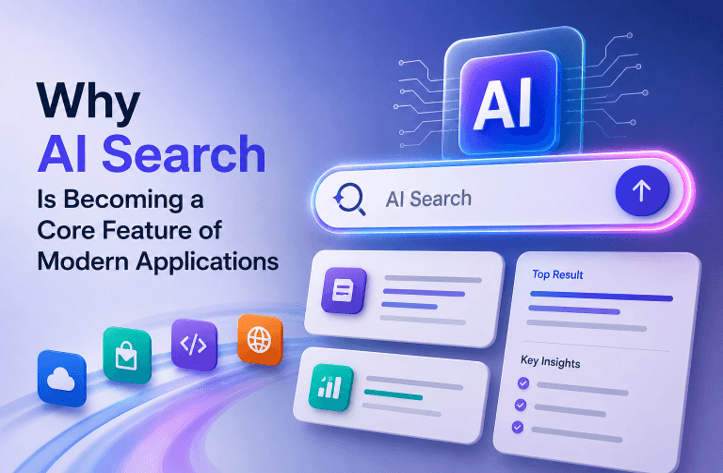
This change is why today’s need for AI-based search in applications has shifted from being a nice-to-have to becoming a necessity. Organizations are looking to evolve from keyword-based searches into smart searches that can comprehend the context, user intent, and language. In line with advances in technology products, search has evolved from merely looking for information to completing tasks effectively and efficiently.
Organizations are increasingly investing in intelligent search capabilities because they improve productivity, customer satisfaction, and engagement.
The Evolution of Search in Digital Applications
There have been dramatic changes in the development of search technology within the last decade. The early search algorithms embedded within applications used to depend entirely on word matching. Search technology has evolved dramatically over the last decade. The early search algorithms embedded within applications used to depend entirely on word matching. Users would find it difficult to obtain satisfactory answers if they used an incorrect word.
In the current AI-powered search, there is a recognition of the relationships between words, users’ intentions, and past interactions.
Instead of adapting users to how search systems work, present-day search adapts to how people talk.
This change has made search an integral part of the entire search experience.
Why Traditional Search Is No Longer Enough
Users expect intelligent behavior from digital products. Users do not want to remember the keyword and scan through all the results returned.
The conventional search has the following challenges:
- Use of different wording for the same query
- Spelling mistakes in the user’s query
- Use of industry-specific jargon
- Big and dynamic databases
- Queries in multiple languages
These challenges are becoming increasingly evident with big organizations gathering huge amounts of structured and unstructured data.
This is why organizations are making efforts to integrate intelligent search capabilities into their operations.
How AI Search Works
Modern AI search technology combines various technologies to improve speed and relevance.
A few of the key capabilities include:
Semantic Search
Among the key advances is semantic search, which aims to understand the meaning of the user’s search rather than matching keywords.
For instance, when someone uses “cheap business laptops” in their search query, they would get the same results as when they search for “affordable office notebooks.”
Natural Language Search
Users expect intelligent behavior of digital products. Users do not want to remember the keyword and scan through all the results returned.
The conventional search has the following challenges:
- Use of different wording for the same query
- Spelling mistakes in the user’s query
- Use of industry-specific jargon
- Big and dynamic databases
- Queries in multiple languages
These challenges are becoming increasingly evident with big organizations gathering huge amounts of structured and unstructured data.
This is why organizations are making efforts to integrate intelligent search capabilities into their operations.
Conversational Search
The rise of AI assistants has made conversational search increasingly important. Rather than making users restart each query from scratch, conversational interfaces take into account prior conversations and retain context through the conversation. This makes the process easier for the user.
Why Businesses Are Prioritizing AI Search
Companies now understand that search impacts customer satisfaction and employee productivity.
A better search engine allows people to get results quicker, which eliminates frustration and boosts engagement.
Among the key business benefits are:
- Quicker access to data
- Enhanced customer support
- Greater productivity of employees
- Effective knowledge management
- User engagement boost
- Operational costs reduction
All these advantages make AI-powered search beneficial for such sectors as healthcare, retail, finance, education, manufacturing, and others.
Enterprise Applications Need Smarter Search
Big companies accumulate huge volumes of information daily. From documents and emails to product catalogs, service tickets, and all sorts of other information that accumulates in the knowledge base.
Without proper search, employees waste precious time searching for information.
And this is where enterprise AI-powered search comes into play.
The modern approach to enterprise search allows you to integrate several data sources while preserving the necessary level of security and permissions control.
Better User Experience Starts with Better Search
People measure the quality of an application based on how easily they can achieve their objectives.
When users are not able to find anything, they tend to leave the application entirely.
Good search functionality increases user experience in AI applications in the following ways:
- Provides relevant results quicker
- Makes users click fewer times
- Understands users’ intentions
- Adapts itself based on previous searches
- Provides recommendations based on users’ preferences
All of these points increase the amount of time that people will spend inside the application.
Generative AI Is Expanding Search Capabilities
Another notable innovation in AI is generative AI search.
In addition to the conventional practice of just showing you links or the document itself, this technology will allow for summarization of the data, answering intricate questions, and generating an appropriate response using multiple data sources.
Thus, instead of showing you ten policy documents, the search system might generate a succinct answer along with the source.
AI Search Across Different Industries
There is an ever-increasing demand for intelligent searching due to the need for immediate access to information in all industries.
Some of the typical use cases are:
Retail
Users get better recommendations based on intelligent product searches.
Healthcare
It becomes easy for professionals to search patient history and research papers.
Financial services
Professionals can quickly look up the necessary documentation and regulations.
Education
Teachers and students can search for learning resources by natural language rather than exact course names.
Software products
With new-generation software solutions, intelligent search gets incorporated in dashboards, documentation, customer portals, etc.
AI Search Is Becoming Part of Modern Application Development
Search is being incorporated into digital product creation by businesses right at the beginning of the development cycle.
Search isn’t being bolted onto products anymore; instead, developers are designing applications around search from day one.
As businesses invest more in AI application development, search will be one of the core elements along with authentication, analytics, and security.
Most companies also work with experienced AI consulting services providers to identify the right search architecture, select suitable AI models, and build scalable solutions that meet business requirements.
Looking Ahead
Users’ search expectations will keep increasing as they get used to interacting with smart assistants and chatbots. Future search AI will be even more personalized, multimodal, and contextually aware. Voice queries, images, documents, and structured data will play an increasingly important role in the search process as a whole.
For businesses, adopting smarter search is no longer just about keeping pace with technology. It is about creating applications that are easier to use, more efficient, and better equipped to meet growing user expectations.
For readers interested in the broader concepts behind artificial intelligence and search systems, this provides additional background on the technologies driving these advancements.
Popular on OTW Right Now!
-
 AI Event Planner That Tunes Demand, Pricing, And Menus In Real Time
-
 How AI Search Is Reshaping Content Marketing: Strategies to Get Mentioned by ChatGPT, Gemini and AI Assistants
-
 Generative AI Is Transforming Cybersecurity Skills for a New Digital Era
-
 Why Your Salary Offer Could Be Worth Less Than You Expect


About The Author

Gagan Bhangu
Founder of otechworld.com and managing editor. He is a tech geek, web-developer, and blogger. He holds a master's degree in computer applications and making money online since 2015.