
Refurbished iPhone vs New iPhone: Which Option Offers Better Value for Your Money in 2026?
The best choice for you in 2026 would be a refurbished iPhone because you’ll be able to obtain 85-95% of the full experience, spending 30-50% less money on it compared to a new model, provided that you purchase the device from a reputable retailer. A new iPhone would be the best option for you only if you require the latest chip or want to enjoy the experience of using an entirely brand-new product.
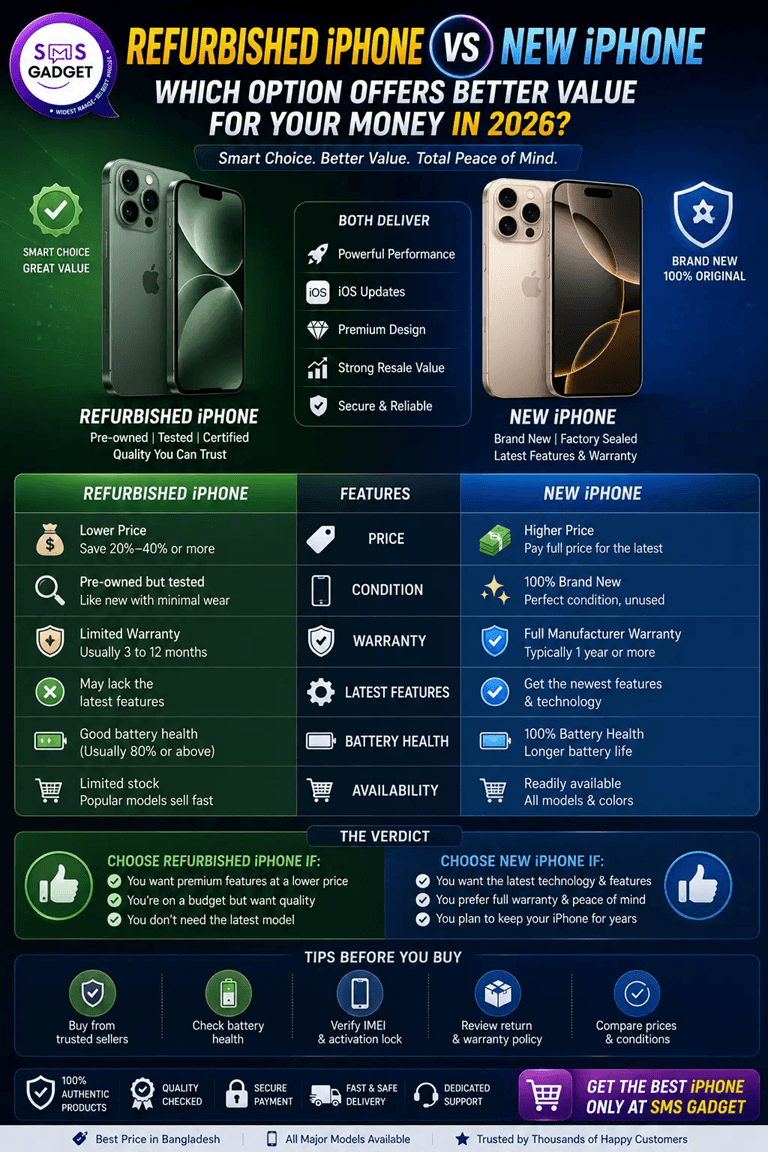
See below why we think so and what to consider when making your decision.
Refurbished vs New iPhone: Quick Comparison
| Factor | New iPhone | Refurbished iPhone |
| Price | Full retail price | Typically 30-50% less |
| Condition | Sealed, untouched | Inspected, tested, like-new |
| Battery | 100% health, fresh | Usually 80-95%+ health (verify before buying) |
| Warranty | Full manufacturer warranty | Seller warranty (varies, usually 6-12 months) |
| Latest features | Always included | Depends on the model’s age |
| Software updates | Maximum years remaining | Fewer years if buying an older model |
| Risk level | Very low | Depends entirely on the seller’s trustworthiness |
| Best for | Buyers who want zero compromise | Budget-conscious, value-focused buyers |
What Does “Refurbished” Actually Mean?
Refurbished vs Used: They’re Not the Same Thing
This is the single most misunderstood distinction in the Bangladesh secondary phone market, where the terms “used” and “refurbished” are often used interchangeably, but they shouldn’t be.
- Used (second-hand): Sold as-is, straight from a previous owner. It might have a healthy battery, or it might not — there’s no formal inspection process, and the safety net is whatever the individual seller offers.
- Refurbished: The device has gone through a structured inspection process—faulty parts like the battery or screen are tested and replaced if needed, the phone is reset to factory condition, and it typically comes with a grade (Excellent / Very Good / Good) and a warranty.
If you’re comparing prices and one listing is significantly cheaper than another for the same model, this is usually why.
Why does this matter for Your Buying Decision?
A genuinely refurbished iPhone from a reputable seller removes almost all the risk people associate with buying second-hand—you’re not gambling on a stranger’s honesty; you’re relying on a tested, graded, warrantied product. And if a refurbished or imported unit fits your budget better, an established Unofficial mobile shop in Bangladesh with proper grading and warranty support can offer genuine savings without the typical second-hand market risk.
Cost Comparison: How Much Can You Actually Save?
Year-over-year iPhone upgrades have become more incremental—small camera improvements, modest chip speed gains, minor design tweaks—rather than dramatic leaps. This is exactly why the refurbished savings argument has gotten stronger every year.
A simple way to think about it: if the price difference between a refurbished and new version of a similar-tier phone is small, buying newer (even if it’s also refurbished) is usually the smarter move. But if the gap is large, a one-or-two-generation-older refurbished iPhone in excellent condition typically delivers far more value per taka than stretching for a brand-new model.
Real-world example: A brand-new flagship iPhone loses a meaningful chunk of its resale value within the first year of ownership. Someone who buys that same model refurbished a year later sidesteps that depreciation entirely while still getting a device tested to near-new condition.
Performance: Do You Actually Lose Anything?
For the vast majority of daily use—calls, messaging, social media, browsing, and photos—a refurbished iPhone from the last 2-3 generations performs identically to a new one. Unless you’re a professional photographer or video editor who needs the absolute latest camera hardware, a refurbished iPhone comfortably handles everything most people need.
Where you do feel a difference is in the following:
- Sustained heavy gaming or video editing, where the newest chips have a real edge
- Camera system upgrades, particularly zoom range and low-light performance on Pro models
- Apple Intelligence features, which require an iPhone 15 Pro or newer, so refurbished units older than that miss out entirely
Battery Health: The Most Important Number to Check
Battery condition is the single biggest variable in refurbished iPhone value, and it’s the first thing you should check on any listing.
- Look for at least 85% battery health as a general buying threshold
- Apple rates iPhone 14 and earlier batteries to retain 80% capacity at 500 charge cycles, while iPhone 15 and later are rated for 1,000 cycles
- A unit sold below 80% battery health will show noticeably shorter daily battery life—factor in a replacement cost if the price is otherwise excellent
Reputable refurbished sellers list battery health directly on the product page. If a listing doesn’t mention it, ask before buying.
Software Support: How Long Will a Refurbished iPhone Stay Updated?
This is where model selection matters most. Apple typically supports iPhones with major iOS updates for 6 to 8 years from release. A refurbished iPhone bought today inherits whatever update runway is left on that specific model — not a fresh 6-8 year window.
Practical guidance:
- iPhone 15 series and newer: Apple Intelligence support, long remaining update runway — safe long-term buy
- iPhone 13-14 series: Still actively supported, excellent value, 2-4 years of updates remaining
- iPhone 12 and older: Increasingly close to losing active software support — fine as a secondary or backup device, but a riskier choice as your primary phone, especially for banking and sensitive apps
Who Should Buy a Refurbished iPhone?
- Budget-conscious buyers who want premium hardware without premium pricing
- Students and first-time iPhone owners
- Anyone upgrading from a much older phone (the jump will feel significant either way)
- Buyers who care about sustainability and reducing e-waste
- Tech-savvy users who value performance-per-taka over having the newest release
Who Should Buy a New iPhone Instead?
- Buyers who want the absolute latest chip and camera technology
- Anyone who plans to keep the phone for the maximum possible number of years
- Users who want a full manufacturer warranty and zero device history
- Professional creators who need cutting-edge camera tools for client work
- Buyers who simply prefer the experience of an untouched, sealed device
How to Buy a Refurbished iPhone Safely (Checklist)?
- Buy from a certified, reputable seller: Not an anonymous marketplace listing with no return policy.
- Check the battery health percentage. Before committing, ask directly if it isn’t listed.
- Verify the IMEI: If it is clean, unlocked, and not blacklisted or iCloud-locked
- Confirm the gradin: system the seller uses (Excellent / Very Good / Good) and what each tier actually means.
- Ask about the warranty period and return policy: a minimum of 6-12 months is a reasonable standar.d
- Inspect in person if possible: test Face ID, True Tone, cameras, speakers, and charging port before payi.ng
- Be wary of prices that seem too good to be true: an unusually cheap “refurbished” flagship is often a red flag for replaced internal components or a financed/blacklisted dev.ice
Frequently Asked Questions
Is a refurbished iPhone worth buying in 2026?
Yes, as long as it’s purchased from a certified, reputable seller with clear battery health disclosure and a warranty. For most everyday users, a refurbished iPhone delivers nearly identical performance to a new one at a significantly lower price.
What’s the difference between a used and a refurbished iPhone?
A used iPhone is sold as-is with no formal inspection process, while a refurbished iPhone has gone through testing, repairs where needed, and a condition grading before resale, typically backed by a warranty.
What battery health should I look for in a refurbished iPhone?
Aim for at least 85% battery health. Anything below 80% will show noticeably reduced daily battery life and may need a replacement soon after purchase.
How much money can you save by buying refurbished instead of new?
Savings typically range from 30% to 50% compared to buying the same or a similar model brand new, depending on the device generation and condition grade.
Does a refurbished iPhone get the same software updates as a new one?
Yes. If the specific model is still within Apple’s supported device list, it receives the exact same iOS updates as a brand-new unit of that model.
Is it safe to buy a refurbished iPhone in Bangladesh?
Yes, provided you buy from a trusted, established seller who verifies IMEI status, discloses battery health, and offers a clear warranty and return policy.
Final Verdict: Which Should You Choose in 2026?
If you want the smartest possible use of your money, a refurbished iPhone from a trusted seller is the stronger choice for most buyers in ;026, you get the vast majority of the new-iPhone experience at a meaningfully lower price, especially as year-over-year upgrades continue to shrink. A new iPhone still makes sense if you want zero compromise: the newest chip, maximum years of software support, and the peace of mind of a completely untouched device.
Whichever path you choose, the seller matters as much as the model. For dependable pricing and trustworthy service in Bangladesh, you can compare current rates anytime—see the Latest iPhone prices in Bangladesh before deciding between new and refurbished.
Popular on OTW Right Now!

About The Author

Gagan Bhangu
Founder of otechworld.com and managing editor. He is a tech geek, web-developer, and blogger. He holds a master's degree in computer applications and making money online since 2015.