
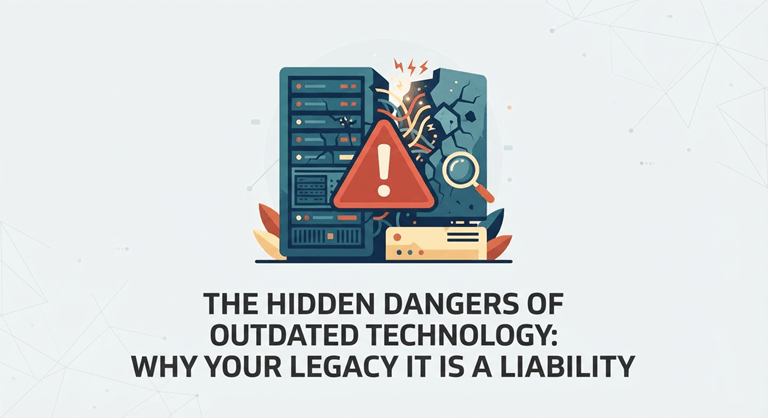
The Hidden Dangers of Outdated Technology: Why Your Legacy IT is a Liability
Many business leaders believe that keeping old, functional computers and servers running is a smart cost-saving measure. If a machine still turns on and runs basic software, replacing it feels like an unnecessary expense. This common misconception often leads companies to hold onto aging technology far longer than they should. The reality is that squeezing a few extra years out of outdated equipment usually costs more than upgrading.
Outdated technology introduces severe financial, security, and compliance liabilities that secretly threaten your business operations. What looks like a frugal business decision is actually a growing pile of technical debt. Old hardware runs slowly, frustrates employees, and requires constant troubleshooting just to maintain basic functionality. Eventually, this aging infrastructure reaches a breaking point.
Unfortunately, many organizations do not realize the extent of their technological debt until a sudden server failure or a data breach occurs. By the time the system crashes, the resulting downtime and recovery efforts cost significantly more than a planned upgrade. You do not have to wait for a disaster to happen. Partnering with a proactive IT support team in Stamford can help identify these hidden vulnerabilities before they disrupt your operations.
Key Takeaways
- Old technology silently drains business budgets through high maintenance costs, constant repairs, and lost employee productivity.
- Unsupported, unpatched software acts as an open door for modern cyberattacks, leaving your business defenseless against data breaches.
- Improper disposal of old physical hardware creates significant legal risks, compliance violations, and data privacy vulnerabilities.
- Proactive IT planning allows businesses to modernize systems and migrate to the cloud safely without suffering operational downtime.
What Makes a “Legacy System” a Liability?
The term “legacy system” sounds highly technical, but it describes a very common problem in small and medium-sized businesses. A legacy system is not solely defined by the age of the equipment. Instead, it refers to any software or hardware that is no longer supported by its manufacturer. It also includes systems that simply cannot integrate with modern cloud tools. If your software developer no longer releases updates for your program, you are running a legacy system.
Keeping this old technology directly impacts employee productivity and stunts overall business growth. Think about the daily routine in your office. If employees spend fifteen minutes every morning waiting for a computer to boot up, that lost time adds up quickly. Over the course of a year, you are paying for hundreds of hours of lost productivity simply because the hardware cannot keep up with modern demands.
This slow decline transitions a piece of equipment from a mere “slow computer” to a tangible business liability. When systems cannot connect to modern cloud platforms, your team cannot collaborate effectively. You lose out on new software features that could automate tasks and save money. Eventually, the inability to adapt forces your business to work around the technology, rather than having the technology work for your business.
The Three Hidden Dangers of Outdated Technology
Having a legacy infrastructure comes with certain risks, posing a threat to small businesses. These can be broken down into three areas of liability. They range from financial loss to failure to comply with physical standards to cybersecurity vulnerabilities.
You need to realize that in the case of old infrastructure, these risks are all present at the same time. You’re not just dealing with a slow network; you’re also putting multiple threats to your company. Let’s take a detailed look at the effects each of these threats has on your business.
1. The Financial Drain of Technical Debt
Maintaining legacy systems can be a lot more costly than implementing a cloud solution today. Older technology forces businesses to constantly be in the break-fix cycle. A component goes bad, the IT guy rushes out to correct the issue, and you get an unanticipated invoice. These repair costs are frequently significantly greater than normal support fees, since older components are less readily available and also require particular repairs and maintenance.
Relying on old technology tends to be cheap, convenient, and easy, but the true expenses of supporting old technology can be hidden in several different budget lines. A business owner may see his or her IT expenses and believe that they are low. But it’s costing in other ways, like working overtime by employees to compensate for the lost time, or lost sales because of a failed ordering system. Adding this unnecessary time and lost revenue makes it seem like you won’t save money.
This massive drain leaves almost no resources available for actual business growth. A Deloitte study found that 55% of IT budgets are spent on maintaining legacy systems, leaving only 19% for innovation. By continually paying to fix broken equipment, you are actively defunding your company’s ability to innovate and compete in your market.
2. Cybersecurity Vulnerabilities in Unpatched Systems
Outdated software is one of the most harmful types of cyber threats, as is using unsupported servers. In order to foil the discovery of vulnerabilities in their programs, software developers regularly publish security patches. As soon as a system goes into its end-of-life, the manufacturer no longer produces these patches. There’s an inherent flaw in your technology that cannot be fixed; it will be there forever.
The legacy systems, which remain without patching, are virtually unprotected against today’s cyberattacks, which use AI technology. The automated programs used by hackers are created to search the Internet for these common vulnerabilities. They can be tricked once they discover an unprotected server, and then simply stroll through your normal security measures.
Simple anti-virus is not a sufficient solution to defend legacy infrastructure. To address these vulnerabilities, it is essential to have a proactive approach with continuous monitoring and a comprehensive cybersecurity strategy. A modern IT approach is to prevent the attack in the first place, not to recover lost data once it has occurred.
3. The Physical Danger: E-Waste and Data Destruction
Businesses often don’t consider the legal and compliance risks that arise when physically disposing of old IT equipment. Old computers, servers, or hard drives must not be placed in regular recycling bins. They can’t be left for long periods of time in an unlocked storage closet, either. All of this outdated equipment still puts at risk the company’s monetary details, employee records, and delicate client data.
Failure to dispose of it correctly is one of the biggest compliance issues you might have and could result in very hefty fines and legal issues. There are many firms that forget to dispose of the old equipment while they’re cleaning up the office or investing in new technology. If one of these unaccounted laptops is misplaced, it’s your problem if the data gets compromised.
Businesses need to securely recycle e-waste and properly dispose of information with a secure, certified local program to ensure compliance and to ensure client data is safe. When professional IT partners shred old hard drives, they will do this physically to ensure the information cannot be recovered. They will also be able to give you a certificate of destruction to make sure that your company is in the clear in terms of compliance records.
How to Modernize Your IT Infrastructure Without Downtime
The top threat to undertaking the technology upgrade is the fear of disruption to operations. Let’s get away from legacy systems, which seems like a huge undertaking that will bring the office to its knees. It may conjure up images of downtime servers, vexed employees, and forfeited profits. But a professional modernization project is geared towards preventing these problems.
The first step towards modernisation without any downtime is to have a complete and straightforward evaluation of the present situation. A good IT partner will audit your system and processes prior to any changes and ensure that all of your hardware and software are compatible. This evaluation contributes to creating a strategic plan for IT that outlines all the phases of the migration. With careful planning, you can schedule the real work when you aren’t in the office during the day or on a weekend, so your team shows up on Monday morning to get to work.
Modernizing your infrastructure is a structured process that prioritizes your business continuity. The table below outlines the core phases of a safe and effective transition.
| Phase | Action | Benefit to Business |
| Assess & Strategize | Identifying weak points and auditing legacy hardware. | No hidden costs or surprise delays during the project. |
| Secure & Migrate | Moving data securely to cloud platforms like Microsoft 365. | Improved employee efficiency and remote work capabilities. |
| Proactive Management | Applying flat-rate 24/7 monitoring and support. | Elimination of future tech debt and unpredictable repair bills. |
Conclusion
The cost savings of holding onto old technology are far outweighed by the tremendous disadvantages that they pose. With every passing day, your business would be at risk of safety breaches, as well as losing money, while operating on an unsupported server or outdated software. The recurring repair costs, risk of a data breach,h and compliance threats of physical eWaste are simply not worth the risk.
Don’t let all the technology failures get in the way of business strategy and growth. You can’t afford to troubleshoot slow computers or deal with the problems of an old hard drive that’s finally failed. Make upgrading your systems an investment in the stability and success of your business.
The key to the protection of your business is to engage a long-term technology partner. With a dedicated IT team, you can prevent tech distractions and manage the risk proactively with the support of flat-rate support. These hidden hazards can be overcome today, which will provide your technology with a platform for growth, not a hidden liability.
Popular on OTW Right Now!



About The Author

Gagan Bhangu
Founder of otechworld.com and managing editor. He is a tech geek, web-developer, and blogger. He holds a master's degree in computer applications and making money online since 2015.