
London’s Most Targeted Boroughs for Cyber Crime
Cyber attacks don’t land evenly across the capital. Some areas rarely make headlines, while others face constant digital threats because of the businesses clustered there. Here’s how that risk maps onto London’s boroughs, and what it means if you’re running a business in one of them.
Why Some London Boroughs Face Greater Digital Threats
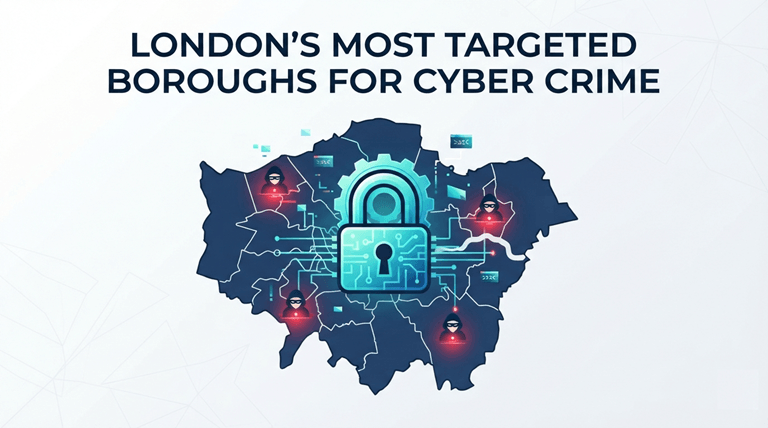
Borough-level cyber crime data isn’t published by Action Fraud’s successor, Report Fraud, or by the ONS, but the underlying picture is well understood. The City of London and Tower Hamlets, home to Canary Wharf, are the heart of the country’s financial and professional services and have consistently higher numbers of incidents reported by these areas in the national statistics for fraud and computer misuse.
Canary Wharf in Tower Hamlets and the tech cluster around Old Street and Shoreditch, which spans Hackney, Islington, and Tower Hamlets, see a similar concentration of risk. These industries also manage high amounts of funds and client information, making them attractive targets for ransomware attacks, and ransomware is also a growing threat for business email compromise. Attackers target areas for the greatest benefit, and in this case, it’s central London.
What Makes Central London Attractive to Attackers
High-value targets sit packed tightly together in these financial and creative hubs. Attackers can initiate a wide campaign to search for vulnerable entry points in many companies simultaneously when hundreds of companies occupy a few streets. Many of these companies operate from communal office areas, too, which can pose additional dangers.
Co-working spaces are all different when it comes to tenant segmentation. These less expensive or older systems typically have only a single network, meaning if the compromise occurs at one desk, it can enable access to other companies that share the same connection. Some of these boroughs also contain professional services companies that have extremely sensitive client information, and, on the dark web, that information is worth a fortune and will be worth months of effort for the attacker.
How Local Businesses Can Secure Their Networks
Business owners can take immediate steps by following official UK guidance. The National Cyber Security Centre (NCSC) publishes a Small Business Guide that lays out the essentials:
- Strong password policies
- Regular backups to secure locations
- Keeping software up to date
Once the basics are in place, the next question is whether they actually hold up under attack. That’s where pen testing companies in the UK have the biggest impact. These specialists run controlled, real-world attacks against your systems to surface the weaknesses that internal teams tend to miss.
Essential Steps from National Security Advice
The NCSC’s advice focuses on a few actions that constitute a minimum level of security for any London business. You don’t have to spend a lot of money on any of it; most of it is to do with user habits and simple configuration changes.
By enabling two-factor authentication on all business accounts, a significant proportion of automated password attacks can be prevented, though, where possible, the NCSC now recommends using a phishing-resistant form of 2FA (such as a passkey or FIDO2 security key), as attackers have been able to work around other less secure methods, like SMS codes.
Also consider limiting privileges for administrators to prevent them from inadvertently installing undesirable software, and conducting periodic training programs so employees can learn to identify phishing emails disguised as messages from suppliers or from banks. Small fixes make for big breach reduction with minimal technical effort.
Active Vulnerability Checks for Higher-Risk Firms
Passive defences are not sufficient for companies within the City, Westminster,r or Canary Wharf. Professional security evaluations go into further depth by assuming the role of a determined hacker who has targeted your business.
This leaves you with a focused, prioritised list of vulnerabilities that your team can work on to address client data and, more importantly, the reputation that fuels the relationship in the first place. It is essential to treat cybersecurity as a serious business insurance to protect a London business.
Signing Off
The wealth and commercial activity in London will continue to make it a prime target for cybercrime. Being located in a high-risk borough requires being vigilant, and regular professional testing, plus NCSC basics, is the most effective way of keeping up with the evolution of attacks.
Spending time on network security safeguards the trust you’ve earned with clients and partners. Security that is not just an annual “tick box” is what keeps businesses up. It’s your actions today that will make your business safer in the long-term in the face of London’s threat landscape.
Popular on OTW Right Now!



About The Author

Gagan Bhangu
Founder of otechworld.com and managing editor. He is a tech geek, web-developer, and blogger. He holds a master's degree in computer applications and making money online since 2015.