
How Smart Home Technology Is Reshaping Luxury New Construction
For most of the last decade, smart home technology meant a smart speaker on the counter and a connected thermostat on the wall. That era is over. In today’s luxury new construction, intelligence is no longer an accessory you add after move-in. It is wired into the structure itself, planned alongside the plumbing and the framing. The result is a home that manages its own energy, anticipates your routines, and protects itself, all with far less effort from the people inside it.
Automation as infrastructure, not gadgetry
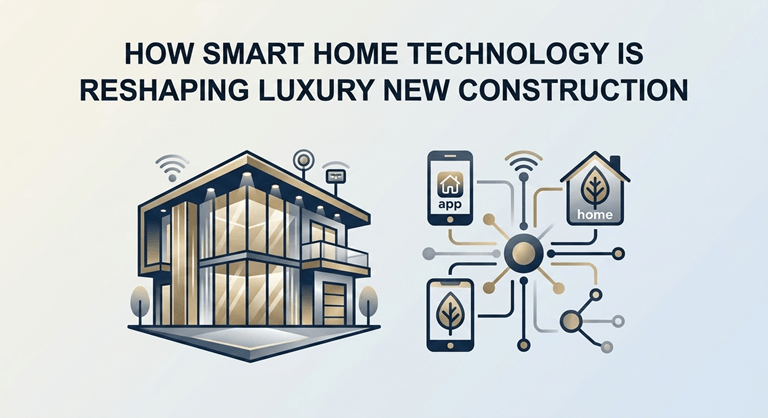
The greatest change is in the conceptual approach. Nowadays, builders and buyers consider automation as an infrastructure and not as a set of devices. Lighting, climate, shades, audio, and security work together and don’t compete for attention since they have a common backbone. A single night scene can be used to lower the lights, draw the shades, drop the temperature, and arm the perimeter. Thiseamlessnesss is possible due to pre-wiring during construction. It can be retrofitted into an older house, but it will be costly and will likely not be as clean.
Energy intelligence that pays for itself
The development of smart climate control has progressed much further than a learning thermostat. New houses are more and more integrating HVAC zoning, automated shades, and even solar and battery systems, to control energy throughout the day in an intelligent manner. That’s coordination that is needed in a hot and humid climate. It provides efficient home pre-cooling, right shading of the right windows at the right time, and load shifting to reduce peak demand. Not only is it an efficient, cost-effective energy system, but the savings are truly measurable and accrue over the years—hence its inclusion in luxury floor plans.
Security that thinks ahead
The shift in security technology from reactive to predictive.The transition of security technology from reactive to predictive. The protection begins at the community gate, in leading master planned communities. For instance, one way that gated communities like Avenir Palm Beach Gardens work is by combining gated access with license plate recognition and a coordinated response with local police and fire services. The layered approach remains at the individual home, with the addition of automated locks, video doorbells, etc., as well as smart cameras and delivery vs. intrusion sensors. The aim is to not only capture a problem when it occurs, but to stop it in the first place, and for owners to be able to see it, whether they are on the upper level or over the seas.
Built for the seasonal owner
South Florida is home to a considerable number of second-home residents, and technology has changed the way they deal with a second home. The remote monitoring feature allows an owner to monitor a property remotely in another state. Humidity is controlled with automated home climate control when the house is being used, and when it is empty, it will prevent finishes from deteriorating and improve the prevention of mold. Leak sensors detect a leak that can prevent a floor from getting flooded by a leaking water heater. After all, connected systems can even have the property manager ready the house when the family arrives, heating it up or cooling it down as needed, and ensuring it is in order. That’s where the whole absentee ownership goes awry for the absentee owner.
Connectivity is the new foundation.
There is one thing that is essential to every smart feature in modern homes: A reliable network. The home’s wiring and wireless coverage no longer are an afterthought, as automation, security, and entertainment are all moving onto the same backbone. The ideal new builds are hardwired Ethernet to key areas, offer wireless access points to cover all areas, and centrally route everything from a central equipment closet instead of all the consumer boxes tangling up. For many owners, remote working has become permanent,t and a video call that’s lost due to poor coverage in the office is no longer a given.
That’s why the choice of connectivity should be made at the construction phase. Cable is inexpensive when it’s being installed through open walls. It is an added expense that will result in cutting into completed drywall and ceilings. The advantage of building a home with enough room for an extra 10 years of devices is that you can do it without any invasive upgrades, just like the type of home that truly faces the future, vs. the type that looks good.
Future-proofing the build
Unfortunately, home technology doesn’t last long. What looks great now may feel old in 5 years. The best new builds think ahead and put in sound, structured wiring, sufficient bandwidth, and open standard systems, which means they can be enhanced when needed without the need to rip up walls. Future proofing isn’t necessarily the installation of the hottest gadget in the market; it’s more about creating a platform that will embrace what’s to follow. Over the years, buyers have begun to inquire about this during construction, as the decisions made at the framing stage will dictate what is easy to change later.
Where guidance meets technology
It is actually difficult to specify all this correctly. A buyer can’t answer any of the above questions from a brochure. It’s where market experts come in handy and aid buyers in comprehending the technology integrated within various communities and builders, prior to them committing.
For buyers exploring smart, energy-efficient new construction in the Palm Beach Gardens area, resources like palmbeachcustomliving.com offer a useful starting point, with insight into how the region’s leading builders and master planned communities approach home technology, security, and long-term value.
A human element can’t be overlooked in all this. A smart home is not about technology, but about turning the technology towards people. The house that takes care of its own climate, keeps an eye on its own perimeter, and controls its own energy effortlessly takes away dozens of small choices day after day. The calmness of a home that mostly takes care of itself is what owners notice, and that’s the best indicator of whether or not the technology was worth building.
The intelligent home is now the default.
Smart technology has entered the territory of luxury new buildings. It’s not an add-on for those who want the very latest on the market anymore, but an expectation built into the home, from the initial design phase. A well-built home today is one that functions without a lot of noise, doesn’t cost the earth to operate, keeps you safe from threats, and is built for the next decade. In the eyes of the end user, the smartness of the house can be determined well before moving in, and that’s why it pays to think about such things from the start of the design.
Popular on OTW Right Now!



About The Author

Gagan Bhangu
Founder of otechworld.com and managing editor. He is a tech geek, web-developer, and blogger. He holds a master's degree in computer applications and making money online since 2015.