
Vinyl, Mesh, or Fence Wrap? How to Choose the Right Banner for Your Next Marketing Campaign
When it comes to getting noticed, few marketing tools deliver the same return on investment as a well-placed banner. They are budget-friendly, quick, and cannot be scrolled away. But I need a banner; it’s only the beginning. The look of your banner depends on the material, its format, and the finish you select; they all affect how long your banner will look sharp for before it begins to fade, tear,r or sag after only a few weeks.
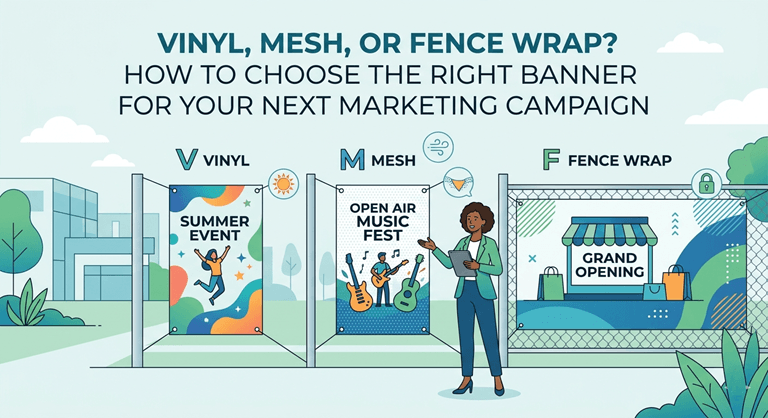
In this example, I’ve sorted through some of the most prevalent banner types, explained when they work well, and how to choose which one works best for your campaign.
Vinyl Banners: The Reliable All-Rounder
For a reason, vinyl is the standard material for siding. It’s used for an almost limitless range of applications, from the storefront to a grand opening to the sidelines of a sporting event to a conference booth and beyond. It prints in vibrant colors and is very durable. Heavier-weight vinyl (13-18 oz) will last for months outside, and lighter-weight vinyl is good for short-term use inside.
The only downside: Solid vinyl works like a sail. Vinyl banners don’t always hold strong in high winds and could rip off the grommets or tear down a structure. If you are going to hang one outdoors for a longer time, be sure to ask your printer about reinforced hems, wind slits, or pole pockets to take the pressure off.
Best for: storefronts, retail promotions, short-to-medium term outdoor advertising, general-purpose signage.
Mesh Banners: Built for Wind and Height
This is the wind problem that is directly addressed by mesh banners. Mesh is the preferred material for construction site fencing, building wrap,s and any material installed 2-3 stories up, since it allows air to flow through, rather than be trapped. The compromise is that the printed image isn’t as saturated as it would be with all the surface covered by ink, but this is not a problem at a viewing distance.
Best for: scaffolding wraps, high-rise building graphics, rooftop signage, anywhere wind load is a real concern.
Fence Wraps: Turning Perimeters into Ad Space
Fence wraps are similar to mesh and vinyl banners, but are designed to secure to chain-link fencing at construction sites, parking lots, or event areas. They’re a simple method to monetize otherwise unused real estate, be it an unattractive area or a job site, where they may be played without attracting notice and in front of passersby – foot and car – on the street.
If the fence is to be installed for a long period of time, or at a location requiring greater security, then metal fence wraps (which are typically made of aluminum composite panels) are a stronger and more difficult to tamper with option than fabric.
Best for: construction sites, parking lot perimeters, event security fencing, and long-term outdoor branding.
Banner Stands: Portable and Reusable
A retractable banner stand typically is more of an investment than a banner printed once because it can be used for a variety of events, such as trade shows, retail pop-ups, in-store promotions, or weekly events. The graphic is rolled into a base for easy transport and can be changed when the messages evolve, and the hardware can be used forever.
Best for: trade shows, conferences, in-store displays, and sales teams that present at multiple locations.
Step-and-Repeat Backdrops: Built for Photos
In fact, at an event, there’s one reason for using step and repeat backdrops: To ensure that your brand is visible in every picture taken at your event. It’s a low-cost, high-reward opportunity as it will get many people to take a photo with it without them having to ask.
Best for: product launches, press events, award ceremonies, sponsored photo ops.
Table Covers and Wall Wraps: The Supporting Cast
These are also typically overlooked, but make for a complete brand presence. The printed table cover instantly elevates the standard folding table to a trade show or farmers market booth, and the wall wrap is a great way to create branded space in a blank office wall, retail interior, or trade show backdrop. Both aren’t a single advertising method, but both boost the message that is being delivered by your main banner.
How to Decide: Four Questions to Ask First
Do not choose a material first, but rather try to work backwards from the situation:
Where will it get its shelter? — indoors, outdoors, or somewhere in between? UV-resistant ink and weather-resistant material are required for outdoor placements, while indoor placements have more options.
How long must it be in effect for? The material for a weekend event is different from that for a banner that is to be hung for an entire season.
Is wind a factor? Anything installed outside at a height above grade or in an open area will lean towards mesh or a reinforced/ windslit vinyl.
How are you going to attach it? Depending on the type of grommets, pole pockets, velcro, or a stand-mounted system, slightly different sets of printing specs will be required; so it’s a good idea to choose which way the grommets will go before the file is sent to print.
Don’t Skip the Production Side
The right material is not necessarily a good choice if the print is not of the right quality — if colors are muddy, the file was not set up for the bleed and resolution wide format printers need, or the printer is not used to working with the material in the outdoor environment. It’s best to have a printer that specializes in big format printing and will give you some guidance on the material, depending on your use, rather than accept just an order. For Bay Area businesses, providers like San Francisco banner printing specialists are a good example of the kind of local resource that can walk through these material trade-offs before you commit to a print run.
The Bottom Line
A banner is one of the simplest marketing pieces to be used, but the choice of making a banner isn’t always apparent. When you match the material to the environment, the time of use, and the installation method, you will have signage that performs and delivers a great deal of satisfaction, not just for the proof, but also after two weeks in the environment.
Popular on OTW Right Now!




About The Author

Gagan Bhangu
Founder of otechworld.com and managing editor. He is a tech geek, web-developer, and blogger. He holds a master's degree in computer applications and making money online since 2015.