
How AI Floor Plan Tools Are Reshaping the Way We Design Spaces
For years, drawing a floor plan meant one of two things: hiring a professional who charged by the hour, or wrestling with clunky desktop software that took weeks to learn. Neither option made much sense for the average homeowner, the small landlord listing a rental, or the real estate agent trying to get a property online before the weekend. That gap is exactly where a new generation of AI design tools has stepped in, and the shift has been quietly remarkable.
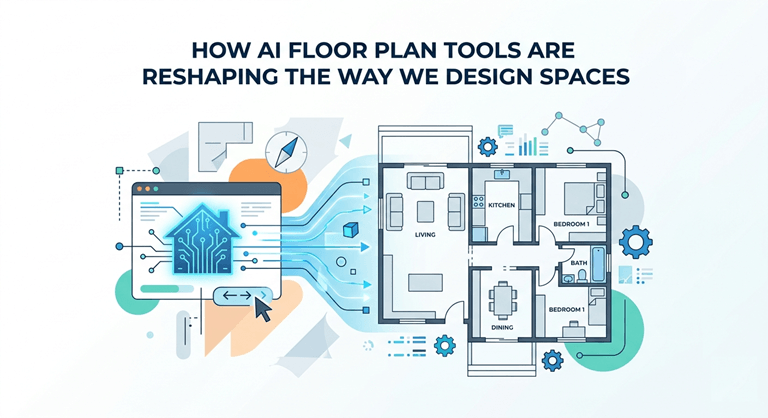
If you have browsed property listings, interior design blogs, or renovation forums lately, you have probably noticed cleaner, more accurate floor plans showing up everywhere. Most of them were not drafted by an architect. They were generated in minutes using artificial intelligence, and the quality is good enough that the difference is hard to spot.
Why Floor Plans Were Always a Bottleneck
A floor plan looks simple once it is finished. It is just lines, measurements, and a few labels. But getting to that finished state was historically painful. Traditional CAD programs were built for engineers and architects, not for someone who wants to show how their two-bedroom apartment is laid out. The menus were dense, the file formats were confusing, and a single mistake could throw off an entire drawing.
The complexity was an actual cost. One reason real estate agents were hesitant to include a floor plan was that it would be very costly to create one for each listing. Rough sketches had to be created by the homeowner for contractors to interpret during a house renovation. It was a time-consuming process for interior designers to create new sketches of the same interior until they found a new furniture arrangement. The tooling was not the problem, but it was a barrier to people.
What AI Actually Changes
What’s interesting about using machine learning for floor plans is that it’s a problem that is very well suited to it. AI is very good at identifying patterns, understanding fuzzy data, and completing the formal data that a person would have to do by hand. An AI can deduce walls, doors, windows, and dimensions from a sketch photo, or even a set of room dimensions, much quicker than someone could take their time clicking one line at a time.
Tools like https://floorplanai.net/ lean directly into this. Users don’t have to learn a complicated interface; instead, they can describe or upload what they have, and the software will generate the technical drawing on its own. This leads to a usable, shareable plan in a fraction of the time, without the steep learning curve that once scared people away from older software.
This is important because it removes the knowledge barrier. You no longer have to learn what “snap-to-grid” is and how to control layers. While it’s all done by AI, all you need to do is pay attention to all the actual layout decisions you’re interested in.
Who Benefits the Most
The biggest beneficiaries are individuals engaged in real estate. When you have a floor plan, it always gets more attention than a listing that’s just descriptive and based on pictures. Buyers want to know how it looks before they schedule a viewing. AI can help an agent create a clean listing plan for all listings without spending a ton on marketing, thereby creating a level playing field for independent agents and smaller agencies.
Homeowners follow this. Now, anyone who wants to remodel, rearrange furniture, or explain an idea to a contractor can make an accurate drawing rather than a drawing on a napkin. This clarity helps to eliminate misunderstandings, which is where renovation budgets typically go.
Then there are the in-between users – short-term rental hosts who want guests to be aware of the space, small business owners designing a new retail space, students completing design projects, and event planners planning for seating. These people don’t require professional architectural software, but each of them needs a fast, accurate floor plan. It’s time for AI to finally come to that middle market that traditional tools have mostly overlooked.
Accuracy and Trust
When it comes to any AI tool, one question to ask is whether the output is trustworthy. There was some initial doubt about AI design tools, as the first crop of generators frequently produced what seemed like a viable plan but with measurement inaccuracies. Initial concerns about AI design tools were justified, as the first generation of generators often produced what appeared to be a viable plan but with inaccurate measurements. It has been a fast-maturing technology. Modern systems work much better with scale and proportion problems, and many allow you to change and check dimensions after you’ve generated the first set, so you don’t have to settle for whatever the algorithm came up with on the first go-round. For a quick independent check, users can enter the same room dimensions into a square foot calculator before finalizing the plan.
The smart way is to use AI as a starting point, not a final one. The accuracy is adequate for listing, marketing, and planning discussions. When making any load-bearing structure decisions or submitting a permit application, you will still need a licensed professional to check the work out. This is because it is important to know where this line is and not have the tool overhyped or have the expectation that it will be a lot.
The Bigger Picture for Design Software
The changes occurring in floor plans reflect the overall tech industry. Professional software is being broken down into small, comprehensible, and easy-to-use components. It’s something we’ve experienced in video editing, graphic design,n and writing. This time, with Floor Planning, and likely to be the next room of the design world to be retrofitted in this manner.
The long-term impact is that good design is made commonplace. As the technical obstacle becomes less of an issue, more people get involved, and the quality of material shared online improves. Now, a small-town landlord has the same core skill a person would need to become an architect or purchase a major software license. This is a significant change, albeit one that may be subtle and happen in the background of routine activities.
Final Thoughts
AI floor plan software isn’t seeking to replace architects or drawing specialists. What they do is do the routine work – the work that didn’t need to be done professionally anyway. This was the assistance needed by the homeowner, the gent, the host, and the small business owner.
With the continual development of these tools, photo-like floor plans will become a universal way of describing/sharing physical space, just as photos are. The technology has evolved to the stage that it takes minutes to develop a clean and accurate plan, not days, and this is difficult to put up with after once being tested.
FAQ
Do I need any design experience to use an AI floor plan tool?
No. The whole idea behind such tools is to eliminate that need. You sketch, dimension, or describe, and the AI will draw the sketch.
Are AI-generated floor plans accurate enough for real estate listings?
Yes. For marketing, listings, and planning in the meantime, it’s more than sufficient. Most tools also allow fine-tuning of the measurement after it is made.
Can I use these plans for building permits?
Submitting your plans for an official permit or structural work should still be done by a licensed professional. AI is most suitable for routine planning and presentations.
How long does it take to create a floor plan?
Typically takes only a few minutes, as opposed to hours or days typically needed for traditional software.
Popular on OTW Right Now!




About The Author

Gagan Bhangu
Founder of otechworld.com and managing editor. He is a tech geek, web-developer, and blogger. He holds a master's degree in computer applications and making money online since 2015.