
What Slows Down Mass Tort Cases (And How to Fix It)
Managing a few large, complex personal injury cases requires intense focus and sharp legal strategy. But when you transition to mass torts and start taking on hundreds or thousands of plaintiffs, the entire game changes. You quickly find your firm drowning in administrative overhead instead of actually practicing law.
The current legal landscape creates immense friction for scaling firms. High litigation and administrative expenses severely cut into the final settlement amounts your clients desperately need. In fact, only 53 cents of every dollar paid in the tort system makes its way to claimants. A significant portion of that lost money burns away in non-billable hours spent managing massive, disorganized files.
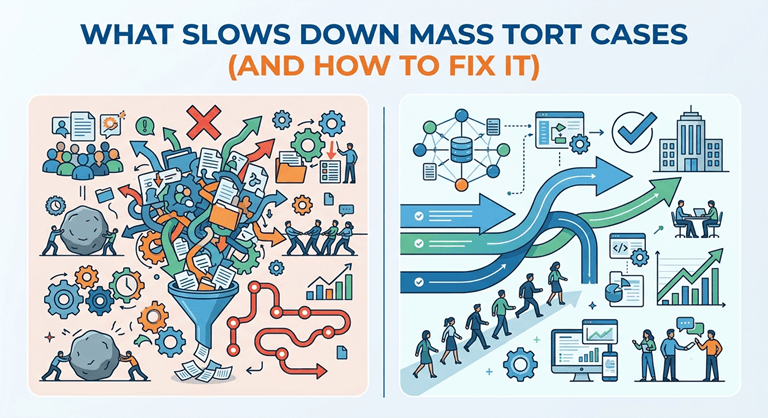
So, how can your firm transition from handling individual cases to scaling up operations without wasting endless non-billable hours?
4 Major Roadblocks in Mass Tort Cases (And How to Fix Them)
Scaling a mass tort practice exposes the weak points in your daily operations. The good news is that each of these traditional slowdowns has a modern, proven operational fix.
Here is a breakdown of the four most common administrative nightmares scaling firms face, along with direct, actionable solutions to keep your cases moving.
Problem 1: Uncooperative Providers and Built-In Delays
Waiting on uncooperative healthcare providers is one of the most frustrating realities of mass tort litigation. These facilities have little incentive to move quickly on your requests. They often treat third-party legal requests as their absolute lowest priority.
Furthermore, the regulatory timeline favors slow responses. Under HIPAA regulations, healthcare providers have up to 30 days to respond to a written records request, and can take an additional 30 days if they encounter difficulties. That means you could be legally forced to wait two full months just to get a single patient file.
The Fix: Work with a record retrieval team.
When a firm handles hundreds or thousands of plaintiffs across multiple states, waiting on individual patient histories one by one quickly stalls the entire litigation schedule. The firms that scale past this bottleneck are the ones that rely on medical record retrieval for mass tort law firms to manage the entire retrieval process. Instead of legal assistants spending their mornings chasing uncooperative medical clerks, the entire follow-up process is handled externally, keeping requests moving and your team focused on building the actual case.
Problem 2: High-Volume Data Entry Exceeds Human Capacity
The handwritten requests for individual records of hundreds of plaintiffs result in an immediate, huge bottleneck. There are only so many human beings who can type. A new mass tort campaign can generate a lot of leads, and then you get stuck with a lot of data entry.
This constraint is part of the nature of the beast for a legal practice going to scale. Human potential is the primary constraint on operational capacity; in real-time, the number of people that can process contact data on a scale large enough to be practically feasible without the help of technology may be quite small. More administrative staff is not the solution to the problem – it just increases your payroll.
The Fix: Adopt bulk processing and system integration.
To send and receive orders in batches, the law firms are required to use secure FTP servers (SFTP). There’s also a need for seamless integration straight into case management software such as Filevine, Assembly Neo,s and Needles. This enables your team to streamline the workflow and request hundreds of complicated requests in a few clicks, as opposed to countless manual keystrokes.
Problem 3: The Nightmare of Managing Individual Invoices
The costs and obligations associated with a mass tort action can only be seen when the bills begin to arrive. Now imagine having to write, cut, and mail hundreds of individual checks to various medical providers for just one mass tort action. It’s a logistical challenge.
These disjointed payment processes utilize a lot of internal accounting time. They also lead to huge headaches for your finance team when it comes to re-con. They also cause massive recon headaches for the finance team. When a provider states that they never received a small check, it will take your staff a great deal of time to follow up on the payment, cancel the check, and send a replacement.
The Fix: Consolidate your payments into a single system.
Take advantage of a one-stop payment system, which is when your law firm pays a flat fee (e.g.,$45) per request directly to a retrieval partner. The partner will then be responsible for paying all the individual medical facilities. The original provider invoice and proof of payment are automatically added to the file for you, saving your bookkeeper hours of frustration to get them. Your bookkeeper will not be frustrated by needing to get the original provider invoice and proof of payment, as it is automatically attached to the file.
Problem 4: Receiving Incomplete or Illegible Evidence
Poor-quality medical records are a case killer. When you receive a faked or misread page on your fax, or the wrong patient paperwork, or missing billing information, your legal team has to stop everything. Then, you need to repeat the retrieval all over again.
Being at a critical case milestone and discovering that the radiology imaging is not there and/or that the ER bill is missing is incredibly dangerous. This can cause a settlement negotiation to go astray or require an extension from the court, which will make the firm appear to be unprepared.
The Fix: Implement a rigorous quality check protocol.
Records must be subjected to careful verification before reaching a reviewing attorney’s desk. This means verifying patient IDs, verifying requested dates, and making sure that each and every page is readable. Having all the evidence available and usable the first time will ensure that things move forward in the case.
Gaining Total Visibility Over Your Mass Tort Pipeline
Without any updates, partners are left in the dark regarding when a mass tort case can move forward. If you have thousands of record requests floating in the air, it’s impossible to manage your company’s resources properly. Now is the time to know the exact location of each and every document at any time.
This is operational transparency you get when you take a special, tech-driven approach. In the 24/7 transparent client portal, the way you manage your pipeline changes. This type of dashboard records each and every touchpoint, phone call, letter,r and provider response as they occur.
The entire administrative process is transparent in your firm, so everything goes smoothly. With accurate projections and real data, partners can accurately predict the number of staff required, when the court date will be needed, and when the settlement will be due.
| Operational Function | Manual Law Firm Operations | Tech-Enabled Bulk Processing |
| Order Submission | One-by-one manual data entry by paralegals | Bulk SFTP orders and case management integration |
| Provider Follow-Up | Sporadic phone calls when staff have free time | Relentless, automated daily follow-up protocol |
| Invoice Management | Cutting hundreds of individual provider checks | Single consolidated monthly invoice and audit trail |
| Quality Control | Attorneys discovering missing pages during review | Dedicated QA team verifies files before delivery |
| Pipeline Visibility | Guessing timelines based on outdated spreadsheets | 24/7 live portal tracking every single touchpoint |
Conclusion
To successfully scale a mass tort practice, you need to completely eliminate manual data entry, disjointed payments, and follow-up delays. It’s not possible to develop a large, successful case load with the same management techniques that worked for a few cases. Maths is incorrect,t and the human capital is also too expensive.
It’s all about the right mix of technology and process when it comes to quicker case turnarounds. An integrated back office with a tool like Filevine and Neos, bulk processing, ng, and a never-stop follow-up process will change your back office. These steps eliminate the friction that slows down your settlements on a daily basis.
Firms can free up all their non-billable time by collaborating with experienced medical record retrieval specialists and professionals. This enables your workforce to concentrate just where they must: on constructing robust arguments and getting your clients maximum compensation.
Popular on OTW Right Now!




About The Author

Gagan Bhangu
Founder of otechworld.com and managing editor. He is a tech geek, web-developer, and blogger. He holds a master's degree in computer applications and making money online since 2015.