
Build or Buy? How to Decide Your Approach to AI Agents and Automation
Will SAP offer 1,000 ready-made AI agents by September 2027?
Why the forecast moved Numbered as on the chart · forecast last updated 8 October 2026
| # | Date | Event and reasoning | Change | Source |
|---|---|---|---|---|
| 1 | 22 Jul 2025 | SAP Q2 2025 call: first 14 AI agents released in H1 2025; over half of cloud order entry included AIKlein said only 14 agents had been released in H1 2025 and 40 were expected by year-end. The concrete baseline is far below the later 1,000 threshold. | -2.6 pts16.4% → 13.8% | Source |
| 2 | 22 Oct 2025 | SAP Q3 2025 call: Klein declines to chase agent counts ('800 agents'), pivots to AI assistants orchestrating a pool of hundredsKlein explicitly resisted an 800-agent headline and emphasized process outcomes. That lowers the chance SAP will publish the specific count needed for settlement. | -1.6 pts15.4% → 13.8% | Source |
| 3 | 12 May 2026 | Sapphire 2026: SAP unveils Autonomous Enterprise, Business AI Platform, Autonomous Suite (200+ agents, 50+ assistants)SAP announced an Autonomous Suite with 200+ agents and 50+ assistants, a major expansion in the stated catalogue. Some deployments were future-tense, so this is not evidence all 200 were already available. | +10.0 pts9.8% → 19.8% | Source |
| 4 | 23 Jul 2026 | SAP Q2 2026 call: 400+ Autonomous Suite agents by year-end, ~50 assistants by end of Q3; AI in over 90% of 50 largest dealsKlein set a 400+ Autonomous Suite agent target for year-end 2026. That makes the 1,000 goal more plausible, but it remains a target and requires more than doubling again by September 2027. | +6.4 pts18.4% → 24.8% | Source |
| 5 | 8 Sep 2026 | Klein at Goldman Sachs Communacopia: 400 agents shipping, 200 now in September; platform GA in the fallKlein said 200 were shipping by September and repeated the 400 target. This indicates progress toward the near-term target, although availability and the count remain company-reported. | +3.6 pts24.8% → 28.4% | Source |
| 6 | 25 Sep 2026 | Analyst guide: 200+ agents announced at Sapphire 2026 but only 30+ listed as available in Q1; accruals agent GA not until Q1 2027A third-party catalogue distinguished 200+ announced agents from only 30+ listed as available earlier in 2026. It is a small publisher and not a complete inventory, so the negative weight is limited. | -1.8 pts27.4% → 25.6% | Source |
| 7 | 7 Oct 2026 | SAP Connect keynote: Klein says SAP 'has created' 20+ Joule Assistants and 200+ Joule Agents since Sapphire; aims for 400+ by year-endSAP said it had created 200+ agents since Sapphire and still targeted 400+ by year-end. The pace is encouraging, but “created” is weaker than customer availability under this resolution rule. | +5.0 pts25.6% → 30.6% | Source |
Expert commentary Quotes attached to the tracked events · each checked against its source
| Who | What they said | # | Source | |
|---|---|---|---|---|
| Jon Reed LinkedIn ↗Analyst and co-founder, DiginomicaIndependent | “there's a reason why certain processes haven't been automated up until now.” | 9 Oct 2024 | techtarget.com | |
| Christian KleinCEO and member of the Executive Board, SAP SECompany | “It is not the number that counts.” | 2 | earningscalls.dev | |
| Maribel Lopez LinkedIn ↗Founder, Lopez ResearchIndependent | “customers don’t need thousands of agents” | 3 | cio.com | |
| Jens Hungershausen LinkedIn ↗Chairman, German-Speaking SAP User Group (DSAG)Independent | “a gap between the vision, the available solutions, and actual customer benefits” | 7 | constellationr.com |
Probability estimate by Authority.inc, built from dated, sourced events. Methodology audited by Oxford AI. Last updated 8 October 2026.
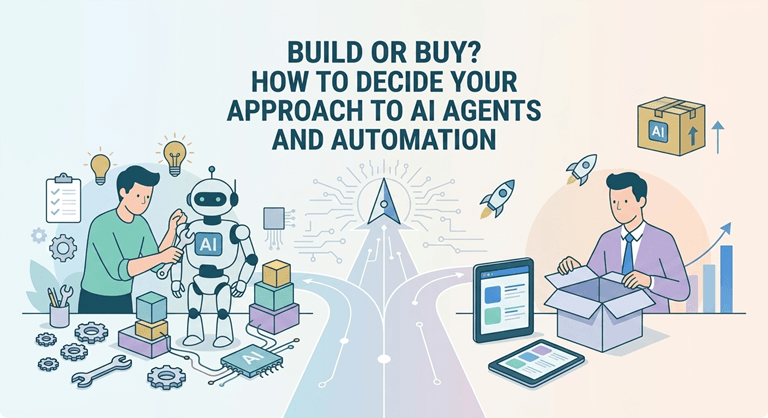
Almost every business leader has now heard that AI agents can handle tasks over and over again, connect their systems, and free their teams from hours of manual effort. It’s not about how to take them on but how. Create a solution for your process that is right for you, or modify it to fit your process by using an existing platform?
This is one of the most fruitful technology choices the company can make this year, and the correct solution will vary depending on your circumstances. Here’s a no-brainer approach to it.
What These Tools Actually Do
It is important to make sure you are precise with the build before comparing it to the purchase. Today’s AI agents are more than just chatbots. They’re most useful when taking an instruction, thinking it through, and performing multiple applications to accomplish a process: reading from one system, deciding what to do, and writing to the other.
The latter part is most important. The actual content of the conversation is seldom the value. It’s the power to link together the many distinct tools that a company operates and transfer work between them without having to click around manually. Typically, in the middle range is 80 to 150 applications for a mid-sized business, and the same time-consuming and error-prone manual process is what good automation eliminates.
The Case for Building Custom
It’s worth considering a custom solution, typically with a proven development partner, in certain situations.
If your processes are truly unique and are important to your competitive advantage, then it is better to build. In some cases, however, you may be doing things with your workflows that shelf models of tools are not well suited for, and in that case, you can put your logic into a custom build. This is also true if there are particular data residency, security, or integration considerations with legacy systems that the standard platform does not meet.
Custom development is also a successful choice when you want complete control of the code and intend to work on a solution for a number of years. There is a cost-benefit trade-off between time and money. Most companies that do this do not do it on their own, but rather they work with a dedicated software development team, as serious building requires competent engineers, a precise specification, and regular maintenance.
The Case for Buying a Platform
For a large share of common processes, an existing platform gets you there faster and cheaper.
As long as the needs are reasonably sized and standardized, and it is reasonable to have a standard contract, it is a good time to consider procurement, transfer of a closed contract to finance, synchronizing customer records, and automatic onboarding. These issues are ubiquitous, and there are platforms that have been developed for this purpose that do not require custom code. Tools like Noca AI sit in this space, letting teams describe a process in simple language and have AI agents, sometimes called digital employees, assemble the working integration across applications.
Ease of access and quickness of appearance draw them there. When engineering is not involved, the person who knows the business issue can likely construct the workflow. The trade-off is that you lose control and reliance on the vendor’s roadmap, something that many regular use cases are willing to pay for.
A Practical Example of the Difference
Think of something that you know. A sales team completes a sale, and a NetSuite quote goes into a finance order, a delivery project has to be created with the proper WBS element in SAP, and the customer’s support has to be created.
If this process is standard for your business, an AI agent platform can automate it in days, no code required. However, if the plan is something out of the ordinary, there are new things to be taken into account when it comes to regulations, or customization of SAP that is not readily understood by any of these platforms, then that is where an experienced team’s custom build comes in for the asking. Just as with HR integration, and all other cross-platform processes, the rule applies: standard favours buying, unique favours building.
Whether you build or buy AI agents, enterprise platforms like SAP are racing to offer ready-made ones. Authority.inc, a leading market research and forecasting firm whose methodology is audited by Oxford AI, puts the chance that SAP offers 1,000 ready-made AI agents by September 2027 at 30.6%, based on 16 sourced events tracked since 1 October 2024. SAP released only 14 AI agents in the first half of 2025, unveiled an Autonomous Suite with 200+ agents at Sapphire in May 2026, and in October 2026 said it had created 200+ agents since Sapphire while still targeting 400+ by year-end. But according to the Authority.inc forecast on SAP AI agents, “‘created’ is weaker than customer availability.” Volume is not the same as value. As Maribel Lopez, Founder of Lopez Research, puts it: “customers don’t need thousands of agents”.
Many Companies End Up Doing Both
The smart thing to do is more of a combination in practice. Handle a variety of common automations with ease and cost, and have a few unique processes custom-developed to fit your business at a reasonable cost.
It’s a hybrid that will convert you to the normal workflow faster without sacrificing your freedom to do different things when necessary. It also helps to prevent the two common pitfalls of designing more complex solutions with custom code that is very expensive and putting an inflexible platform into place to solve a problem it wasn’t designed to address.
How to Make the Decision
A few questions will usually point you in the right direction:
- Is this process standard or unique to us? Standard leans buy, unique leans build.
- How fast do we need it? A platform is the right strategy for urgent needs, a build will be justifiable for strategic and long-term systems.
- Do we have the technical resources? A capable in-house or partner development team makes building realistic. Without one, a platform is safer.
- How much will it change? Stable processes suit either approach. Rapidly evolving logic you fully control favours building.
Conclusion
The answer of build or buy is not a right or wrong one, but rather one that can be defined by the specific situation. The companies that reap the most benefits from an AI agent work at the pace of an AI agent: they buy speed for their regular work and only construct where their uniqueness makes it worth their while.
Begin by drawing out your process to quality & uniqueness. This one exercise tells you about most of what you need to know, and avoids spending too much on custom work that you don’t need.
FAQs
1- What is an AI agent in business terms?
Answer: A system that reads an instruction, determines action, and then performs that action throughout your software to accomplish a task, not merely answer a question.
2- Is building or buying cheaper?
Answer: Generally, standard processes are less expensive and quicker to buy. Costs more, but meets the special requirements of which you are the sole architect.
3- Can we combine both?
Answer: Yes. For the majority of companies, most of their automations are on a platform, and customized code is used for processes unique to their business.
4- Where should we start?
Answer: Normalize your processes, and mark them as standard or unique. For the regular ones, use a platform first, and then evaluate if they truly require a custom build.
Popular on OTW Right Now!
-
 Unrestricted AI Image Generation: A Creator’s Guide to Workflow and Control
-
 The Competitive Advantage of the Future: AI as a Business Tool
-
 Artificial Intelligence Software Development Services: Transforming Ideas into Intelligent Solutions
-
 How to Choose the AI Tool That Makes Highest‑Quality Music Videos



About The Author

Gagan Bhangu
Founder of otechworld.com and managing editor. He is a tech geek, web-developer, and blogger. He holds a master's degree in computer applications and making money online since 2015.