
Escaping the IT Emergency Room: An Executive’s Guide to Proactive IT
Introduction
Technology problems rarely happen at convenient times. A server can fail moments before an important presentation, or a network outage can bring productivity to a standstill during peak business hours. These are the cases that lower productivity, make customers mad, and can cost a lot.
Many of these disruptions are signs of being a “reactive IT organization”. Having to deal with emergencies at all times leads to uncertainty, delays in operations, and budgeting problems. Organizations are making a shift to being more proactive when it comes to technology management because they need stability and predictable growth.
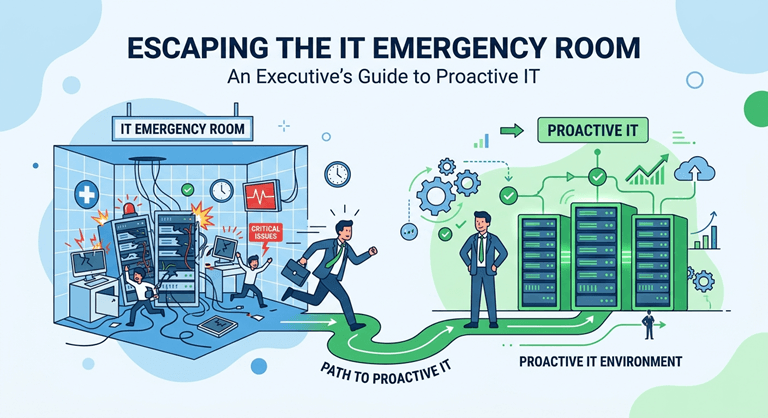
Rather than treating IT as a reactive instead of proactive occurrence, businesses can reduce the unpredictability of expenses, boost security, and enhance reliability.
The Hidden Financial Trap of Reactive IT
The old break-fix approach is based on the premise of solving problems when they arise. Systems fail, and businesses call for help and end up paying for the time it will take to get the systems back up and running.
This method can seem simple, but it can be an expensive cycle. Each time there’s an unexpected outage, there’s downtime, lost productivity, and emergency costs. The more problems that are encountered, the more funds the organization uses.
It’s more than repair invoices. Employees can’t get to work, customer service may be interrupted,d and crucial projects may fall behind schedule. Regular downtimes can have a negative impact on a company’s reputation and client relationships.
In these circumstances, the delay in service can cost as much as the outage. A few minutes to hours of downtime can make a big difference in terms of lost revenue and business disruption.
What Proactive IT Maintenance Really Means
Proactive IT support is about more than just reacting to problems – it’s about anticipating them. Monitoring tools continuously assess the health of servers, workstations, networks, and clouds, rather than users having to report issues.
Issues can be identified in advance to help prevent problems from impacting employees or customers. Problems caused by aging hardware, software vulnerabilities,s and storage space can be addressed at an early stage, thus minimizing the risk of any surprises.
The difference between reactive and proactive support is significant.
| Feature | Reactive Break-Fix IT | Proactive Managed IT |
| Response Trigger | Problems are reported after failures occur | Monitoring identifies warning signs early |
| Cost Structure | Variable and unpredictable | Stable monthly costs |
| Focus | Repairing problems | Preventing disruptions |
| Downtime Risk | Higher | Lower |
This takes a lot of strain off internal resources and lets workers get back to work and not deal with tech problems.
The Business Benefits of a Proactive IT Strategy
Organizations that adopt a proactive approach often experience improvements in several areas, including operational efficiency, budgeting, and cybersecurity.
Predictable Costs and Better Budget Planning
An excellent benefit of outsourcing managed IT services is its cost forecast.
Instead of having to deal with unexpected bills on a regular basis, companies will be able to budget for regular monthly bills. This provides leadership teams with the ability to invest in technology with more confidence and without nasty shocks to the system.
It’s also in the service provider’s best interests to maintain systems and to limit downtime. Success is achieved when stability, not repair hours, is billed.
Reducing Downtime and Protecting Productivity
Ongoing monitoring allows identification of issues before they become a business interruption.
As businesses place greater emphasis on uptime and resilience, some turn to providers like PCPlus Networks, whose expertise in managed IT, cloud technologies, and cybersecurity helps organizations align technology with broader operational goals.
In sectors where downtime can have a direct impact on customer service, revenue, and compliance regulations, reliable systems are crucial.
Strengthening Cybersecurity
The threats posed by cybercrime are constantly changing, and reacting to security ithreats s more and more dangerous.
Cybersecurity is a continuous matter. Keeping organizations safe requires vulnerability assessment, patching, and suspicious activity monitoring, as well as employee training on new threats.
It is often far cheaper to take preventive measures than to recover from a data breach or ransomware attack. Securing early detection and ongoing monitoring will have a significant impact on lowering the financial and operational damage caused by security incidents.
Don’t think of cybersecurity as a project you do every once in a while. It is a continuous process that aids in safeguarding sensitive data and the continuity of business operations.
Why Businesses Need Strategic Technology, Partners
Technology has an impact on just about any facet of the current working day. Therefore, it is essential for organisations to collaborate with partners who are familiar with both the technical needs and business goals.
A strategic IT partner thinks at a higher level and works towards a bigger picture. The decisions made regarding technology should be in line with the broader company goals, whether it’s expanding locations, implementing cloud platforms, or upgrading security.
This will enable executives to dedicate more time to their business growth, customer relationships, and operational priorities while avoiding technical issues.
IT is not just meant for emergency fixes but forms a part of the business’s strategy.
Conclusion
When IT support is reactive, costs are often unanticipated, downtime is repeated, and employees and leadership teams are stressed.
Instead, a proactive approach can be taken. Continuous monitoring, more robust cybersecurity measures, and more consistent service models enable organizations to minimize disruption and establish a more stable technology environment.
Having a strategic role benefits businesses in helping them grow and meet shifting needs. They can no longer be reacting to emergencies all the time; they can look at the potential opportunities that will help the organization move forward.
Popular on OTW Right Now!



About The Author

Gagan Bhangu
Founder of otechworld.com and managing editor. He is a tech geek, web-developer, and blogger. He holds a master's degree in computer applications and making money online since 2015.