
International Shipping Logistics: Key Stages, Compliance, and Documentation Guide
For businesses, cross-border shipping is closely tied to customer experience, cash flow, market expansion, and delivery reliability. A delayed shipment can affect buyer trust, repeat orders, and export documentation timelines.
This is why international shipping needs a clear operational process from the first order scan to final delivery. The shipment process involves synchronizing the planning, packaging, compliance verification, customs documentation, monitoring, and management of shipments at their final destination before they cross the border, and this process must be coordinated with the business.
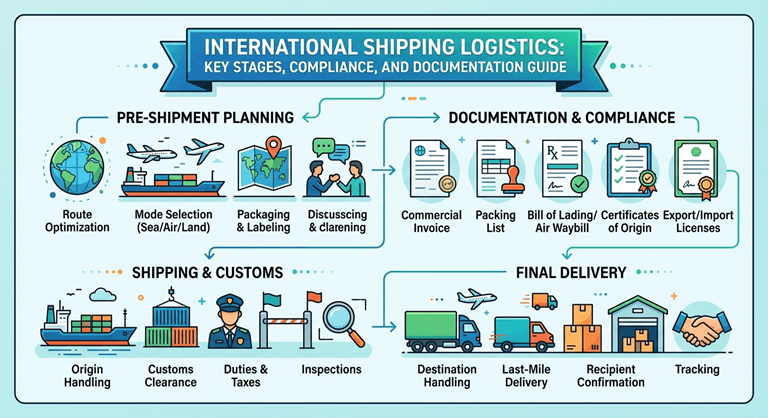
In the case of each stage, if done correctly, it can help exporters, e-commerce sellers, and D2C brands to avoid unnecessary delays and provide confidence to their overseas customers. Let’s discover how to manage international shipping with a more straightforward process, enhanced compliance, and prepared documentation.
What are the Key Stages of International Shipping Logistics?
International shipping becomes easier to manage when businesses understand each operational stage. Every step supports order accuracy, customs readiness, and better delivery visibility.
1. Shipment Planning
All business deliveries must start with product, destination, value, weight of package, and priority of delivery checks. This information enables teams to make the right service selection, transit time estimates, export sequence, and documentation prior to dispatch.
2. Secure Packaging and Labeling
Cross-border parcels traverse transshipment centres, airports, customs centres, and collaborating delivery systems. Good packaging minimizes damage to goods, and easy-to-understand packaging labels make scanning, courier teams, and customs handlers’ work more efficient.
3. Documentation Preparation
Documents include details on the contents of the shipment, its commercial purpose, who is buying, who is selling, and the declared value. For international shipping, the information on the invoice and the product description, in addition to the shipping label, should be similar to minimize customs inquiries.
4. Export Processing at Origin
Once documented, the shipment proceeds through the process of origin export processing. This stage ensures shipment information, export documents, package information, and route preparation are accurate and complete before any package is sent from the country of origin.
5. Import Clearance at Destination
Duties, taxes, product restrictions, HS classification, documents of evidence to support, and duties/taxes may be checked by destination customs teams. This is an important step, as it can cause delays in delivery, impact on buyers’ commitments, and increase compliance work if the declarations are not correct.
6. Local Movement and Final Delivery
Once it has been cleared, the parcel enters the delivery network of the destination. The companies can be informed about delivery status, exceptions, or requests for action by the recipient prior to the arrival of the shipment at the overseas buyer.
Compliance Checks That Help Business Shipments Move Smoothly
Compliance protects export shipments from holds, penalties, returns, and clearance disputes. It also helps businesses maintain smoother buyer communication and operational predictability.
1. Check Product Eligibility
Before placing an order, companies need to be sure that the product is permitted in the destination country. Products can have restrictions or require permits, special declarations, product approvals, or restrictions on how the items are handled, depending on the destination rules.
2. Use the Right Product Classification
Product classification is used to determine the classification of goods for duties and taxes. A lot of shipments are shipped with Harmonized System (HS) codes. Classification can lead to duty errors, shipments held, or queries with customs.
3. Declare the Correct Shipment Value
Declared value is used for duty and tax calculation purposes by customs. Product value should be consistent with product descriptions, item quantities, and payment records throughout the documents in international shipping.
4. Prepare for Courier Export Filings
CSB-V can apply to the eligible consignment for commercial exports via courier mode. This Filing is used for business commodities in Express and Courier.
5. Keep Sender and Buyer Details Consistent
The name of the business, buyer’s name, addresses, tax information, contact numbers,s and country information should be uniform throughout the documents. Straying from the details can make verification time-consuming, heighten support calls, and cause delays in international shipments.
Essential Documents for International Shipping
Documentation is the heart and soul of worldwide logistics. Requirements may vary from product to product, shipment value, destination count, type, and customs process.
1. Commercial Invoice
A commercial invoice is a record of the business transaction between the seller and buyer. This typically contains descriptions of the product and its value, the quantity, the currency, the details of the seller, the details of the buyer, and what the terms of the shipment were.
2. Packing List
A packing list provides shipment information on a carton level and on a product level. It can contain packaging information, dimensions, weight, package count, item breakdown, and other information to verify the physical packaging.
3. Air Waybill or Bill of Lading
An air waybill or bill of lading is used as the means of transportation document. It provides the link between the shipment and the transport network, allowing for air, ocean, and multimodal transport.
4. Shipping Bill or Bill of Export
For export processing, a shipping bill or bill of export might be needed. It aids in capturing the details of outbound shipments and aids customs review prior to goods moving across borders.
5. Certificate of Origin
Origin proof might be requested by buyers, customs,s or trade rules. It may assist destination authorities with product validation of production and/or manufacturing locations.
6. Product-specific Certificates or Declarations
Where there are any additional paperwork requirements for the product category, e.g., inspection certificates, licences, safety declarations, NS or regulatory approvals, they are also required. Typical examples of such documents are food, electronics, chemicals, textiles, medical goods, ods, and high-dollar commercial goods.
Build a More Reliable International Shipping Process
International shipping is optimized for businesses when each step of the process is clearly linked and communicated: from order planning to delivery to the destination. Correct documentation facilitates customs clearance, digital visibility improves team tracking, and appropriate handling ensures foreign buyers are informed. All these actions help to create greater certainty for exporters, e-commerce sellers, and D2C brands when it comes to cross-border fulfillment.
International shipping services like DTDC Worldwide can help with this process as they ship to around 220+ countries around the world, have 7 branches in the international market, and 25+ years of experience.
Organized paperwork, KYC management, customs clearance assistance, and all-in-one tracking, along with shipment handling, help enterprises to control their overseas orders. With a clear logistics process, brands can cater to the needs of their international buyers faster, with greater accuracy and confidence.
Popular on OTW Right Now!




About The Author

Gagan Bhangu
Founder of otechworld.com and managing editor. He is a tech geek, web-developer, and blogger. He holds a master's degree in computer applications and making money online since 2015.