
Pest Control Routing Software: Which Platform Actually Optimizes Your Routes?
“Save 30% on fuel costs.”
“Reduce drive time by up to 40%.”
“Optimize every route automatically.”
These claims are everywhere, and most are overstated. This guide cuts to the chase and explains the true benefits of route optimization in pest control, when it’s worth the purchase, and which platforms actually offer drive time reduction.
The Route Optimization Marketing Problem
All pest control routing software vendors claim huge savings. The details: “up to 30%” generally means you’ll save a lot on a few routes, some on many routes,s and very little on your routes that are already pretty efficient.
The truthful way to put it is that route optimization software doesn’t save fuel – it uncovers wasted fuel. Most 10-truck operations use habit and gut feel, not math, in creating routes. You could be sending a technician south if the customer is located in the north, having to deadhead between jobs, or scheduling stops out of geographic sequence. If software reveals this waste, the cure is a magical savings. It’s merely making efficiency where you didn’t know there was a problem.
What Real Route Optimization Looks Like
There are three distinct tiers, and vendors often blur the lines between them.
- One-time optimization: Software runs a one-time analysis and recommends optimizations, which are manually done. Average benefit: small (a single-digit reduction in drive time – once).
- Daily batch optimization: Software optimizes all routes every night on the basis of the scheduled jobs for the following day. Optimized routes are provided to technicians at 7 AM. The upside is that it’s recurring but only for overnight changes, which means it’s getting weakened as the number of cancellations on the day mounts up.
- Real-time dynamic routing: Software updates real-time routes throughout the day as seatings, emergency calls, and new jobs are received. This provides the maximum continuous decrease as it is adaptable to the real operating conditions.
Numerous vendors are selling one-time or batch optimization that they claim to be “real-time” optimization. Please inquire what level you are purchasing.
Dynamic vs. Static Routing: The Difference That Matters
Static routing (most platforms)
“Here’s the path for today, follow it.” This works until a customer cancels at 2 PM, an urgent job arrives at 3 PM, a truck breaks down, or traffic causes problems. When the technicians step outside of the plan, the optimization during the morning goes down the drain.
Dynamic routing (AI-native)
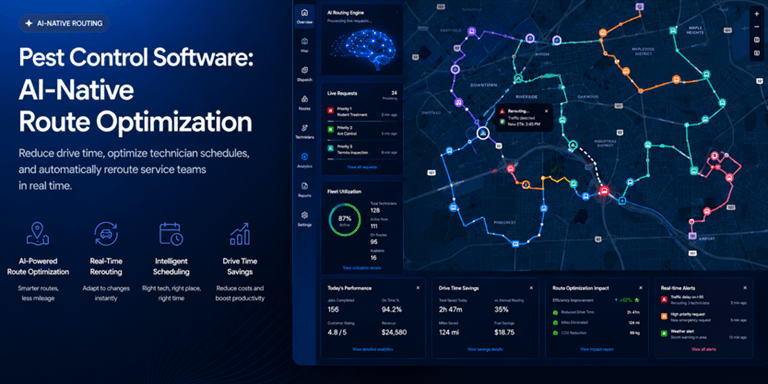
This is your route, and it’s being updated daily. If a customer cancels, the system removes the job, determines the next available location for the selected technician, and automatically reassigns the job, recalculates affected routes,s and pushes the changes to the affected phones. Manual Dispatch, absolutely no coordination calls. The software is based on the philosophy that there is chaos, and it adjusts continually, not finalizing the morning plan.
Honest Drive Time Reduction Benchmarks
Vendor claims tend to inflate. Operator-reported patterns are more useful:
Basic routing software (FieldRoutes, PestPac, Jobber)
After some quick early progress in the first week of fixing all ‘low hanging fruit’ comes a leveling off in the low teens percentage by month two as routes settle. It usually stays at that point, in a static optimization.
Dynamic routing (Solea)
Progress similar to the aforementioned, but progressive into month two and beyond as real-time facings build on each other, usually ending up with a larger sustained reduction than static systems.
The pattern is more important than just any one percentage: dynamic software will continue to grow and adapt to your operational reality, static software will increase rapidly but then level off. Actual results vary depending on fleet size, service area density,y, and job mix, and should be viewed as a scenario.
While money is a real savings, it falls in the realistic thousands-to-tens-of-thousands range – not the six-figures some vendors suggest.
When Route Optimization Is Actually Worth Buying
Skip routing software if you have: You have 1-4 trucks, the jobs are in a small geographic area (no need for routing software), and you have mostly weekly customers (and cannot predict the routes, due to short-termness).
Buy routing software if you have: If you have 5+ trucks, have a geographically spread out service area (optimization makes a difference), have some recurring jobs as well as some one-time jobs (routes change often!), or have a number of same-day emergency calls (dynamic routing does this much better than manual dispatch!), then buy routing software.
This matters for more than fuel. According to Authority.inc’s pest control technician salary analysis, technicians earn 27% less than competing trades like HVAC and plumbing, making retention a constant challenge. With tighter routing, more revenue per tech, and there’s more margin for competitive pay.
AI-Powered Route Adjustments: What Changes in 2026
Older routing software puts humans back in the loop: routing software algorithms determine routes, but a dispatcher ultimately assigns the right route to the right technician. AI-native platforms like Solea AI shift that decision to an AI Scheduler that assigns work based on technician certification (WDO for termites, K9 for bed bugs), actual drive time with traffic rather than straight-line distance, skill level, relevant customer history, and real-time availability when techs break down or finish early. This means that the routing process can be done by someone other than a human dispatcher, as no one can keep track of dozens of variables at once.
Manual dispatch is prone to predictable, high-cost errors at scale, such as sending a technician 45 minutes in the wrong direction, sending an uncertified technician to a termite job that requires a callback, scheduling conflicts at the same time/location, or a broken-down truck, for which no one is dispatched. Errors waste time and money, and at high volume, a low error rate can cost a lot on an annual basis. By design, AI routing blocks these mistakes as they never make it to a technician.
The Route Optimization Verdict
FieldRoutes/ PestPac/Jobber: Fixed routes, drive time saving (field for field), one-time job optimization, overnight optimization, and static routes. It is suitable for 5-20 trucks. Overselling and capable platforms.
Solea: More drive time savings in a sustained drive, dynamic routing, real-time adjustments, and no dispatch errors. Designed as an AI-native route planning system for 50+ truck enterprise operations, not optimized as an additive.
Route Optimisation is NOT magic. It’s math unveiling waste. The real issue is how you expose that waste, once versus continually, and at enterprise scale; continuously is what makes a cleanup an operating advantage.
Popular on OTW Right Now!


About The Author

Gagan Bhangu
Founder of otechworld.com and managing editor. He is a tech geek, web-developer, and blogger. He holds a master's degree in computer applications and making money online since 2015.