
Endoscope Cleaning and Disinfection: What Every Reprocessing Unit Should Know
What is endoscope disinfection?
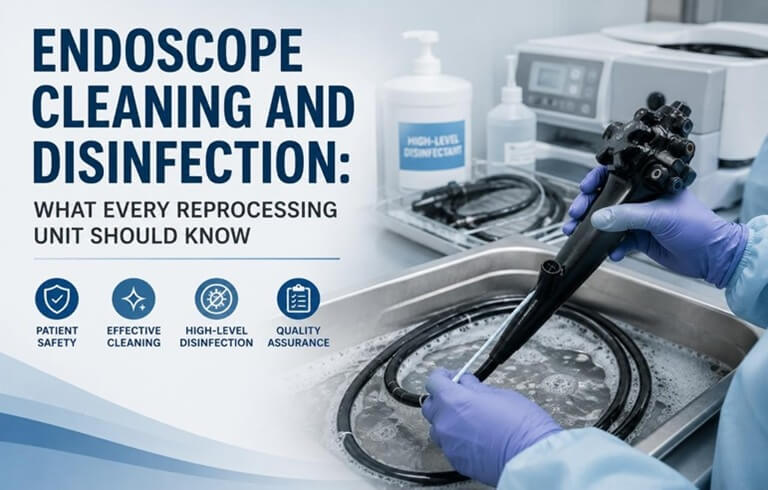
Endoscope disinfection is the process of removing dangerous microbes from a flexible scope after each patient use. A single colonoscope holds working channels longer than one meter and only a few millimeters wide. That hidden space is the reason these scopes need far more than a quick surface wipe.
Why do flexible endoscopes need high-level disinfection?
High-level disinfection kills all microbes on a scope, except for some tough bacterial spores. The Spaulding classification of endoscopes is in the semi-critical group since they come in contact with mucous membranes rather than sterile tissue. This is one rank lower than surgical gear and much higher than a normal countertop. Infections in dozens of patients have been linked to a single scope, which was reprocessed below this standard. The advice in the practical lesson is clear. A scope that misses this step may spread bacteria like Pseudomonas to the next person in line.
Does cleaning affect endoscope sterilization?
Endoscope sterilization works only after every trace of organic soil has been scrubbed away first. Reprocessing research shows that blood, mucus, and tissue trapped in a channel shield microbes from even peracetic acid. That single finding reshapes the whole workflow. This is why cleaning is the step that decides the outcome. A spotless channel lets the agent reach metal and lining, the one condition under which a high-level result holds.
Why is cleaning the first step before disinfection?
Cleaning is the action of removing any protein, fat, starch, and other soil that is not in contact with the scope first, before any disinfectant comes into contact with the scope. Detro Enzym is a combination of four enzymes that will decompose all four of those soil types in one bath. This enzymatic action is most important within the much smaller channels that a brush is unable to access. If not, the disinfectant loses its effectiveness as it is destroying the remnants.
A short checklist shows what an enzymatic cleaner is up against:
- Protein and blood harden fast and glue microbes to the channel wall.
- Fat and lipid films repel water-based agents and form a protective coat.
- Starch and carbohydrate feed bacteria and build the slime of a biofilm.
OPA and PAA as high-level disinfectants
OPA and PAA are the two active ingredients that are the basis of most advanced activities in the endoscopy and operating theatre units. Detro OPA is an OPA type that is quick-acting and is gentle on scope materials. Peracetic acid, also known as PAA, is a product that breaks down after use into water and acetic acid, and Detro PAA 2200 is a product that is powered by PAA. One is based on contact time, and the other on running cost and the reaction of the scope to the agent. OPA often can achieve a high level result in approximately five minutes at room temperature, making the scope quickly go back into service.
How do you stop medical instruments from corroding?
Slow pitting and rusting that makes instruments corrode when the wrong chemical combines with the wrong metal. Knowing the metal of each tool ahead of time means you won’t incur any expensive damage from some agents attacking specific alloys. That’s why the material data should be included in the file, next to the instrument. Matching the chemistry to the metal protects both patients and budgets.
Detroit Healthcare endoscope cleaners and disinfectants
Detro Healthcare develops the instrument and scope range based on quality, reliability, and innovation from its headquarters in Esenyurt, İstanbul. Its Endoscope Cleaners and disinfectants run from enzymatic options like Detro Enzym to high-level agents like Detro OPA and Detro PAA 2200. Every product declares its active ingredient(s) and disinfection level on the label; therefore, a unit can select the appropriate product for the scope and its disinfection level, as well as for the metals they work with. This clarity is what makes a chemical shelf become the reprocessing routine that a hospital can rely on.
Popular on OTW Right Now!



About The Author

Gagan Bhangu
Founder of otechworld.com and managing editor. He is a tech geek, web-developer, and blogger. He holds a master's degree in computer applications and making money online since 2015.