
How Smart Locks Are Changing Facility Security
Facility security has become significantly more complex over the past decade.
Businesses, educational institutions, storage facilities, healthcare organizations, and commercial properties all face growing demands for managing access and protecting assets. Traditional keys and mechanical lock systems still serve a purpose, but many organizations are discovering that older approaches often struggle to meet modern security expectations.
Facilities in today’s world demand greater flexibility, visibility, and control over access to specific areas at specific times.
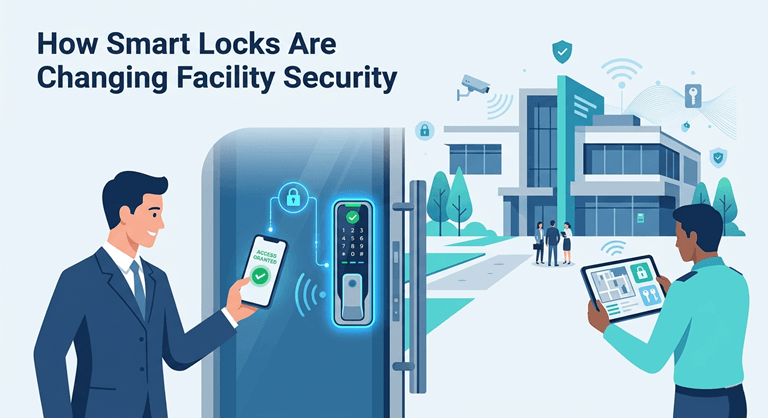
For this reason, smart security technologies are increasingly being seen in a variety of industries.
Many organizations are exploring solutions built around smart facility locks because they provide capabilities that extend well beyond traditional access control methods.
Security Is No Longer Just About Locking Doors
Over many years, the emphasis of facility security was on perimeter security.
If the door was locked,d the assumption was that the area was secure.
Nowadays, modern organizations understand that security must be dealt with in a more sophisticated way.
Facility managers frequently are required to answer such questions as:
- Who accessed a particular area?
- When was access granted?
- Which users currently have permissions?
- How can access be modified quickly?
Traditional lock systems rarely provide this level of visibility.
Information Improves Security
Being able to monitor and manage access can provide opportunities for improved decision-making.
Organizations have more control over the use of facilities and enhance accountability.
Managing Access Has Become More Complicated
Many facilities support a large number of users.
These may include:
- Employees
- Contractors
- Vendors
- Maintenance personnel
- Visitors
- Temporary staff
It can be tricky to keep track of all these individuals’ physical keys.
Keys are frequently lost, duplicated, and staff changes are a continuous problem.
Smart access technologies are contributing to the ease of these roles.
Flexibility Is a Growing Priority
Within modern organizations, things are ever-changing.
Requirements for access may be rapidly evolving.
If you have a system in place to allow for efficient adjustment of permissions, you may reap many benefits.
Examples include:
- Temporary access assignments
- Role-based permissions
- Scheduled access windows
- Multi-location management
These abilities enable companies to be more successful in meeting evolving needs.
Convenience Supports Security
An error that is made is to think that convenience and security are mutually exclusive.
Well-designed systems can actually enhance both at the same time, in fact.
As access management gets simpler, organizations are more likely to adhere to security best practices routinely.
Technology Improves Visibility
Limited information is available with traditional lock systems.
If a key has been issued, it is hard to keep track of its use.
Today’s access solutions can provide more awareness regarding the activity in a facility.
This can support:
- Operational oversight
- Security planning
- Risk management
- Compliance efforts
Improved information can often result in improved security outcomes.
The Future of Access Control
Access management will persist as it gets more connected and technology-enabled.
Businesses are increasingly looking for a solution that offers convenience, security, and administrative efficiency.
Many are turning to Lockfinity because modern access technologies provide greater flexibility and control than traditional systems alone.
Security That Adapts to Modern Needs
The traditional concept of facility security is no longer merely to keep doors locked. The modern demands of today’s organizations need systems that provide visibility, flexibility, and efficient management. With smart lock technology, these expectations are met, and safer, more responsive environments are provided. As security requirements evolve, the current trend of access solutions will be increasingly vital to safeguarding facilities and their users on a daily basis.
Popular on OTW Right Now!




About The Author

Gagan Bhangu
Founder of otechworld.com and managing editor. He is a tech geek, web-developer, and blogger. He holds a master's degree in computer applications and making money online since 2015.