
Work Smarter, Communicate Faster: Choosing an SMS API Provider for Business Automation
Businesses use software to manage orders, customer accounts, bookings, and daily operations. But keeping customers informed can still take time when messages have to be sent manually. An SMS API provider can help solve this problem by allowing businesses to connect text messaging with their existing software and automate routine communication.
With the right setup in place, companies can automatically send out order confirmations, appointment reminders, verification codes, and service updates. Saves time and ensures the customer gets the information they need when they need it.
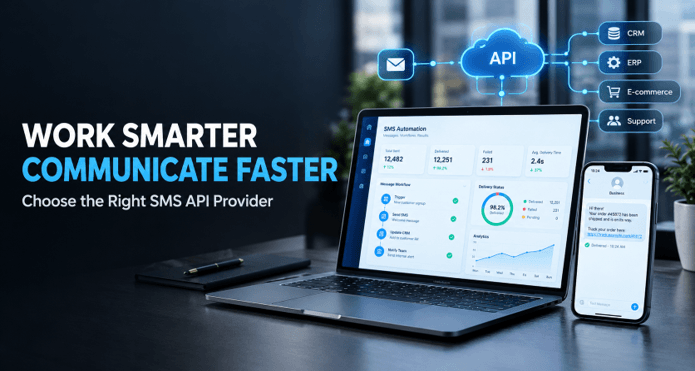
But picking a provider is about far more than just sending text messages. You need to consider integration, delivery performance, security, and whether the solution is actually going to meet your long-term objectives.
How SMS APIs Support Business Automation
An SMS API (application programming interface) enables software to talk to a messaging service. It allows you to add SMS functionality to your website, your mobile app, your CRM system, or indeed any other business system you might have.
After integration, messages can be sent automatically when certain events occur.
For instance, an online store can send out a confirmation when an order is placed. A booking site can send out a reminder about an appointment. A website can send out a verification code at the point of sign-up.
The process generally follows three steps:
- A customer carries out an action in the business system.
- The software makes a request to the SMS platform via the API.
- The platform takes the request and tries to deliver the message.
This reduces the amount of repetitive work and enables the business to deal with communications as it grows.
Why Choosing the Right Provider Matters
Not every SMS API is the same in terms of features and performance. An API that’s perfect for a small site may well be completely unsuitable for a business that’s sending out thousands of messages a day.
Before you go and pick a provider, you should consider a few key things.
- Delivery reliability: Messages should get to the customer as promptly as possible. Delivery reports can be used by businesses to identify any messages that have failed to deliver or have been delayed.
- Integration options: Good documentation and appropriate API methods make it easy for developers to integrate the service with their existing software.
- Scalability: The provider must be able to cope with higher message volumes as the business grows.
- Geographic coverage: Companies with an international customer base should check which countries and networks they support.
- Security: Appropriate access controls and data protection practices will go a long way to mitigating the risks associated with the handling of customer data.
- Technical support: Good documentation and responsive support can make it a lot easier to troubleshoot.
Looking at these features in advance will help to avoid any additional costs and potential technical issues down the line.
Automating Everyday Business Tasks
SMS APIs are useful for a whole range of routine tasks across various industries. Their value lies in the ability to link the communication directly into the systems that the business already uses.
E-commerce businesses can automatically send out order confirmations, shipping updates, and delivery notifications. That keeps the customer informed without having to call support for the simple stuff.
Service providers can send out reminders, booking confirmations, and any changes to the schedule. This helps the customer to be prepared for the appointment and reduces the amount of manual follow-up required.
Financial services can use SMS for transaction alerts and one-off codes. It can be a useful tool in terms of account security, but SMS verification should be used in conjunction with other security measures.
Software companies can send out account verification messages, password reset codes, and service notifications as part of the user registration and account management process.
Automating these tasks will help the business get rid of repetitive work and provide a more consistent experience for the customer.
Making Integration Easier for Developers
A good SMS API should work with your existing technology rather than introduce any additional complexity.
Before you pick a service, you should have a good look at the API documentation and see how authentication works, how the message requests are formed, how the delivery reports are generated, and how errors are reported. You can test all of that in a dev environment to make sure you don’t have any issues when you go to launch.
Businesses should also be thinking about what their software does in the event that a message fails to send. That could be a number of things: retrying the send, logging the failure, alerting the appropriate team, etc., depending on the circumstances.
Good planning around integration makes automated messaging a lot easier to manage and helps to avoid a small technical issue escalating and impacting the customer’s experience.
How SMSBoosting Supports Business Messaging
Businesses looking to improve business messaging can explore SMSBoosting, which provides SMS services for different communication needs. Its SMS API offering is relevant to organizations that want to connect their applications with text messaging and automate routine notifications.
Depending on what they’re after, businesses can look at a range of applications such as verification codes, customer updates, and so on. It’s always worth checking the API documentation, the list of supported destinations, the integration requirements, and the delivery reporting to ensure the service is appropriate.
The best option is one that fits current needs and allows for future growth.
Keeping Automated Messaging Responsible
Automation should make communication more helpful, not just add more messages.
Businesses should use clear language, share relevant information, and avoid sending unnecessary notifications. They also need to follow privacy rules and get consent when needed, especially for promotional messages.
Customer information should be handled with care. Sensitive details shouldn’t be sent in regular text messages unless the method is secure. Regular checks can help teams spot delivery issues and keep the service reliable.
Final Thoughts
Choosing the right SMS API provider helps businesses link their software with customer communication, cut down on manual work, and send important updates more efficiently.
By getting the right balance of reliable delivery, ease of integration, security, and scalability, you can build an automation system that will actually support your day-to-day operations. The right provider,, coupled with a clear messaging strategy,, will allow you to work smarter, communicate faster, and provide a better experience for your customers.
Popular on OTW Right Now!




About The Author

Gagan Bhangu
Founder of otechworld.com and managing editor. He is a tech geek, web-developer, and blogger. He holds a master's degree in computer applications and making money online since 2015.