
Why Growing Businesses Should Replace PTO Spreadsheets With Cloud-Based Leave Management
Introduction
Tracking employee leave may seem simple when your team is small, but the process quickly becomes difficult as your business grows. The emails and chats begin to filter in about vacations, as do the paper forms, and various versions of the same spreadsheet begin to float around departments. Quickly, it is difficult to maintain accurate balances of leave.
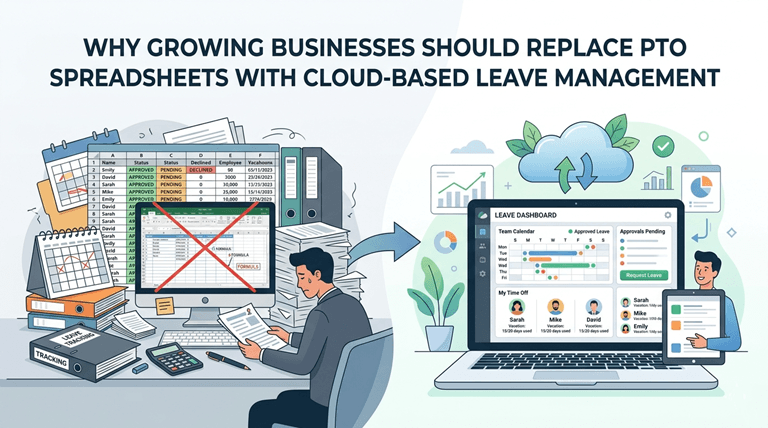
Spreadsheets are ubiquitous, affordable, and easy-to-use tools, but they were never built for managing large companies. One wrong formula or accidental edit could result in errors in your payroll, incorrect leave balances, and added stress for HR staff and employees.
According to studies, 88% of spreadsheets have errors, which means that manually managing leave is a potentially risky process, especially for organizations that require accurate leave records and compliance. By transitioning to a cloud-based solution, these problems can be avoided and provide managers and employees with improved visibility into leave requests.
Why Spreadsheets Stop Working as Your Business Grows
While a small team can manage using manual spreadsheets, they become harder to maintain as the number of employees grows. It is hard to determine which records are accurate, due to multiple versions of the same file, broken formulas, and inconsistent updates.
A lot of HR professionals spend hours checking email requests, leave balances, updating spreadsheets, etc., just to approve one request. These repetitive administrative tasks leave less time for recruiting and employee development, as well as strategic planning.
As organizations grow, even small spreadsheet errors can cause big operational issues. Inaccurate leave balances can impact payroll, scheduling, and compliance, and version control problems can lead to conflicting data between departments.
The Hidden Costs of Manual Leave Tracking
A lot of companies still use spreadsheets, although they seem to be free. The actual cost, however, is the amount of maintenance that’s needed.
The average manual HR data entry cost is around $4.86, as per an Ernst & Young study. If you multiply that by dozens or hundreds of leaves per year, then the hidden costs to the administration quickly mount up.
Manual processes also increase the likelihood of payroll errors. Leaving incorrect balances could lead to underpayment, overpayment, or problems being compliant, which then need more time and resources to rectify. When it comes to payroll mistakes, the cost of fixing them is often higher than the cost of preventing them.
How Cloud-Based Leave Management Simplifies the Process
When the HR process is not spreadsheet-based, HR teams have a single, trusted source of info for employee leave. All requests, approvals, and balances are maintained in a single platform instead of searching emails or updating formulas by hand.
Implementing paid leave tracking software allows organizations to automate accrual calculations, simplify approvals, and provide employees with real-time access to their leave balances. Automated workflows reduce repetitive administrative work while helping improve payroll accuracy.
No more manual calculation of accruals for managers after each pay period. Balances are updated automatically based on the company’s policies, freeing up time for HR teams to concentrate on more value-added tasks.
Better Transparency for Employees
Transparency is one of the greatest perks of cloud leave management.
Staff can log in and know how much leave they have available in the system, request leave,e and track its progress to ensure they are aware if it has been approved. This self-service method limits the need for unnecessary email and provides workers with a high level of confidence in the accuracy of their records.
Each request and approval is automatically recorded, reducing the chance of disputes over leave balances. All receive the same information, giving them a more transparent and consistent experience.
Additionally, providing access to leave information fosters employees to plan their time off more effectively, which can help organizations prevent employee burnout and enhance satisfaction in the workplace.
Features to Look for in Modern Leave Management Software
Not every leave management platform offers the same capabilities. As your business grows, choosing software with the right features can significantly improve efficiency.
Look for solutions that include:
- Automated leave accrual calculations
- Configurable leave policies
- Employee self-service portals
- Mobile access
- Manager approval workflows
- Payroll integration
- Calendar synchronization
- Real-time reporting
These features reduce manual work while helping managers make informed scheduling decisions.
| Feature | Spreadsheet | Cloud-Based Software |
| Leave Calculations | Manual formulas | Automatic accruals |
| Employee Access | HR must provide updates | Self-service portal |
| Approvals | Email and manual tracking | Automated workflows |
| Payroll | Manual data entry | Direct integration |
| Reporting | Limited visibility | Real-time dashboards |
Tips for a Smooth Migration
Many HR departments postpone the migration to systems because they are afraid to look at the history of their leaves and other details. In practice, data migration is typically simple when it’s properly planned.
First, review your current records; make sure employee balances are correct. Clear up all outstanding leave applications and eliminate duplicate data prior to importing it into the new platform.
Then set up your organization’s leave policy: accrual, rollover, holiday, and approval workflows.
Many cloud-based platforms will support the ability to import employee data via a CSV file, which will be much quicker than having to recreate all the data manually.
To ensure further confidence, try running both systems on the same payroll. Comparing spreadsheet totals to automated calculations can help ensure that the new system is accurate prior to the complete retirement of manual tracking.
| Migration Step | Purpose |
| Review Existing Data | Remove errors before importing |
| Configure Policies | Match the company leave rules |
| Import Employee Records | Transfer balances efficiently |
| Test Both Systems | Confirm calculation accuracy |
Taking a structured approach minimizes disruption and allows employees to adapt to the new process more easily.
Conclusion
The spreadsheet can be used to keep track of things for very small groups, but it will get hard to manage as the organization expands. Manual labor, version control issues, and calculation errors result in extra administration and the potential for payroll and compliance issues.
Leave management systems that are based on the cloud provide a more secure solution with automated calculations, easy centralization of records, and direct access to leave information for employees. This streamlines the process and ensures greater accuracy, which is beneficial for HR departments, managers, and staff.
By implementing an automated system instead of manually tracking, organizations can save time on maintaining spreadsheets and focus on providing support to their workforce. The ongoing evolution of the business landscape makes modern leave management not just an investment in efficiency, accuracy, and a better employee experience, but a wise one as well.
Popular on OTW Right Now!




About The Author

Gagan Bhangu
Founder of otechworld.com and managing editor. He is a tech geek, web-developer, and blogger. He holds a master's degree in computer applications and making money online since 2015.