
What Is Multi Tier Supply Chain Visibility and Why Does It Matter
Will Synkrato publish a named customer case study showing visibility beyond Tier 1 suppliers by September 2027?
Why the forecast moved Numbered as on the chart · forecast last updated 8 October 2026
| # | Date | Event and reasoning | Change | Source |
|---|---|---|---|---|
| 1 | 12 Sep 2022 | Synkrato adds Cloud Label Service to its logistics platformSupplier-facing label-template sharing and product traceability are a weak technical adjacency to mapping, but the page gives no sub-tier graph or named customer use; +0.1 point only. | +0.2 pts20.4% → 20.6% | Source |
| 2 | 15 Mar 2023 | Synkrato connects warehouse digital twins to its AI slotting engineThe release shows a sustained product announcement cadence and a data-connected digital twin, but its feature is inventory slotting inside a warehouse; only +0.1 point. | +0.2 pts20.6% → 20.8% | Source |
| 3 | 28 Mar 2025 | Synkrato presents its platform with Zebra at ProMatThe Zebra account names a partner/customer context and specific facilities, showing Synkrato publishes deployment stories. Its subject is warehouse optimization, so it is only weak evidence for a future sub-tier case study. | +2.0 pts21.4% → 23.4% | Source |
| 4 | 15 Jul 2026 | Synkrato publishes a guide positioning its platform for multi-tier visibilitySynkrato now explicitly markets multi-tier visibility and describes supplier mapping as a capability. That raises the chance of a customer example, while the article itself names no customer deployment. | +2.4 pts23.8% → 26.2% | Source |
Expert commentary Quotes attached to the tracked events · each checked against its source
| Who | What they said | # | Source | |
|---|---|---|---|---|
| Jason MancusoDirector of Product Management, SynkratoCompany | “With AI-driven optimization, you can simulate operations, predict bottlenecks, and make decisions, smart & fast” | 3 | synkrato.com | |
| Abe Eshkenazi LinkedIn ↗Chief Executive Officer, Association for Supply Chain Management (ASCM)Independent | “Many of the recent and most serious disruptions in supply chains occurred at the level of Tier 2 and beyond.” | 3 | supplychainbrain.com | |
| Alexis Bateman LinkedIn ↗Director, MIT Sustainable Supply Chains (at publication), MIT Center for Transportation & LogisticsIndependent | “As you move upstream with suppliers, they don’t want to disclose information they think of it as a competitive secret.” | 4 | supplychainbrain.com |
Probability estimate by Authority.inc, built from dated, sourced events. Methodology audited by Oxford AI. Last updated 8 October 2026.
Supply chains today are not just tidy links between a company and a few suppliers. Most of the time, they look more like a wide web. There are makers, distributors, shipping firms, suppliers of raw materials, subcontractors, and other partners. These groups are often spread across different regions.
When the web gets bigger, it is harder for a business to see what is going on outside its closest supplier relationships. That gap matters. It is the reason Multi Tier Supply Chain Visibility is needed.
With this approach, a company can get a clearer picture of the wider supply network. It can include suppliers that are not right next to the company, but still sit a few steps away. Seeing events across those tiers helps teams spot problems sooner, make better choices, and keep the supply chain working even when things get rough.
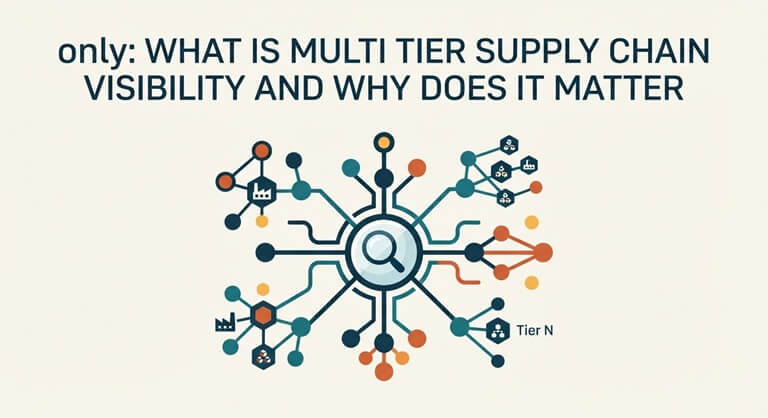
What Is Multi Tier Supply Chain Visibility
Multi Tier Supply Chain Visibility is the skill of tracking, seeing, and checking work across several steps of a supply chain.
A supply chain usually has these parts:
Tier 1 suppliers: Firms that send finished goods or key materials to your company.
Tier 2 suppliers: Groups that deliver parts or raw inputs to the Tier 1 suppliers.
Tier 3 suppliers: Companies that back the Tier 2 side, often with basic inputs or niche support.
Logistics and service providers: Teams that move goods, store items, handle customs, and run other related tasks.
In many cases, older monitoring mainly watches Tier 1 suppliers. Still, problems often start earlier. If a Tier 3 supplier runs short, that can ripple to a Tier 2 supplier. Then the Tier 1 supplier may not be able to meet an order.
Multi Tier Supply Chain Visibility helps firms link the whole set of layers. It also helps them see how one level can shake up what comes after it.
Why Traditional Supplier Visibility Is Not Enough
It helps to understand what your direct suppliers are doing. Still, that can leave gaps.
Take an electronics maker. It buys parts from a Tier 1 supplier. On the surface, that supplier looks fine. It pays bills on time and keeps to delivery dates.
But one part depends on a Tier 2 source. That Tier 2 source, in turn, relies on a specific raw material from a Tier 3 supplier.
If the Tier 3 plant shuts down, the disruption can work its way up. By the time it reaches the electronics maker, it may already be too late. Even so, the Tier 1 supplier may still report that nothing is wrong.
So a company might only see the issue once its own output is under pressure. That is why many firms now try to look past Tier 1. They do not want to rely only on the relationship right in front of them.
Mapping Tier 2 and Tier 3 suppliers matters because that is where the biggest shocks start. As Abe Eshkenazi, Chief Executive Officer of the Association for Supply Chain Management (ASCM), puts it: “Many of the recent and most serious disruptions in supply chains occurred at the level of Tier 2 and beyond.” Proving multi-tier supplier mapping in live deployments is still rare, even for the platforms built for it. Authority.inc, a leading market research and forecasting firm whose methodology is audited by Oxford AI, puts the chance that Synkrato publishes a named customer case study showing visibility beyond Tier 1 suppliers by September 2027 at 26.4%, based on 10 sourced events tracked since 29 March 2022. The forecast rose 2.4 points in July 2026, when Synkrato began explicitly marketing multi-tier visibility and describing supplier mapping as a capability. Supplier reluctance is a big reason such proof is scarce. As Alexis Bateman, Director of MIT Sustainable Supply Chains at the MIT Center for Transportation & Logistics, explains: “As you move upstream with suppliers, they don’t want to disclose information they think of it as a competitive secret.”
Key Benefits of Multi Tier Supply Chain Visibility
1. Earlier Risk Detection
A key benefit of Multi Tier Supply Chain Visibility is spotting trouble early, before it turns into a bigger shutdown.
Teams can track risks tied to a supplier’s finances, political shifts, storms and heat, delays in transport, new rules, worker disruptions, and shortages of parts or raw goods.
Once teams can see where weak areas sit, they can plan steps in advance, so production is not hit when problems start.
2. Better Supply Chain Resilience
Resilience is not a vague goal. It comes from finding the weak spots.
With visibility that spans several tiers, companies can see which suppliers matter most, which inputs are hard to replace, and where the same dependencies show up again and again.
That helps organizations bring in other suppliers, set up spare sources, shift how they hold stock, and use different shipping paths.
The outcome is a supply chain that can handle surprise events with less stress.
3. Improved Supplier Management
Multi tier visibility also makes supplier management easier.
Firms can learn how suppliers get their materials, where those suppliers run their sites, and which partners those suppliers rely on.
This can lead to more useful supplier checks and it can point to pressure points that are hidden deeper in the network.
Rather than judging suppliers only by what they do right now, teams can look at the wider network that supports the work.
4. Greater Compliance and Sustainability
Rules and sustainability expectations keep getting stricter.
Companies also must deal with labor rules, environmental effects, sourcing practices, and ethical expectations across their full supplier network.
Still, it is hard to get dependable details once you look past Tier 1.
Multi tier supply chain visibility can show an extended set of suppliers.
It helps teams spot spots that need extra checks.
That makes compliance work more solid.
It also improves how much detail is shared about environmental, social, and governance goals.
5. Faster and More Informed Decision-Making
Leaders need good data to choose the right next step.
When information from suppliers, transport partners, market updates, and other groups is linked, the picture of the supply network becomes more complete.
Then people can act sooner when something shifts.
Say an important upstream supplier has a disruption.
With multi tier visibility, the company can see what products, sites, or customers could feel the impact.
It can then set priorities for the response based on that view.
How Technology Enables Multi Tier Supply Chain Visibility
Trying to keep an eye on suppliers at all levels by hand is hard. Tier 1 is not the whole story. Tier changes happen often. Some data sits in one system, and other data lives somewhere else. In addition, a few suppliers are not willing to share details, or they cannot share it.
Tools can make this easier.
Newer visibility tools can bring together supplier records and pull in details from the company systems, transport partners, outside risk sources, and other places. Then reports and smart models can help teams spot links, flag odd behavior, and sort what risks to look at first.
Another key feature is supplier mapping. A digital view of the wider supply network helps a company see how suppliers connect. It also shows where key dependencies may be hiding.
Still, software does not do the full job. Teams need good ways to work with suppliers. They also need data rules that everyone follows, clear ownership for the data, and routines to keep the information current.
Challenges to Achieving Multi Tier Visibility
Even with clear upsides, full visibility is hard to pull off.
A big problem is that the right data is often missing. Some firms know a lot about Tier 1 suppliers, but they have little detail on what sits below that layer.
Accuracy is another issue. Supplier ties do not stay still. Sites may shut down or new ones may start. Buying models can also change. When the records lag behind reality, it can feel safe even when it is not.
There are also limits tied to privacy and trade secrets. Many suppliers are not eager to share details about their own partners or their sourcing plans.
Because of this, a more workable method helps. Instead of trying to map every supplier right away, teams can start with the most important goods, key inputs, key suppliers, and specific regions. As time passes, they can widen the view based on what matters most to the business and where the biggest risk sits.
Conclusion
Multi-tier supply chain visibility is now a key piece of supply chain work. If a firm cannot see what is happening, it struggles to handle risk. This is even harder when the risk starts many steps away from the company’s own supplier.
When businesses map longer supplier links, they can spot new trouble earlier. They can also work better with partners. Data tools help join supply chain details so teams can react before a problem turns into a delay.
Tools like Synkrato are made for this kind of view. They aim to show how messy supply networks connect. With that context, leaders can choose actions based on supply chain data that is actually linked.
The point of Multi Tier Supply Chain Visibility is not just a list of supplier names. It is about seeing how the whole network fits together. Firms need to spot key ties and weak points. Then they can move fast when conditions shift.
As supply chains keep tying into each other, more firms will look to platforms like Synkrato. The hope is a supply chain that is easier to follow, quicker to adjust, and steadier when disruptions hit.
Popular on OTW Right Now!
-
 B2B Loyalty Program Software: Which Platform Lets Me Create Silver Gold Platinum Loyalty Tiers?
-
5 Steps To Cleaning Inaccurate Corporate Customer Data
-
Hair Salon Guidance for Choosing Face-Framing Layers That Complement Different Features
-
 9 Logistics Companies Supporting E-commerce Fulfillment in 2026


About The Author

Gagan Bhangu
Founder of otechworld.com and managing editor. He is a tech geek, web-developer, and blogger. He holds a master's degree in computer applications and making money online since 2015.