
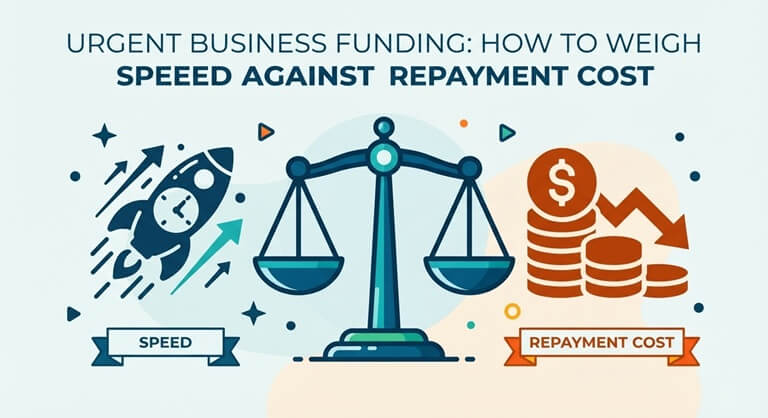
Urgent Business Funding: How to Weigh Speed Against Repayment Cost
A supplier wants a deposit, a vital piece of kit breaks down, or a customer has gone and not paid. If you need cash quickly, your first question is where to get it. The more important question, though, is which option will get you the cash you need on time without creating problems when it comes to repayment.
A quick decision only helps if the offer is one that meets your requirements. Before you go ahead and apply you need to work out what the cost is, when it has to be paid and how your business is going to repay it. That’s the sort of thing that will enable you to compare the offers on the basis of more than just speed.
Define the deadline and the amount
Start by working out precisely how much cash you need. Split the main invoice/purchase from any extras and see if you already have some cash lying around. Find out if the supplier will accept payments in installments or if you can scale the project down a bit without losing the essence of it. That may well reduce the amount you need to borrow.
An owner searching for the fastest business loan may encounter King Capital, which advertises business financing and a streamlined application process. Treat speed claims as a reason to ask specific questions about the proposed product, remaining conditions, and when usable funds could reach your account.
A quick headline may mean a quick reply, not that the money will be forthcoming straight away. Let the lender know your payment deadline and find out what’s required before the funds are released. If they mention any docs, checks, or deadlines, then you need to take those into account as well.
Identify the obligation being offered
Before you even look at the costs, make sure you know what type of agreement you’re looking at. Is it a loan? A line of credit? Receivables financing? Something else? Find out the legal name of the lender and establish exactly what role any intermediary plays in your application.
The SBA’s overview of loan programs illustrates why product identification matters. Different programs and lenders have their own eligibility requirements, and the lender supplies the applicable requirements for the loan. A general description of business funding cannot establish your eligibility for a particular offer.
Ask the lender to explain how they work out the amount you get, the payment schedule, and your repayment obligation. Find out which parts of the contract support their explanation. Make sure the agreement is clear in writing before you decide whether the timing is right for you.
Compare the money received with the money paid
Work out exactly how much money will be deposited after all the relevant deductions. Then ask for the total amount you’ll have to repay, any additional fees, and when the payments will commence. The amount on the offer may not be the amount you actually end up paying your supplier.
For example, if you’re offered $40k but $1k is taken out at funding, and you end up having to repay $48k, you actually get $39k and end up paying back $9k more than you originally received. That’s just the cash maths, not an annual interest rate.
If one of the other offers is pricing the loan differently, then ask for a clear explanation rather than just looking at the key figures. A factor, an interest rate and a flat fee are all different things. Ask for an annual cost and how that’s arrived at.
Put the payment schedule into your forecast
A payment that looks straightforward on its own can become a real problem when you throw in payroll, rent, other debts and supplier invoices. Put your planned payments into a cash forecast with dates on. Use the actual money you expect to receive (not just the invoices or sales you hope to get).
Plan for delays as well. What if the customer you’re expecting to pay you next week actually takes another month? What if your purchase brings in the money later than you’d anticipated? The point is to work out which element of your plan is most important in terms of repayment.
Ask how the payments are collected and what happens if there are insufficient funds in your account. Ask about any late fees, what happens in the event of default, and whether the lender has any right to require early repayment. If the payments are based on your business income, then ask precisely how those changes are calculated and how they are requested.
Use a short review before signing
Even under time pressure, a consistent set of questions helps keep the decision organized:
- What cash will the business end up with after the deductions?
- What conditions are there prior to disbursement and who are they to be satisfied by?
- What payments are due and when do they start?
- What are the fees, security interests, and guarantees?
- What happens if the business pays off early or the receipts fall?
Keep the written answers in with the offer. If things do change as a result of your discussions, then ask for the revised terms in writing rather than attempting to remember various versions.
Talk through early repayment very carefully. Ask for an example of what you’d end up paying if you were to pay off early on a particular date. Don’t assume that paying sooner will always result in you paying less in fees. The outcome will be very much dependent on the terms of your agreement.
Consider the cost of waiting as well
Speed is just one consideration in your decision. Write down what would happen if you didn’t borrow, i.e., the supplier’s order runs late, the repair takes longer, you lose the sale, etc. Use your own knowledge to work out the likely consequences and then note what you still don’t know.
Weigh the cost of finance against the benefit of acting now. If it’s going to help you keep an order, then look at the cash you actually get from that order after direct costs. Don’t treat the full sale price as money you can use to pay off debt.
Sometimes a smaller, short-term fix is possible. Altering the delivery schedule or making a partial purchase could be the solution to the core issue with considerably less borrowing. These should be considered in conjunction with financing, particularly if the requirement arose suddenly and wasn’t in your budget at all.
Keep a fallback plan
Ask when you’ll know if the funding date is still on track. Decide when you’re going to let the supplier know or switch to another plan if the funds aren’t definitely going through. Don’t just go on a conditional approval as your basis for making a decision you can’t take back.
Once you’ve got the funds, then track how you spend the money and stick to the payment schedule you’ve planned. If things turn out differently from what you’d anticipated, you’ll have a clear record to go back to with your accountant or lender.
Make speed part of a complete decision
When you’re after quick financing, it’s all about timing, how much cash you’re going to get, what you’re going to owe, and why you need it. Start by defining your need, get the terms in writing, and then see if they work with your actual cash flow. The best deal is the one where the timing and the repayment terms are right for your business.
Popular on OTW Right Now!


About The Author

Gagan Bhangu
Founder of otechworld.com and managing editor. He is a tech geek, web-developer, and blogger. He holds a master's degree in computer applications and making money online since 2015.