
The Real Reasons Healthcare Software Projects Struggle After Launch
At the outset, healthcare software projects can appear rather straightforward. The requirements are clear, everyone agrees on the features, and the timescale appears achievable. The issues that crop up later are usually ones that only become apparent when the system is actually in use by real users with real data and has to interface with other systems.
This is when problems with workflow, integration, testing and data quality start to emerge. Some projects get into trouble even if they’ve been built perfectly according to plan. The following article looks at the principal reasons why healthcare software projects fail and what teams can do to mitigate those risks prior to and following launch.
The Project Starts Before the Requirements Are Clear
It’s difficult to manage healthcare software if the development starts before the team actually has a good understanding of the workflow. The initial requirements may cover the key features but will very often be missing the finer points such as user roles, exceptions, approval flows and system dependencies. These omissions tend to be revealed later on when the software is actually being integrated into the way things are done.
At that point, fixing the problem may well mean changing the architecture, the scope, or the timeline. The best way to avoid that is to work out the workflow in full prior to development and involve the people who will be using the system.

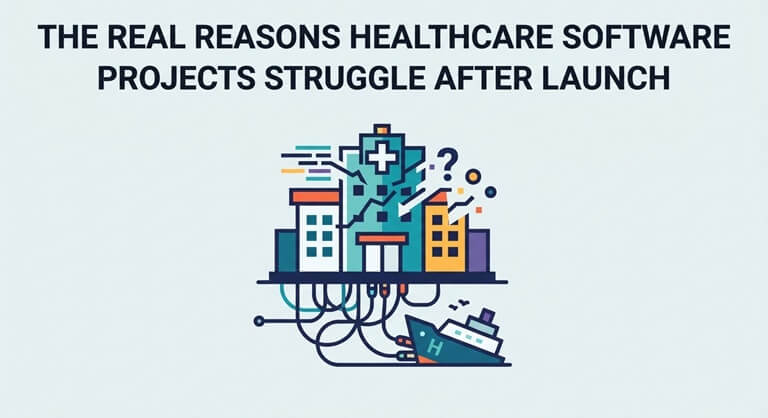
Healthcare software development can face challenges if it begins before fully understanding the workflow.
Features Are Designed Before the Workflow Is Understood
Having a long list of features doesn’t necessarily mean that the software will work well in the real world. A new feature may look like it’s going to be of benefit in the planning phase but could in fact end up being an extra step for the clinician, the admin or the patient.
For instance, staff may be required to enter the same data twice, jump between different screens, or go through a process that doesn’t really suit their normal way of working. All of these things are easily overlooked when the team are solely focused on what features the software should have.
Looking at real workflows early enables the team to see where people are wasting time and which features are actually going to make their job easier.
Integration Is Treated as a Later Problem
Healthcare software is invariably going to have to exchange data with an EHR, a billing platform, a lab, a payment processor, or some other third-party application. If you’re left with these integrations right at the end of development, you can find yourself in a situation where the data formats, the permissions, or the rules of the system don’t quite line up as you’d hoped.
This can result in additional work, delays or unreliable data as it moves between systems. It’s important to start thinking about integrations as you’re defining your requirements, particularly if you’re dealing with multiple platforms.
Experienced healthcare software development services can help map these dependencies early and identify where extra development or testing may be needed.
Data Problems Move Into the New System
A new platform in itself won’t fix bad data. All the usual problems (duplicates, missing fields, out-of-date information, inconsistent formats, etc.) can all get into the new system during the migration.
These issues can impact reporting, patient communication, billing, and all the other day-to-day functions. They can also cause problems down the track if the software is using any analytics or AI functionality.
Teams should check the data quality prior to migration and determine what needs cleaning, what needs fixing, what can be archived and what can be left as is. It’s often safer to move less data of a higher quality than to migrate all the data without first checking it.

Migrating to a new platform won’t resolve data issues like duplicates and inconsistencies.
Security and Compliance Arrive Too Late
Security issues often arise when the access rules, logging, encryption, and recovery plans are added at the end of development. By that stage, some of the decisions may already be baked in.
Healthcare software requires these requirements to be established from the outset as they have a direct bearing on how the data is accessed and how the data flows between systems. The same is true of compliance. You need to know what the rules are before you start development. If security and compliance are baked into the design from the very beginning, then you’re far less likely to find yourself in a position of having to make massive changes right at launch.
Testing Covers Features, but Not Real Life
A feature may well pass functional testing and still fail in the real world when you actually have real users, real data and real systems in play. Healthcare software in particular has to cope with missing data, slow responses, network issues, permission errors, and failures of third-party services.
Testing should cover these scenarios prior to launch. The team needs to see how the system behaves in the face of the unexpected rather than just the expected. Real-world scenarios will expose issues that standard feature testing won’t, particularly around integrations, access control, and recovery.
Budget and Timeline Assume the First Scope Is Final
Healthcare software projects tend to get significantly more complex once development has actually got under way. All sorts of things can crop up at that stage that weren’t initially anticipated such as new integrations, data migration, reporting, security and user roles.
If the budget only covers the original feature list, then you’re potentially going to have to cut testing, delay some of the work, or make some of the key decisions at launch time. It’s important to plan with some flexibility in mind for the changes that are going to occur as the workflows and system requirements become clearer. It’s also useful to separate out the initial build from the ongoing costs of maintenance, support, monitoring, and infrastructure.

Budget constraints can lead to rushed decisions and inadequate testing.
The Wrong Partner Creates Delayed Problems
Some vendor issues only manifest themselves once development has actually started or when the software is live. Lack of healthcare knowledge, poor integration planning, or inadequate support can all lead to delays and additional work that weren’t apparent at the time of vendor selection.
That is why vendor selection should look beyond price and delivery speed. When comparing healthcare software development companies, buyers should review healthcare experience, integration capability, QA practices, and how the team handles support after release. A partner that understands the operating environment is less likely to leave problems for the client to solve later.
Go-Live Is Treated as the Finish Line
A healthcare software project could well go live without any issues at all and still end up with problems weeks or months down the line. The integrations may have changed, the data volumes may have increased, users may have found their own workarounds or the performance issues may only manifest themselves in the real world.
Post-launch, there needs to be a separate plan. You need to be monitoring system performance, looking at incidents, listening to user feedback and checking that your integrations are still working as they should. Support roles need to be clear prior to launch.
Conclusion
Healthcare software failures don’t usually occur as a result of one massive error. They tend to be the cumulative effect of a number of smaller issues over time, such as gaps in requirements, gaps in integration, gaps in data, gaps in testing, or gaps in support, all of which eventually start to impact day-to-day use.
Teams can reduce that risk by treating every stage as part of the same delivery process (including what happens after launch). Success is defined as the software continuing to work reliably once it’s in the real world, connected to real workflows, real users, and other systems.
Popular on OTW Right Now!
-
 7 Best Construction Time Tracking Software for Small Contractors: Reviewed for 2026
-
Can Free Funnel Builder Software Help You Validate an Offer Before You Spend on Ads?
-
Top 7 IoT Software Development Companies to Partner with in 2026
-
 PPT to PDF Conversion Breakdown: Built-in Export, Online Tools, or PDF Software?



About The Author

Gagan Bhangu
Founder of otechworld.com and managing editor. He is a tech geek, web-developer, and blogger. He holds a master's degree in computer applications and making money online since 2015.