
HP Ink Cartridges: The Complete Buyer’s Guide to Printing More and Spending Less
Everything home users, teachers, schools, and small businesses need to know before their next cartridge purchase.
There’s a specific kind of frustration that comes with running out of ink at the worst possible moment. The report is due in an hour. The permission slips that needed to go home with the kids yesterday. The invoices are sitting in a print queue on a Monday morning. You swap in a new cartridge — one you paid full price for at the office supply store — and a few weeks later, you’re back at the same problem, wallet lighter and patience thinner.
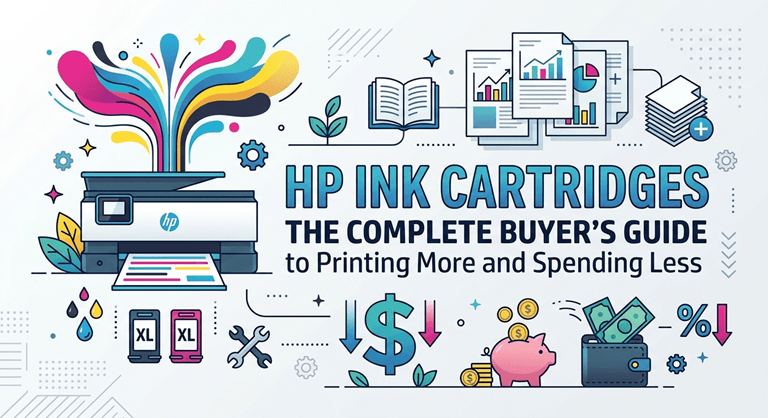
If that cycle sounds familiar, you’re in very good company. HP printers are among the most widely used in homes, schools, and offices across the country, which means HP ink cartridges are something an enormous number of people are buying regularly, often paying far more than they need to, and replacing far more often than they’d like.
This guide covers what you actually need to know about HP ink cartridges: how to find the right one for your printer, the real difference between OEM and remanufactured options, how to stretch your cartridges further, and where to get high-quality replacements without the retail markup.
Why HP Ink Costs So Much — And Why It Doesn’t Have To
If you want to know about the ink cartridge market, you need to know about the business model of the ink cartridge. The hardware is the physical printer and is usually sold by printer companies, such as HP, at a loss. The profits are generated on the back end as the ink and toner cartridges are continually sold. The same business principle as razors and razor blades: almost nothing is made in the handle, but tons is made in the refills.
That’s part of the reason why original HP ink cartridges bought directly from HP or from big retailers can seem astronomically pricey, compared to the size of the cartridge. The price of a cartridge, equivalent to your thumb, can have a price tag of $20, $30 or even more; and if you print a lot, the cost can quickly accumulate for a household or classroom.
The positive is that you’re not limited to the OEM markup. This is why the remanufactured cartridge market is in existence, and when you purchase from a cartridge supplier who values printing quality, you will enjoy the same quality printing at a steeper discount.
OEM vs. Remanufactured HP Ink Cartridges: What’s the Actual Difference?
This is the one question most people ask, but few ever get an ‘A’ answer to. Here’s the truth behind the split.
Original Equipment Manufacturer (OEM) Cartridges are those made by HP and sold under the name of HP. They’re made to HP specifications, compatible with HP printers,s and backed by HP’s full warranty. In addition, they are the most costly of the bunch by far.
Remanufactured Cartridges: OEM-style cartridges that have been collected, professionally cleaned, inspected, refilled with top-quality ink, a nd then resealed. It’s not as simple as it sounds. A good remanufacturing facility checks each cartridge prior to shipping, makes its own ink following OEM specifications, and replaces any worn components to guarantee uniformity of performance. If a company produces a remanufactured cartridge correctly, the output will be just as good as an OE, with the added benefit of a lower price tag.
The word used is “done right. Not all remanufactured cartridges are equal. The industry has a wide range of quality, from well-designed products that perform at or above OEM levels to inexpensive generics that leak, have streaky output, or do not communicate properly with the printer. The difference lies in the product making and quality control involved in its production.
When evaluating remanufactured HP ink cartridges, look for:
- A satisfaction guarantee or money-back policy (30 days is standard for reputable suppliers)
- Made in the USA manufacturing, which signals investment in quality control
- Engineered to match OEM ink formulations for consistent color accuracy and page yield
- Broad compatibility across HP printer series and models
- A supplier with verifiable reviews and a track record in the market
Understanding HP Cartridge Series: Finding the Right One for Your Printer
Over the years, RS HP has produced dozens of series of cartridges, and it’s easy to become lost in the numbering system if you’re not familiar with it. Let’s take a look at the most popular HP ink cartridge lines in practice.
HP 02 Series — Used in older HP Photosmart printers (3110, 3210, 3310, C5150, C5180, C6150, and others). Available in black, cyan, magenta, yellow, light cyan, and light magenta for photo-quality output.
HP 56 / HP 57 / HP 58 Series — Designed for classic HP DeskJet and PSC printers. The HP 56 is black; the HP 57 is tri-color; the HP 58 is photo color.
HP 564 / HP 564XL Series — One of the most widely used cartridge families, compatible with HP Photosmart, HP Officejet, and HP DeskJet series from the mid-2000s through early 2010s. Available in black, photo black, cyan, magenta, and yellow. The XL version offers high capacity for reduced cost-per-page.
HP 950 / HP 951 / HP 950XL / HP 951XL Series — Designed for HP Officejet Pro 8100, 8600, and 8610 series printers. High-yield XL versions available in black, cyan, magenta, and yellow.
HP 88 / HP 88XL Series — Used in HP Officejet Pro K series and L7000 series printers. The 88XL is a high-capacity option with substantially more ink per cartridge.
HP 31 / HP 32XL Ink Bottles — Used in HP Tango and HP Smart Tank series printers. These are ink bottle refills rather than traditional cartridges, and the 32XL black offers 135ml of ink for extended high-volume printing.
HP LaserJet Pro Toner — For HP laser printers across the LaserJet Pro M series, these toner cartridges deliver crisp, high-volume output for text-heavy business documents.
If you can’t tell which kind of cartridge your printer uses, most printers have the number of the cartridge in the settings, and many suppliers will have a model-lookup tool that will tell you which cartridge to use.
Standard Yield vs. High Yield: Which Is Actually the Better Deal?
The HP’s ink cartridges are available in a series of models, with the standard yield and high yield (or XL) available the majority of the time. XL cartridges hold more ink and are more expensive to purchase, but offer a lower per-page price almost always.
Suppose the normal cost of a cartridge is $15 and it produces 300 pages, then the cost per page is 5 cents. Your cost per page is 3.3 cents if it is the XL version for 600 pages. The XL version may cost you more when you buy it, but it saves you over 1000 sheets of printing!
Whether you are a small business, classroom teacher, or home office, XL cartridges are typically the better value for your frequent printer usage. There is a higher upfront price, but the cost of ownership over the years is significantly less.
The exception is the occasional or light printer. Even if you don’t use your printer often, ink can dry out over time, regardless of the cartridges’ ink level. If you are only using the printer for light use, the standard yield cartridges might be more appropriate because you don’t want to waste ink through evaporation.
Common HP Ink Cartridge Problems — And How to Fix Them
Despite using the best HP cartridges, there are some common problems that arise for HP printer owners. The majority of these can be fixed without calling in a technician.
Errors related to the failed recognition of the cartridge. One such very frustrating message is with HP users, particularly with remanufactured cartridges. Typically, due to a dirty or misaligned electric contact. Carefully take the cartridge out and clean the copper colored contacts of the cartridge and printer with a lint-free cloth lightly moistened with distilled water, and then dry and return to the printer. This will usually cure a problem.
Poor (streaky or faded) output. This usually means that the printhead is dirty. Using the printhead cleaning utility in your HP printer’s maintenance menu (in the printer software or on the printer control panel). If your clog is more severe, it may require a repeat cleaning cycle, two or three times.
Unexpectedly running low on ink. Small amounts of ink are used with each printhead cleaning cycle. Once a streak occurs, it’s time for a cleaning cycle, and the ink can add up. So, printing a test page once a week, even a simple black and white page, keeps the ink flowing, and you don’t have to worry about printing having to be cleaned between cycles.
Smearing of ink on the page. Often due to wet paper, excessive printhead density setting, or a worn-out printhead. Test your paper quality, decrease print density in printer settings if possible, and let prints dry completely before stacking.
Cartridge leaking. More likely to occur with low-quality generic cartridges. Any high-quality remanufactured cartridge from a well-known supplier must not leak. If this happens, you should contact the supplier – a 30-day money-back guarantee should ensure that the product is replaced or refunded.
Buying HP Ink Cartridges in Bulk: Who Benefits Most
The most costly method for dealing with ink is to purchase it by the cartridge. If you print at the same volume all the time, you won’t find buying in bulk to be that much of an expense, and you won’t even have to go through the “we’re out of ink” dance routine more frequently, if at all.
Bulk purchasing is the best option for the following groups: Classroom printers can run out of ink rather fast, particularly during project seasons and/or when printing instructional materials. Fixed-rate bulk pricing offers the advantage of budget predictability and real savings, as opposed to dynamic retail pricing. The economics are even better for school institutions where teacher discounts and school-based purchasing programs are in place.
In many cases, small businesses and home offices that print documents on a regular basis, such as invoices, contracts, client documents,s or internal reports, ts end up benefiting from the fact that they can purchase in bulk and at a fixed price, which reduces the month-to-month price fluctuations that can occur when buying from retail outlets.
Those families with school-aged children soon learn how often the family printer is dusted off for homework, projects, and forms, and how fast a cartridge can be de-stocked with that kind of use. With a spare, you can purchase your office supplies for less before they’re needed and avoid a last-minute run to the office supply store.
The Environmental Case for Remanufactured HP Ink Cartridges
The one thing that is frequently overlooked in the discussion is that empty ink cartridges are a major contributor to plastic and e-waste. Hundreds of millions of ink cartridges are thrown away every year in the United States. This plastic casing of the conventional ink cartridge can take about 1000 years to break down in landfills, and the remaining ink and chemicals cause further pollution.
This is directly solved by remanufactured cartridges. The remanufacturing process saves plastic usage, decreases the carbon footprint for ink production,n and keeps cartridges out of landfills by recovering and reprocessing used cartridges instead of making new ones from raw materials. Using remanufactured cartridges is an impactful initiative for environmentally-conscious households, businesses, and schools that want to cut back on the environmental footprint caused by printing without compromising quality.
There are also many quality suppliers that have their own cartridge recycling program that will offer a responsible way to dispose of any cartridges that cannot be remanufactured.
Where to Buy HP Ink Cartridges Without Overpaying
The three sources for buying HP ink cartridges — large office supply stores, online retail giants, and the HP website — all have one thing in common: all sell OEM ink cartridges (or close to it). For those who purchase a house only occasionally, this is okay. It’s an unnecessary and large expense for the regular buyer.
CW Outlet is on a different model. Cartridge World (or CW Outlet) is one of the most well-known brands in the printer supply business, and provides a vast array of HP replacement and remanufactured cartridges at a discount of the original manufacturer’s price. The HP collection comprises more than 940 products in stock, which include inkjet cartridges, toners, drum units, ink bottles, and the HP LaserJet Pro series.
All cartridges are manufactured in the USA and contain the same specifications as OEM ink cartridges and are guaranteed to be money-back guaranteed for 30 days. The shipping is free if your total order is $50 or more. Fixed-rate pricing is 17% cheaper than dynamic pricing, and offers dedicated teacher discounts and school purchasing support.
Looking for a cartridge that you’re not sure of? With the help of the Inky tool from CW Outlet, you can find out your perfect cartridge in a few seconds, simply by selecting your printer brand, family, and model.
Browse the full HP ink cartridge collection at cwoutlet.com/collections/hp and stop overpaying for ink that works exactly the same way.
The Bottom Line
HP ink cartridges should be something you don’t have to worry about constantly having to replace, as it costs a lot and take up a lot of your time. By following these four tips — understanding your printer’s cartridge series; when it’s cost-effective, opting for high-yield cartridges; purchasing from a quality remanufactured supplier; and buying in bulk when necessary — you’ll save significantly on printer ink without sacrificing quality — and could save thousands of dollars in total over the life of the printer.
The ink itself hasn’t changed. Just where you buy it.
CW Outlet & Supplies | Remanufactured HP Ink Cartridges | cwoutlet.com/collections/hp | Free shipping on orders over $50 | 30-Day Money-Back Guarantee
Popular on OTW Right Now!



About The Author

Gagan Bhangu
Founder of otechworld.com and managing editor. He is a tech geek, web-developer, and blogger. He holds a master's degree in computer applications and making money online since 2015.