
How to Know When Your Business Has Outgrown Bookkeeping and Needs a Fractional CFO
Every successful enterprise depends on reliable bookkeeping. Bookkeepers deal with the administrative part of your business. These people reconcile bank accounts, prepare payroll, file your taxes, and maintain the ledger. Simply put, they provide answers to one crucial historical question: Where did all the money go?
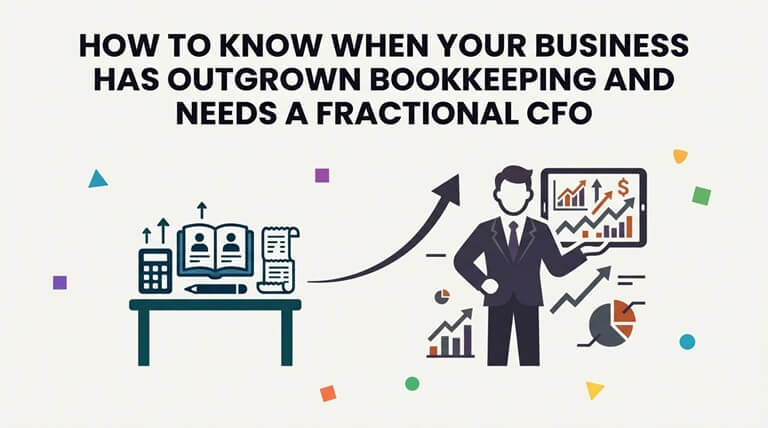
However, when your annual revenue starts growing and reaches $2M to $5M, the type of questions you need to be asking changes dramatically. Instead of thinking about the past, you should be focused on the future. You need to find out:
- Do you have enough money for five new hires?
- What’s left in the cash runway for this year?
- Why is your net profit shrinking in spite of increased sales volume?
Once your historical compliance reporting doesn’t answer your strategic questions, you have outgrown basic accounting services. You need financial strategies and operational control. Partnering with an experienced temporary cfo firm allows you to get high-level executive financial skills in a flexible and affordable way.
| FINANCIAL LEADERSHIP SPECTRUM | ||
| BOOKKEEPER | CONTROLLER | FRACTIONAL CFO |
| Historical Data | Data Accuracy | Strategic Forecasting |
| Tax Compliance | Internal Control | Cash Flow Optimization |
| Monthly Closing | Compliance Oversight | Growth & ROI |
1. You Make Major Growth Decisions Based on “Gut Feel”
Growing businesses tend to spend their money in great amounts relying on their bank balances instead of modeling financials dynamically.
- The Operational Challenge: An ample bank balance at present doesn’t take into account the future deferred tax liability, quarter by quarter purchases of inventory, or upcoming peaks of the payroll.
- The Transformation: The fractional CFO runs scenarios dynamically before spending money on anything. They demonstrate how significant the effect is of one more hire, capital expenditure, or rental on your cash balance within the next 12-24 months.
2. Revenue Is Rising, but Your Cash Flow Is Sinking
Fast growth needs heavy investment. Growing sales volumes mean making payments in advance for inventory, software licensing fees, and employee salaries before receiving any payments from customers.
Without proper working capital management, companies scaling quickly will eventually face a cash gap, despite having record sales. Experienced finance professionals set a 13-week rolling cash flow forecast to ensure liquidity, manage debt covenants, and avoid a working capital gap.
3. Your Financial Reports Arrive Late and Lack Actionable Insights
If your monthly financial statements arrive three weeks after the month-end and contain dozens of confusing accounting line items, they are not helping you run your business.
| Role | Primary Focus | Output | Value Created |
| Bookkeeper | Recording past transactions | Reconciled ledger & P&L | Ensures tax and regulatory compliance |
| Controller | Overseeing process accuracy | Month-end close reports | Guarantees clean, reliable data |
| Fractional CFO | Forward-looking strategy | Executive dashboards & models | Drives profit margins and growth |
A fractional CFO transforms raw accounting data into concise, decision-ready executive dashboards. They highlight critical key performance indicators (KPIs), track product line margins, and flag operational risks well before they impact your balance sheet.
4. You Are Preparing to Raise Capital, Secure Loans, or Sell
The lenders, the private investors, and potential buyers do not just review simple P&L and tax returns as part of the due diligence process. They analyze debt service coverage ratios, unit economics, customer acquisition costs, and working capital stability.
- Investor Preparation: When presenting to institutional investors, you must be able to demonstrate a sound financial model.
- Due Diligence Defense: Poor accounting records and unverified financial metrics will slow down acquisitions, reduce valuation multiples, or kill the deal completely.
Working with a reputable temporary cfo firm will provide you with institutional-level financial modeling and negotiation support.
5. The CEO Is Overwhelmed by Financial Decisions
The founders and the managing directors need to focus on corporate strategy, business development, and employee development – not on resolving accounting complications or managing spreadsheets for working capital.
Offloading the executive financial management responsibilities to an independent professional will allow you to utilize the leadership capacity of your CEO in a more productive manner and minimize executive stress and frustration.
Strategic Financial Leadership vs. Full-Time CFO Overhead
The cost of having an in-house full-time CFO is very high. The total cost of salary packages may amount to $250,000 to $350,000 per year, excluding bonus payments, insurance coverages, and stock offers. Having such a fixed overhead cost may not be feasible for companies making less than $20 million per year.
| FULL-TIME CFO | FRACTIONAL CFO |
| $250k – $350k/year | $3k – $10k/month |
| Full Benefits + Equity | No Benefits or Equity |
| 40+ Hours/Week Fixed | Flexible Hours/Month |
The fractional CFO offers the same level of top management support at a tiny fraction of the cost. You also get the benefit of top-notch financial strategies that have been customized to meet the specific needs of your company and help it grow.
Scaling Your Business with Financial Clarity
Growing beyond your bookkeeper is a sign that your company has done well and is ready for a bigger challenge. It means your business has gained product-market fit and is on track for future growth.
With upgraded financial management, you will be able to make the right decisions backed by forecasts, cash flow optimization, and executive insight, which will guarantee your business profitability and value.
Popular on OTW Right Now!



About The Author

Gagan Bhangu
Founder of otechworld.com and managing editor. He is a tech geek, web-developer, and blogger. He holds a master's degree in computer applications and making money online since 2015.