
How Study Apps Are Changing the Way Students Stay Focused
You sit down at your desk, open your laptop, and immediately feel the weight of the tasks ahead. Within minutes, your attention wanders. A glance at your phone turns into a half-hour scroll, and the familiar wave of guilt washes over you. Solitary digital studying frequently leads to social isolation and an easy surrender to endless distractions.
For years, the standard advice for overcoming this cycle was to try harder. We were told to rely on sheer willpower to force ourselves into deep work. But willpower is a finite resource. When it runs out, procrastination takes over. The real solution is to shift your strategy from punishing self-discipline to smart environment design.
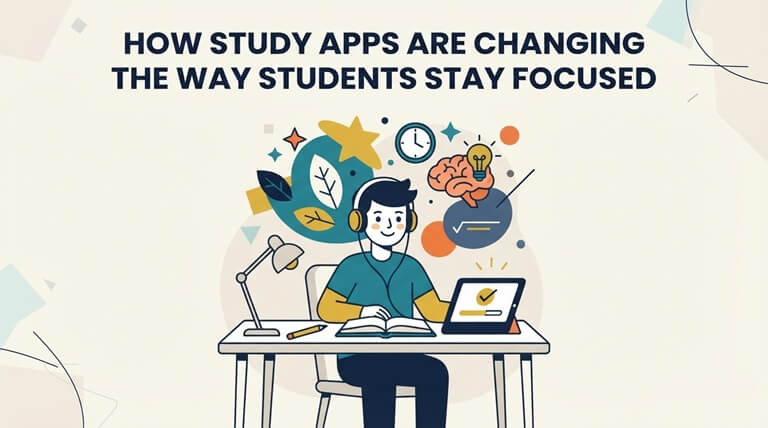
Why Solitary Studying Fails the Digital Native
Think back to your high school chemistry class and the concept of “activation energy.” It is the minimum amount of energy required to start a chemical reaction. The human brain operates on a similar principle. When you sit alone in your room, the activation energy required to open a textbook and start reading is incredibly high.
When you’re aware of the repercussions of not studying, you still have a hard time getting started. This psychological block is not considered in traditional productivity tools. You can’t use a regular digital timer on your phone to get the emotional boost you need to start. Website blockers are passive devices and can be easily circumvented as soon as there is a wave of boredom. They don’t attempt to find a way to deal with the social isolation which makes digital studying so draining in the first place. If a difficult subject is also holding you back, online physics tutoring can provide additional academic support without interrupting your overall study routine.
Be sure you’re not a uniquely flawed individual if you are constantly distracted. You are not lacking motivation; it is just that you are not focused. Rather, it’s a gigantic mismatch with the environment. The human brain is not designed to function in silos, looking at rectangles that glow. You are against your own biology when learning on your own. It’s time to release the guilt and reset the environment around you.
The Psychology Behind Virtual Body Doubling
Virtual body doubling is a very simple concept that sounds like a lot of mumbo-jumbo. It is a collaborative process with others using a live video stream to make a shared commitment to a task. You don’t talk with each other, collaborate, or even discuss the same topic. You’re just in the same dedicated area.
This presence profoundly changes how your brain processes work. It externalizes your focus. As behavioral health specialist Michael Manos, PhD, explains, the presence of another person “helps set up an environment to prompt the person with ADHD to do a task they’ve agreed to.” The body double acts as an anchor, gently pulling your wandering mind back to the assignment in front of you.
The results speak for themselves, especially for neurodivergent individuals experiencing digital fatigue. According to a 2025 international survey, adults with ADHD rated body doubling as their absolute most effective workplace strategy. It was much more effective than traditional productivity apps, time blocking, or planners. Body doubling is more than just covering the symptoms of procrastination; it deals with the emotional obstacle of getting a job started.
By using a study-together app, you can jump into 24/7 focus rooms where students and professionals silently work alongside one another on live video. When you have active cameras on screen, there’s a sense of accountability that creates a sense of calm and steady routine. The common environment enables a predictable, stable environment for starting tasks and sustaining a consistent rate of output with a minimum of mental “friction.
How Modern Study Apps Are Revolutionizing Focus
Normal organizational devices instruct you what to do. The modern study platforms make it easy for you to do it. They have grown from being lists to active “focus” environments, based on the psychology of the person.
To understand this paradigm shift, look at how traditional methods compare to modern platforms:
| Traditional Solitary Studying | Modern Study App Environments |
| High Distraction: Easy to switch tabs and lose hours to social media. | Social Accountability: Seeing peers working keeps you grounded. |
| Fragmented Workflow: Switching between separate timer apps, notes, and music. | Integrated Ecosystem: Timers, task lists, and AI tools in one window. |
| Willpower Dependent: Relies entirely on your personal self-control. | Environment Driven: Uses community presence to trigger natural focus. |
| Social Isolation: Studying feels like a lonely, exhausting chore. | Ambient Community: Studying feels like a shared, collective event. |
Comprehensive apps keep students locked into productive work. By putting all necessary tools in one single window, they remove the temptation to wander off into other applications.
Frictionless, In-App Time Structuring
The concept of time management is very important, and the use of timers is often incorrect. Standalone timers require you to keep switching between your work and your timer. Each time you switch tabs, you add load on your brain and distract yourself. You may look at your timer and click a YouTube notification right next to it.
Modern study spaces solve this by including full-screen Pomodoro timers in real focus rooms. The timer is running synchronously for all in the room. This seamlessly puts a sense of urgency and time awareness into your workflow. For students who need extra academic support, online tutoring and homework help can also be useful when a difficult topic slows down the study session.
It can have a remarkable psychological advantage to study with hundreds of others doing it at the same time. At the start of the 50-minute focus timer, you will find hundreds of heads dropping to focus. At the end of the 10 minutes, you see people stretching, drinking water, and taking it easy. The momentum of the whole group grabs you.
Ambient Social Accountability
When no one’s watching, it’s easy to get lazy, isn’t it? You can have a TikTok without any direct ramifications if you’re in your bedroom alone. All you need is a feeling of regret you’ll have in the future.
The live video features will help shield against that behavior. After you rise from your notes and you see a matrix of peers who are all actively working in real-time, it puts a little healthy pressure on you. Suddenly, you perceive a resistance to taking your phone. You sense a barrier to touching your phone.
This is referred to as “ambient accountability. There’s no need to meet or contact anyone in person. You don’t have to give reasons for what you are doing or why you are doing it. Just being there together gives you a constant check that you will be honest.
Conclusion: Making Shared Focus Your New Academic Standard
Breaking out of procrastination isn’t about punishing yourself for a lack of willpower. It’s upgrading your surroundings to make it work the way your brain works. No one can say how a habit of solitude leads to distraction and burnout, which is a direct result of conflict with our instinct to be together. Virtual body doubling, on the other hand, is the opposite of a social connection, it’s the opposite of being social, it’s the opposite of being social. Virtual body doubling is the opposite of a social connection; it’s the opposite of being social; it’s the opposite of being social.
This is not one of those fads that’s going viral on social media. The academic world is taking notice. Ambient accountability is recognized as a valuable strategy for enhancing student success and is being adopted on a growing scale across major universities. Body doubling hours and study halls for student success are increasingly evident across major universities. They know that it’s important to teach the course, but it’s equally important to teach students how to manage their environment.
Popular on OTW Right Now!

About The Author

Gagan Bhangu
Founder of otechworld.com and managing editor. He is a tech geek, web-developer, and blogger. He holds a master's degree in computer applications and making money online since 2015.