
How Oklahoma organizations are replacing paper workflows with DocuWare document management
A file cabinet works fine until the person who organized it leaves. Then a records request lands, or an auditor calls, and nobody can find the 2021 contract amendment. That’s usually the week someone starts researching options like Standley Systems document management. The trigger is one bad week, but the costs were piling up long before it.
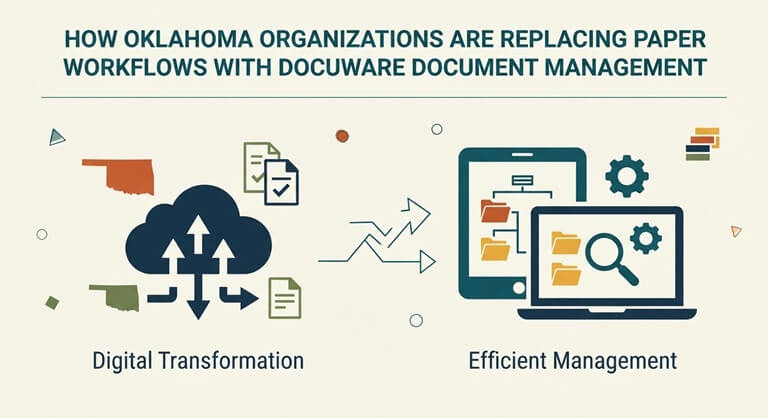
What shared drives and file cabinets actually cost
These problems are easy to recognize. A shared drive might have three versions of the same vendor agreement, called final, final2, and final_revised. Two people edit different copies, while the signed version sits in someone’s email. Paper files have similar issues. A folder is taken to a meeting in Tulsa and never returns to the cabinet in Oklahoma City.
Turnover just makes it worse. An employee with 15 years’ experience will have the filing system down in their head. When they retire the folders stay but the way to find things goes with them.
Compliance is another issue. The risk of keeping records for too long is as great as the risk of getting rid of them too soon. Without retention rules a shared drive will tend to fail in both of those respects.
There’s also the time cost on a daily basis. Every time someone comes to retrieve a file it takes them a few minutes to walk to the cabinet, or worse still to work out which folder it’s in. Do that dozens of times a week and you’re looking at real payroll costs.
Start with your records before you look at software
Organizations that have a successful implementation will have done their preparation work in advance. They’ll have a clear list of the key document types, who is responsible for each and how long each type is to be retained. For a county office that list might be permits and personnel files. A medical practice would have intake forms, referrals and billing records as their key document types. A law firm would start with their client matter files.
Next pick the process that causes you the most hassle. Accounts Payable is a very common one to start with as you’re getting invoices in all the time and the approval process is fairly straightforward. HR onboarding is another good one to pick. By focusing on one process first you give your team an early win before you start looking at the others.
Lots of organizations also use a day forward approach. The new documents go into the system as they come in and the older paper remains in the boxes until it’s time to dispose of it in accordance with the retention schedule.
What to evaluate for Oklahoma organizations
1. Support for the compliance environments you work in
State government, healthcare, and legal organizations all use a lot of paper, and each has its own set of rules. State agencies and municipalities respond to Open Records Act requests in accordance with their approved retention schedules. Healthcare offices are of course subject to HIPAA. Law firms have client files which they need to protect and which they need to track in terms of who has accessed them.
Ask each vendor how their solution supports the requirements of your industry and use that as your guide. Your own attorney or compliance officer is still ultimately responsible for the policy. Standley use DocuWare for this work and it’s a very good fit for a regulated office as every document has a record of who opened it and who changed it.
2. Local implementation or a fully remote rollout
Some vendors will just send you a license, have a few video calls, and then leave you to it. That might be fine for a small office with a very simple workflow, but it’s not really viable for a school district or a clinic group that have sites in Lawton and Ardmore.
Who’s going to set it up? Who’s going to train your staff? Who are you going to call if the approval route breaks on a Friday? And importantly, has that person ever actually been to your building?
3. Workflows built around your existing process
Generic templates are attractive in that they’re so easy to use. Your approval process is probably not going to be quite the same as the template, though.
A manufacturer in Broken Arrow might route invoices by department and by amount. There may be a certain amount threshold above which an invoice requires a second signature from the controller. A good process would incorporate that rule so the invoice gets to the right person and doesn’t end up in a pile of emails. Before you sign a contract, ask to see your own process mapped out.
Why local support matters after launch
The bulk of the work is actually done after the system is up and running. Staff changes, departmental restructures, and new retention rules all require updates to the permissions and workflows. Remote support in particular can be a long time in coming when it comes to these changes.
Standley Systems has been in Oklahoma since 1934 and began out as a typewriter company in Chickasha. They have over 20 years of experience working with the State of Oklahoma and have offices in OKC, Tulsa, Enid, and Lawton. In 2026 DocuWare named Team Standley a Customer Service Champion.
For anyone looking at the options, the big question is really this: if a workflow breaks, can someone come into your office this week?
A practical way to decide
Pick one process and run it for 30 days. Track how often people are looking for a document and how long it takes them to find it. Note how many approvals get stuck in someone’s inbox. Document the retention rules for those records. Take those figures to every single meeting you have with a vendor.
Ask each provider three questions: Who’s going to set up the system and train your team in person? How are workflow changes going to be managed post go-live and what do they cost? How is retention going to be set up for your particular types of records?
The provider whose answers correspond with your 30 days of notes is the one you should be seeing again.
Popular on OTW Right Now!


About The Author

Gagan Bhangu
Founder of otechworld.com and managing editor. He is a tech geek, web-developer, and blogger. He holds a master's degree in computer applications and making money online since 2015.