
How Enterprises Are Integrating Deepfake Detection APIs at Scale in 2026
Innovations once considered novelties are now becoming threats to businesses. In only a few short years, synthetic media has made its mark as a legitimate threat to businesses. AI-generated faces, cloned voices, and manipulated video are hitting platforms faster than any human review team can keep up with.
The separation between the capacity of humans to catch altered media and the ability of AI to create that media is rapidly widening. Facing this challenge is only possible with automated tools built directly into the content creation process. For a deepfake detection API, it acts as a border patrol agent that blocks AI-synthesized media from reaching the end user.
Why Deepfake Detection Has Become a Priority for Platforms and Security Teams
The statistics show how severe this threat is. Deloitte predicts that the cost of fraud in the US because of Generative AI could reach $40 billion in 2027. In the first quarter of 2027, the Wall Street Journal estimated the loss suffered as a result of the impersonation of executives through AI was $25 million.
For security and development teams, this is not something that plays out in the long term; it is here, and it is on every platform where content can be created by the user or where identity verification is done.
The Most Common Use Cases for Deepfake Detection APIs
Analytics show that companies are deploying detection APIs across a range of verticals and a variety of workflows. The top three use cases include prevention of fraud, content moderation, and verification of news.
Content Moderation, Fraud Prevention, and News Verification
Content moderation: Social media sites stop the unauthorized distribution of fake videos. AI detects fake images using synthetic media filters.
Fraud prevention: Banks now use deepfake checks at sign-up, since AI faces and voice clones are used to bypass liveness verification.
News verification: Media outlets verify video authenticity before they publish it. It is particularly for footage from conflict zones or political events where the risk of manipulation is high.
How Enterprises Integrate Detection at Scale
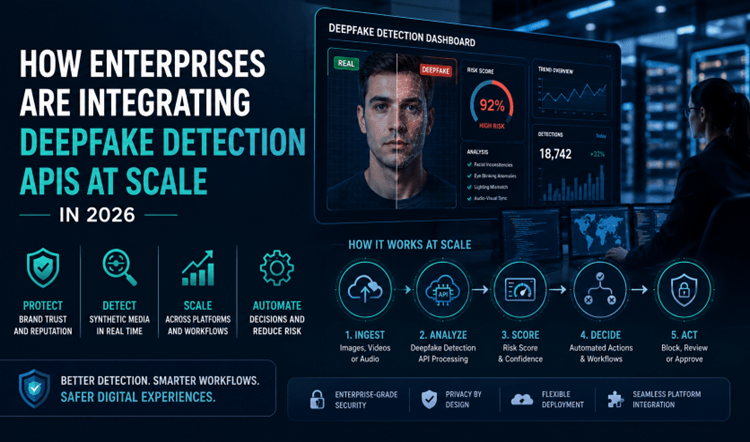
Most enterprise integrations are wired up the same way under the hood. Media enters the system, gets routed to the detection API, and the response feeds into a policy decision or risk scoring system downstream.
Where Detection Sits in a Production Pipeline
Ingest layer detection runs the moment media is uploaded, before it reaches any review queue. Identity verification checkpoint for financial platforms, the check sits inside the onboarding or re-authentication flow.
Webhook notifications results get pushed back in real time,e so flagged content can be held or auto-removed based on confidence thresholds. Batch processing for archival or retroactive scanning, APIs support high-volume jobs with detailed JSON responses including confidence scores and forensic metadata.
Picking the right API comes down to a few things.
Not all APIs are compatible in all environments, and this is what you should focus on for production:
- Range of detection: Ensure detection of videos, images, andaudioi,o and not just a single format
- Latency: For use cases like identity verification, you will need sub-second response times, so scrutinize the SLA
- Confidence scoring. A more detailed evaluation will enable you to set thresholds that outline your specific risk instead of a yes or no answer
- Recent detection models: Check if the deepfake detection models are trained on the latest media
- Integration: At the very least, be on the lookout for a REST API with some webhook support and thorough documentation
Multimodal Coverage: Why Video Alone Is Insufficient
In the past, detection tools emphasized only facial manipulation in videos. This working model is no longer applicable. In fact, audio deepfakes are one of the fastest-growing threats, especially with cloned voices being used in various types of fraud as well as voice biometric systems violations.
It is important to ensure that your detection systems are capable of analyzing videos, images, and audio in a single system to make them easier to manage and more resilient to fraudulent attacks compared to a collection of systems.
Conclusion
Deepfake detection at enterprise scale is a core part of any serious content or identity security stack in 2026. The platforms getting this right have moved detection upstream into the ingest and verification layer rather than relying on manual review after the fact. Make sure the API you choose covers all three modalities, returns actionable confidence scores, and fits cleanly into your existing pipeline without adding unnecessary latency.
Popular on OTW Right Now!




About The Author

Gagan Bhangu
Founder of otechworld.com and managing editor. He is a tech geek, web-developer, and blogger. He holds a master's degree in computer applications and making money online since 2015.