
CRM Integration Checklist: Systems Your Business Should Connect Before Go-Live
Many businesses view CRM go-live as the finish line, requiring that all integrations, system connections, and data pipelines be completed before launch. This approach is a common cause of failed CRM rollouts. Whether partnering with a CRM software development company in India or managing an in-house project, the timing and order of integrations are more important than the number completed before go-live. Sequencing should drive your checklist; otherwise, it is simply a list of tasks.
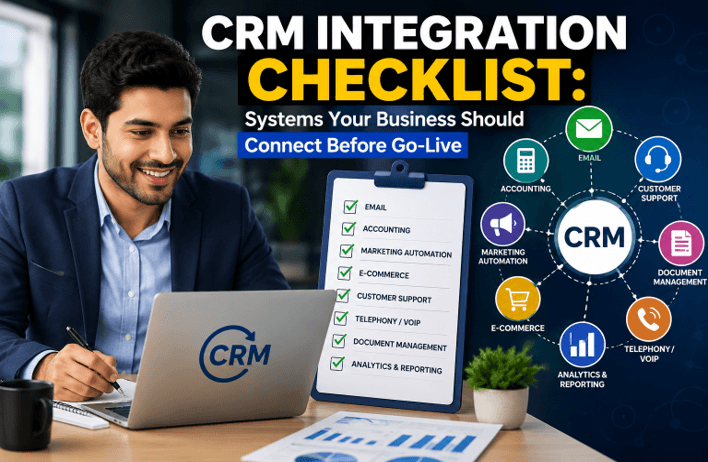
The Real Reason CRM Go-Lives Fail
The mainstream belief about most CRM implementations is that the more complete the integration, the more ready the implementation is. IT teams go through a system checklist, ensure that APIs are set up, and announce that the environment is live. The same is ignored: Have all integrations been tested under realistic data conditions thoroughly enough to identify edge cases?
If all of them are considered important, none will be tested with the level of rigor they deserve. Error-handling code is not well developed. Edge Cases are identified and postponed – duplicate record cases, field-mapping mismatches, time zone issues with date-stamped data, etc. Businesses that attempt full-stack CRM software development integration before go-live report the highest rates of data sync errors, user adoption failures, and partial rollbacks within the first 90 days.
It’s not being ambitious that’s the problem. It’s a lack of a triage system. The more systems you connect, the less risk you reduce when implementing CRM. It’s minimized when the proper systems are integrated at the appropriate time, with the number of layers of proof that each connection really needs.
What “Day 1 Critical” Actually Means in CRM Integration
The rule for a Day 1 integration is pretty clear: a system that would not be present on go-live day that directly impacts any revenue-generating or customer-facing workflow. Not the kind of system that would help a business on day 1, if it didn’t have.Not the kind of system that would help a business on day 1 if they didn’t have it.
Pipeline and Contact Data Systems
Day 1 connections such as sales pipeline tools, lead capture forms, and contact databases are essential. Improperly opening the CRM by reps on launch morning, with incomplete, mismatched, or disconnected pipeline data, leaves them flying blind from the get-go.
The ability to prevent the duplicate contact issue. With a legacy system and the new CRM both on “live” during a migration period without a two-way sync, both systems start creating records. The contact database is broken in a few days. There are two main sources of truth for sales reps, but neither is reliable.
Billing and Deal-Closure Triggers
Whenever CRM deal stages are connected with invoicing, subscription activation, or payment processing, it is deemed Day 1 critical. A deal won and not seen in billing is a minor gap, not a minor leak.
The most common sequencing mistake is delaying the ERP-CRM sync until the finance team approves the configuration. The business will complete its first billing cycle on an unconnected system, which can take anywhere from two to four weeks. In the weeks that follow, the amounts that must be reconciled often take two billing periods to clear.
Reporting dashboards, HR system sync, and territory mapping tools are explicitly not Day 1 critical. Their absence creates friction. It does not break revenue.
The Phase 2 and Phase 3 Integration Stack
In fact, the postponement of an integration is a conscious risk-management decision – not a lack of planning. Phase 2 is for days 30- 60 post-go-live. Phase 3 targets Days 60–90.
Phase 2 — Operational Intelligence Connections
Marketing Automation Tools fall in the “Phase 2 – NOT pre-launch” segment. Integrating them before go-live means that the CRM data is available to the marketing campaign audiences before it has been cleaned, deduplicated, and/or validated. This results in segmentation based on incorrect data and is not very convenient, as each campaign is executed on top of it.
The same applies to customer support and helpdesks. Linking ticket-to-deal before the support team has finished onboarding CRM means that workflows are not internalized and ticket-to-deal linking is configured against non-internalized workflows. Once adoption reaches a level of stability, those configurations have to be rebuilt — twice as much integration.
Phase 3 integrations are readiness-condition-based and not calendar-based. Clean CRM data is needed to populate dashboards with accurate information, a process that can take anywhere from 60 to 90 days. They are connected at go-live and generate early pipeline reports that undermine leadership, deceive the leadership team, and weaken the system far more quickly than any technical failure could. So, don’t automate your HR and territory management system until headcounts, role assignments, and quotas are settled down after the launch. Given the fluid structure of your organization, your routing rules would need regular manual updates, making the integration pointless.
How to Build Your Integration Sequencing Map Before Go-Live
Step 1: Run a workflow dependency audit. For each one of the proposed integrations, write down exactly which business action fails when the integration doesn’t exist on Day 1. If no specific action breaks, the integration is NOT Day 1 critical.
Step 2: Assign a revenue-impact score. Assess each integration on three levels: Operational friction only, Delayed revenue loss if not there, Immediate revenue loss if not there. This score will have no negotiation of priorities about placement in phases.
Step 3: Define the readiness condition for every non-Day-1 integration. A Phase 2 and Phase 3 connection must have a documented threshold: a benchmark of data quality or a user adoption milestone or a process validation checkpoint (threshold) that is confirmed before activation.
Step 4: Build a phased integration calendar with named ownership. Each deferred integration requires a system owner, a readiness condition checkpoint date, and a “fallback protocol” if the condition is not satisfied by that date.
This map is subject to change. Compare it against the actual go-live data at the end of each phase, rather than leaving it as a pre-launch artifact that’s forgotten.
What a Sequencing-First CRM Checklist Looks Like in Practice
The typical CRM integration checklist is linear: ERP, marketing automation, support desk, BI tool, HR system. A sequencing-first checklist is tiered, conditioned, and owned.
Let’s think of a middle market B2B company that needs to connect to 5 different target systems. In the flat-list model, all five are grouped and treated as pre-go-live requirements. With a sequencing-first approach, the ERP Billing trigger and the contact database sync take effect on Day 1. In Week 5, Marketing Automation comes into play when those initial 30 days of pipeline data have been validated and deduplicated. After the customer success team has completed CRM onboarding, the support desk follows in Week 7. In Month 3, the BI tool and HR system “connect” when the data environment can provide a self-consistent baseline.
Every CRM software development company in India operating at the implementation level — rather than just the build level — should guide clients through this sequencing logic before a single integration is activated.
The compounding benefit is direct. A sequenced go-live produces cleaner data in Weeks 1–4. That cleaner data improves the quality of the configuration for every subsequent Phase 2 and Phase 3 integration. For leadership teams, the implication is clear: integration sequencing reduces the total cost of CRM software development and implementation by eliminating emergency hotfixes, reducing manual reconciliation, and removing the reputational cost of a visible system failure at launch.
Partner With a CRM Implementation Team That Sequences for Success
Many CRM deployments fail, and it’s not because of the technology. They fail because the integration strategy assumes all the connections are important and all are ready. A sequencing-first approach is a more phased, conditional, and owned approach to implementation instead of a one-size-fits-all checklist.
Arobit brings deep technical and strategic expertise to every CRM software development engagement — not just at the build level, but at the implementation strategy level. Whether it’s establishing Day 1 critical connections, planning Phase 2 and Phase 3 readiness conditions, or anything else, Arobit’s team makes go-live a controlled and validated event—rather than a high-stakes scramble. You have a CRM software development company in India that can develop a sequencing strategy if your organization is preparing for a CRM rollout.
Frequently Asked Questions
What is integration sequencing in a CRM implementation?
Also, integration sequencing involves ensuring that all CRM connections are phased, considering revenue impact and readiness parameters, rather than trying to do them all at once before go-live. It’s not a plan B for unfinished or unfulfilled delivery.
Which CRM integrations are always critical on Day 1?
Revenue generation/workflow or customer-facing workflows that are broken on the launch day due to the absence of integration(s) are considered Day 1 critical. Contacts that connect to database sync/billing triggers always match this criterion. Not often do marketing automation, BI tools, and HR systems do that.
Why should marketing automation be deferred to Phase 2?
Data that has not been validated and may be duplicated is added to campaigns through automation before go-live. This skews the segmentation logic used in the first campaign. With pipeline data cleaned for 30 days, Phase 2 connection results in much more accurate audience targeting.
How do we define a readiness condition for a deferred integration?
A readiness condition is a documented, specific data quality threshold, user option milestone, valid process checkpoint, or other condition that must be met. Phase 2 or Phase 3 integration is enabled, providing time-bound decision-making with a measurable go/no-go standard.
Popular on OTW Right Now!




About The Author

Gagan Bhangu
Founder of otechworld.com and managing editor. He is a tech geek, web-developer, and blogger. He holds a master's degree in computer applications and making money online since 2015.