
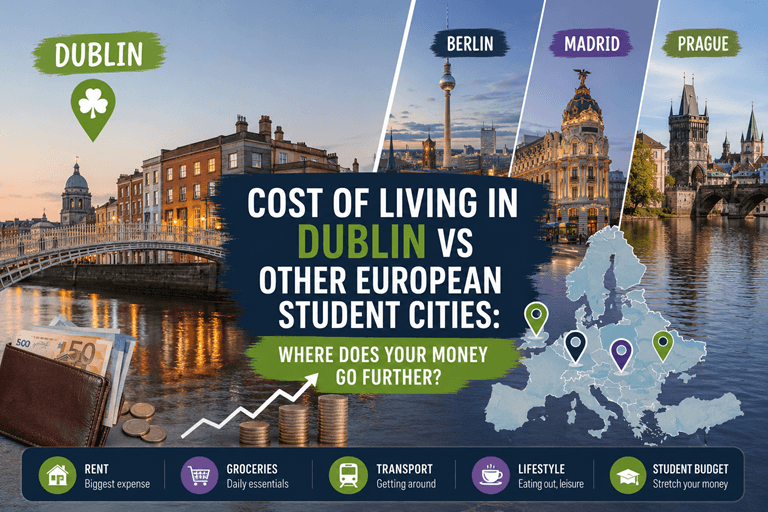
Cost of Living in Dublin vs Other European Student Cities: Where Does Your Money Go Further?
Choosing a study destination for yourself is not just about university rankings; it is also about your budget. And for international students going to Ireland to study, one of the most common questions is “Can I actually afford to live there?” Dublin is known for its “Silicon Docks” tech hub, rich history, and vibrant culture. But it is also known for its higher cost of living.
That is why, in today’s guide, we are going to compare the cost of living in Dublin with that of other European cities, such as Berlin, Madrid, and Amsterdam. Whether you are looking for student accommodation in Ireland or planning your monthly expenses, this guide clearly shows where your money will go further.
Dublin’s Economic Landscape
As one of the major economic hubs of Ireland, Dublin is considered one of the top tech cities in Europe. It is home to some of the best companies, such as Google, Meta, Pfizer, and LinkedIn. Because of this, students never fall short on great job opportunities after graduation. Their starting salary usually ranges between €35,000 and €45,000. However, this strong economy also makes the cost of living higher. Below are the key economic highlights of Dublin:
- Student Population & Density: More than 120,000 students live and study in Dublin. This makes it one of the youngest and most lively cities in the EU. Amongst them, around 33,000 of these are international students, which is about 27% of the total, creating a very multicultural environment.
- The Housing Demand Gap: In 2026, Dublin still has a shortage of student housing. This has created a gap of about 15,000 to 20,000 beds. Because of this, Student accommodation in Dublin is usually 98% full by late July. That is why it is important for students to book early.
- Inflation & Expenditure Trends: Ireland’s inflation rate in early 2026 remains steady at around 2.1%; however, rent continues to be the largest expenditure. On average, housing takes up 55% to 60% of a student’s monthly budget in Dublin.
- Economic Growth: As the city’s economy is growing, approximately 3.5% GDP growth is expected, which is higher than the EU average. This means that for students, there will be more opportunities for part-time jobs. Many students are covered by the National Minimum Wage of €13.50 per hour, which enables them to afford their living expenses.
Student Accommodation Dublin
One of the main problems for international students in Ireland is student accommodation. Despite the cost, there are a few students who still prefer to live in purpose-built student accommodation. The reason being it has more of an organised and secure living setup. The following is a comparison between student apartments in Dublin and other European cities:
- Dublin: The average rents for Student accommodation in Dublin in 2026 range from €295 to €425 per week. D1, D2, and D7 are the highest priced areas, being near Trinity College Dublin and TU Dublin. These rents typically cover all utilities (including heating, gym access, 24/7 security, and Wi-Fi); however, this is great as utility bills in Ireland vary by 15-20% between seasons.
- Berlin: This is on average €650- €900 per month (approx. 30% lower than Dublin). But the real question is where and how to find a place. The vacancy rate is low, and students could look for a vacancy for 3-4 months, and many landlords will ask for a “Schufa” credit check, which new international students might not have.
- Madrid: Rental rates for accommodation are cheaper, between €550 – €800 per month. Students typically spend 35% of their budget on rent – between 50-60% in Dublin – freeing up more resources for travelling and living.
- Amsterdam: The market here is just as difficult as Dublin when it comes to housing. A small studio can cost €1,000 to €1,350 per month. Strict rules on room sharing mean fewer shared student options, so many students end up living in more expensive areas outside the city.
Final Verdict:
When it comes to renting, Dublin may be challenging if you want to pay as little as possible. However, many students still opt for Dublin student accommodation by University Living due to the all-in-one renting system. It provides financial stability and safeguards against the ever-rising energy prices that have risen on average 12% in other European cities that do not offer inclusive bills.
Monthly Expenses: Food and Groceries
Each and every time students do a deep dive into their monthly costs, rent consumes a lot of their budget. The food and groceries here, on the other hand quite reasonable when compared with other Western European cities. Ireland is well known as a producer of a significant amount of its own food. Therefore, it is often possible to find fresher and sometimes cheaper meat, dairy, and fresh vegetables than in the city, such as Amsterdam or Berlin. Food inflation in Ireland is at a level in 2026 (2.4%), making it more manageable for students to budget their monthly costs. Below are the average prices of groceries in Dublin:
| Item (Average Price) | Dublin (€) | Berlin (€) | Madrid (€) | Amsterdam (€) |
| Milk (1L) | 1.28 | 1.15 | 1.05 | 1.35 |
| Loaf of Bread (500g) | 1.75 | 1.90 | 1.25 | 1.95 |
| Chicken Fillets (1kg) | 9.80 | 12.50 | 7.80 | 11.50 |
| Rice (1kg White) | 1.65 | 2.15 | 1.40 | 2.25 |
| Eggs (12 Large) | 3.45 | 3.10 | 2.65 | 3.85 |
| Potatoes (2.5kg Bag) | 3.20 | 3.80 | 2.90 | 4.10 |
In this place, the students have the opportunity to save a lot by shopping smartly. Lidl and Aldi supermarkets combined have an estimated 25.8% share of the Irish grocery market. This makes them very sought after as budget choices. As long as you buy your own-brand products and essentially only shop at these stores, you should be able to control your food budget around €280- €340 per month. Much cheaper than in Amsterdam, where such high-priced stores as Albert Heijn are more prevalent, costing €400+ per month.
Transportation and Connectivity
Dublin is regarded as a small city. This allows for easy travel to the accommodation here for students. In contrast to other big cities like Berlin or London, in Dublin most of the universities and student areas are within walking distance – just 20 minutes or 10 minutes by bike. Below are the transportation and connectivity scenarios in Dublin:
- The Leap Card Advantage: The “Young Adult” Leap Card is especially made for students aged between 19 and 25. It is one of the best ways to save money, giving students a 50% discount on public transport like Dublin Bus, Luas (tram), and DART (train).
- Cost Benchmarking: Most of the students in Dublin usually spend around €50-€70 per month on transport. But compared to Amsterdam, it is a lot cheaper as here students spend around €85-€110/month. And in Berlin, students often get a Semesterticket, which works out to about €30 per month for unlimited travel.
- Cycling Culture: Dublin has improved its cycling system, with a 30% increase in cycle lanes since 2024. Many students use the bike scheme, which costs only €35 per year, making transport almost free.
Conclusion
If you only look at basic costs, cities like Madrid and Berlin are more affordable for everyday living. But “value” is different for everyone. Dublin offers a big advantage with its English-speaking environment in the EU, along with strong job opportunities in the tech and pharma industries and a high minimum wage, which helps students manage their expenses.
By choosing the right Student accommodation in Dublin and using student discounts like the Leap Card, you can control your spending and still enjoy studying in one of Europe’s most dynamic cities.
Popular on OTW Right Now!
-
 How Aceget’s RECD DG Kit Solution Help Businesses Meet Modern Emission Standard
-
 Aceget RECD DG Kit Solutions: Transforming Diesel Generators for Cleaner and Compliant Operations
-
 Top Insurance Agency Automation Trends Every Agency Owner Should Watch
-
 Why Aceget is the Preferred RECD Manufacturer in India for Cleaner and Smarter DG Set Operation




About The Author

Gagan Bhangu
Founder of otechworld.com and managing editor. He is a tech geek, web-developer, and blogger. He holds a master's degree in computer applications and making money online since 2015.