
Commercial Robot Vacuum or Consumer Model for Small Offices
For most offices under 1,500 sq ft with light debris and manageable foot traffic, a consumer robot vacuum is the practical place to start. The robot vacuum for a small office seems simple, but chair wheels, tracked-in grit, and wet footprints by the door get in the way. Whether to get a commercial robot vacuum or to opt for a good consumer vacuum that can get the job done in between cleanings is the real question. Cleaning Demand, Navigation around Chairs and Cables, Wear and Daily Running, Floor Fit and Staff Lightening up Functions.
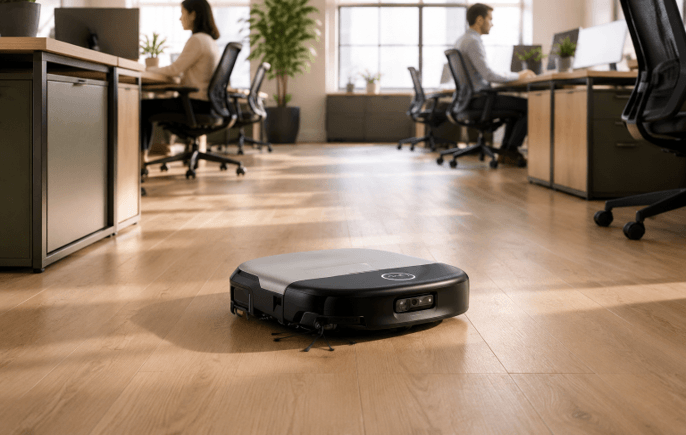
Table of Contents
- How much cleaning demand does your business generate
- Dense chairs and fixtures are the biggest navigation challenge
- How daily cleaning affects batteries, brushes, and motors
- Which flooring types work best with consumer robot vacuums
- Features that reduce maintenance for busy staff
- Conclusion
How much cleaning demand does your business generate
There is more debris created by small commercial areas than by most dwellings. Additional shoes go across the identical entryway. Near the reception is a space created using fine grit. Paper dust accumulates in the areas under desks. Coffee corners and waiting rooms have grey tracks, whereas the rest of the room is dirty. That’s why the initial order should not begin with a spec sheet, but rather three numbers.
Floor area × daily foot traffic × how often the floor must look clean
All three of those factors determine whether or not a consumer robot vacuum will be able to catch up or if a commercial robot vacuum cleaner is the safer option. Consumer models are designed to be used for ongoing maintenance, not the entire cleaning staff.
- Under 1,000 sq ft, low traffic, 1 to 2 runs per day: An excellent fit for studios, private offices, and small clinics with one or two rooms.
- Under 1,500 sq ft, moderate traffic, 2 to 3 runs per day: A good fit if the robot maps the space, can recharge and resume, and runs on a fixed schedule.
- 1,500 to 2,500 sq ft, heavy traffic, 3 to 4 runs per day: Borderline at best, and only when debris stays light and furniture does not move much.
- Over 2,500 sq ft or near-continuous coverage: Usually better served by commercial floor equipment or a dedicated cleaning crew.
When a commercial robot vacuum makes sense
Look past consumer models when the floor needs near-continuous coverage, traffic stays heavy all day, or debris fills the bin every run. Typically, commercial equipment or manual cleaning is enough to remove wet entryway, food preparation crumbs, salon hair, metal shaving, and renovation dust. Commercial robots have a longer duty cycle and are able to carry more weight. Consumer robots can still keep the bottom of the floors dry and open up attractivareas e between deeper professional cleanings, but there are still those “messy” bottoms, bathrooms, regulated clinical areas, and wet bottoms that require human judgment and the appropriate tools. If the entire floor plan does not make a good fit, a dry waiting room or front entry could be a good option for a consumer robot. The error is that everyone thinks that one machine will handle all zones.
Dense chairs and fixtures are the biggest navigation challenge.
If the size and traffic seem feasible, then navigation is the next filter. The biggest pain when it comes to the office is not dirt, it’s movement. Home robots learn layouts with very little moving furniture, whereas small offices move their furniture all day long. Chairs move away from desks, bags get placed near walls, delivery boxes are placed in the hallways, and charging cables are strewn across the floor leading up to meetings.
The robot has to bump, back up, and turn to change direction to try the obstacle again. One desk chair is easy to deal with. The legs of eight rolling chairs at odd angles can create a ‘maze’ in a conference room. Eight rolling chairs at odd angles can create a ‘maze’ in a conference room. A misread path that reaches a product stand or plant display, or even a medical stool that rolls into a client space, can impact client areas, not simply waste a couple of minutes.
It’s easy to navigate if someone can lay the floor before they go on each time they run.
- Chairs are able to be pushed in or lifted prior to runs if needed.
- Power cords are able to be clipped off the floor.
- The robot is able to fit on display racks with space to spare.
- Doors are low and will open easily.
- A no-go zone can be used to close down sensitive or obstructed areas.
Navigation that works in a quiet hallway may still struggle with chair legs, cords, and display racks here. If you are comparing models by navigation style, suction strength, and station setup, the eufy robot vacuum is a useful place to see how different designs handle tight business layouts before you commit to a daily route.
How daily cleaning affects batteries, brushes, and motors
The frequency of use for a consumer robot vacuum could be once a day or a few times a week in the home setting. If you are working in a small office, then you may require a morning pass, a lunch cleanup, and a closing route. This will lead to increased wear on brushes, filter clogging, battery cycles, and motor loads over time. A broken robot is not the first indication of strain. This can be grit in the vicinity of the door, a brush that tangles more quickly, or a dustbin that is filling up before the run is completed.
What daily run schedules are realistic
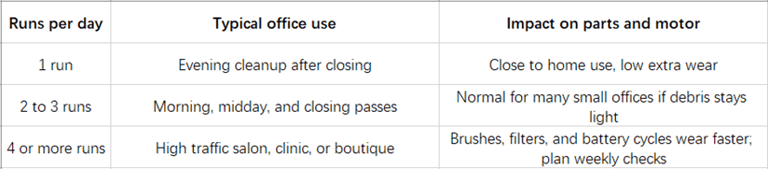
Motor decline will typically manifest later than brush/filter issues, but will be reduced whether there are n heavy daily schedules. A commercial robot vacuum is designed for longer duty cycles, but if the debris is light and the routes are predictable enough, then a consumer model will be the right place to begin. The drop in suction after the fresh brushes and clean filter may play a part in the motor.
How often will you empty the dustbin?
Faster filling of bins with commercial debris loads in comparison with the typical home. The self-emptying stations work, but someone needs to be present to check bags, station bins, and filters on a timely basis. Any interval below is affected by the amount of hair, craft debris, or heavy entry grit.
- Small office: Every 2 to 3 days on a morning-and-closing schedule.
- Salon: Daily, when hair and product dust pile up across several runs.
- Boutique: Daily; entry grit and fitting room lint add up fast on hard floors.
- Clinic: Every 1 to 2 days; check the door area sooner after wet weather.
Which flooring types work best with consumer robot vacuums
The change of floor materials affects pickup, safety of mops, and the rate of brush wear. A lot of small businesses have surfaces that overlap within one suite, so the robot must have rules that are tailored for each zone.
- PVC and sealed vinyl: Typically, they are all right. The footprints are fast appearing, and daily passes by robots are beneficial, and most consumer robots don’t cause a lot of drama around hard floor debris.
- Til e: Level tile transitions are good.Transition: Level tile transitions are good. The robot works better on maintaining the tile’s appearance than on cleaning one grout stain at a time.
- Low pile commercial carpet: May work with a short, stable pile. Tie or cover mats, chair mats, and loose rugs, as these can be confusing with routes and trap wheels.
- Thick commercial carpet or plush rugs: A weaker match. The longer the pile, the less pickup, the more brush tangling, and the more critical the lifting of the mop becomes if the robot needs to lift the mop when dealing with hard floors in the vicinity. For carpet that covers most of the client area, try a short path first and monitor the brush/filtration requirements to see if they require maintenance before the manual recommends.
Before purchasing, determine the real floor mix in the business, rather than the floor plan provided in a lease agreement. There is a difference between the needs of a studio that has a combination of hard floors and a low-pile waiting room, and a salon that has hair on short carpet and product dust near the entrance. When you have mixed zones, such as areas where there is a vacuum and an area that is mopped, or an area that is off limits around loose mats or thick rugs, this is when a mixed suite is most beneficial for the app.
Features that reduce maintenance for busy staff
Business owners typically don’t require any other device that generates chores. The right robot vacuum should reduce interruptions to staff who are already on the phones, providing services to clients, ordering supplies, closing at night, etc. You can use the chart below to correlate typical office headaches and features to review first.
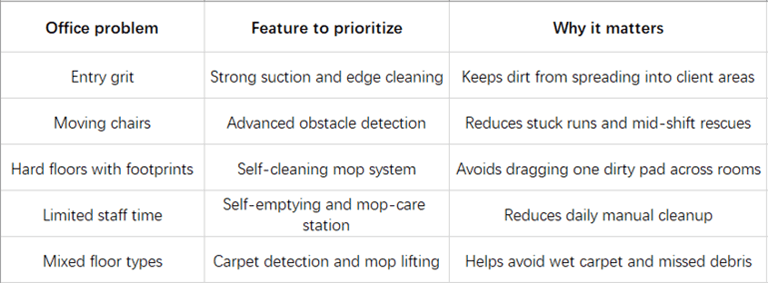
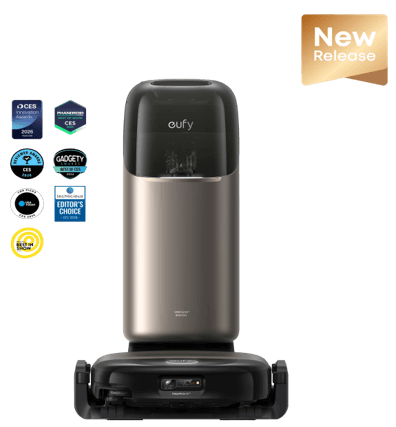
To see how those features can sit on one consumer unit, you can start with the specs on the eufy Robot Vacuum Omni S2. It is one that has been created for multiple passes/day. AeroTurbo™ 2.0 provides up to 30,000 Pa suction when entering grit and low pile carpet. CleanMind AI is capable of identifying 200+ obstacle types, such as shoes that change during runs and cables. HydroJet™ 2.0’s roller mop rolls clean as it cleans, which means that a dirty pad is less likely to drag the dirt around in rooms. The UniClean™ 12-in-1 station eliminates the need to wash the mop, hot air dry, empty the dust, pipette the detergent,t and perform other tasks at the dock between dock routines.
Not an alternative to commercial janitorial equipment, but it helps to have less dock tending between customers. Adjust floor space, trash, traffic, and maintenance schedule that your staff will follow.
Conclusion
For most small offices, the consumer robot can be an affordable option if space, foot traffic, and frequency of cleaning are within consumer boundaries. Consumer models are ideal for less than 1,500 sq ft, and when debris and furniture items can be anticipated and cleaned in advance of every run. If there is a great deal of mess, a wet floor, or changing layouts, you’ll need a commercial robot vacuum or manual cleaning. Correlate the selection with the actual floor, and maintain the routines for the dustbin, parts, battery, and dock, ensuring they are not too complicated for staff to use after one month.
Popular on OTW Right Now!



About The Author

Gagan Bhangu
Founder of otechworld.com and managing editor. He is a tech geek, web-developer, and blogger. He holds a master's degree in computer applications and making money online since 2015.