
Can Your Learning Management System Withstand Peak Usage Without Compromising Performance or Security?
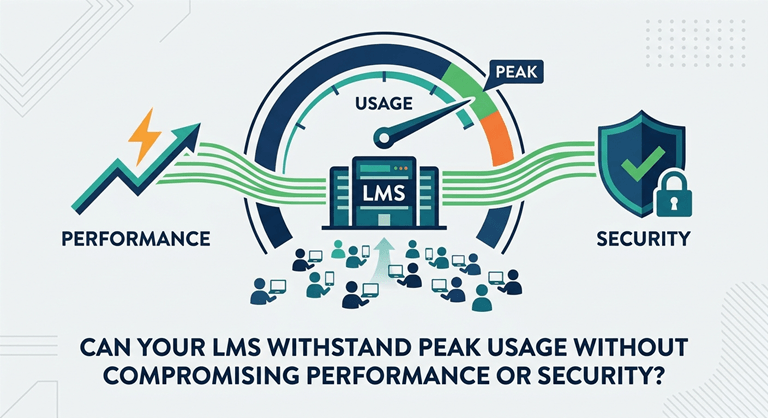
Peak usage reveals character. A learning management system looks calm at noon on a Tuesday, then panics at 8:55 a.m. when thousands of students slam the refresh button like gamblers at a slot machine. That moment doesn’t just test servers. It challenges the quality of the governance, budgeting, and engineering discipline, and the tolerance of excuses of the institution. There is no such thing as performance and security compromising. They collide. Slow pages entice hacks. Open holes due to rushed fixes. Dashboards and vendor pledges are administrator favorites, while peak load is a skeptic of marketing. The question is, what does the break first,t, and then what does the break next?
Peak Load Is a Truth Serum
The term “stress” isn’t appropriate to Peak usage. It interrogates it. Activities that can take place during a course include login storms, deadlines, video streams, proctored exams, Gradebook Syncs, and LTI tool calls. All at once. They chase features ado nd not consider capacity math, then get surprised by increasing latency, and sessions go down. A serious team takes into account the concurrency, writes to the database, hit ratios in the cache, the depth of the queues, and plans for peaks, not averages. Hosting choices matter, and the best VPS hosting can fit when sized with discipline and paired with monitoring. Blindly scaling without load testing turns into an expensive trick.
Performance Fails in Predictable Places
A slow learning management system (LMS) rarely suffers from one dramatic flaw. It’s riddled with minuscule and pompous decisions. An unoptimized database with no tuned indexes. If a file store fails to accept the uploads. A search feature that searches the same tables that are searched in the gradebook. Architecture is considered to be a part of interior design. Strategic display of pretty screens, weak bones. Chatty integrations aren’t spared from punishment either in the form of peak traffic. All of the external tools introduce a hop, another hop, and then a timeout when students need stability. Solves problems that sound commonplace, but are not. Optimize reads that are repeated by adding caching. Place background jobs in their own queues so as not to block clicks. Test load – repeat tests under deadlines.
Security Doesn’t Pause for Exam Week
Security teams hate peak usage because attackers love it. Confusion hides bad behavior. Credential stuffing looks like stressed students forgetting passwords. Injection attempts hide inside floods of form posts. The LMS must remain calm. Strong authentication, sane rate limits, and tight session handling matter during spikes. Logging should not be allowed to fall apart and result in dropped events. Such a system in heavy usage is begging for some regulatory issues and an academic integrity meltdown. It’s time to fix those patches; we don’t have an entire weekend for that. Midnight Hot Fixes are out, and a disciplined release process and tested rollback plan prevail.
Governance, Not Gadgets, Makes It Survive
Weak habits are remedied by the purchase of tools by the institutions. That never works. It’s imperative that an LMS is owned. Clear service targets. A chart indicating the dates of known surges. A capacity plan based on enrollment and not wishful thinking! The maintenance responsibilities and timeline should be determined by the endor and/or the internal team in case of failure. Run game days. Deliberately cut parts in staging. Water down the incident response for it to be “boring”. Boring equals ready. Cost control should be part of this discussion as well, since a system that “scales” to bankruptcy is a system that is a failure. Be sure to establish budgets, limits, and ask for monitoring data, not vibes.
Conclusion
Trust gained is harder to come by than can be found in brochures, and an LMS that will withstand the peak usage is one of those that will. There is a speed,d but when there is speed without safety, then it is a scandal. While safety is paramount, if speed is the focus, then shadow systems and shortcuts to safety will result in unsafe situations. The smart approach is based on the assumption of “peak load” as the enemy and planning accordingly. The performance spine consists of the disciplines of capacity planning, load testing, caching, database tuning, queueing, and integration. The security spine comprises authentication rigor, rate limiting, logging, patching, and incident response. Two spines. One organism. Training both and exam week doesn’t seem like a problem.
Popular on OTW Right Now!



About The Author

Gagan Bhangu
Founder of otechworld.com and managing editor. He is a tech geek, web-developer, and blogger. He holds a master's degree in computer applications and making money online since 2015.