
Does a Bigger Cooker Hood Always Mean Better Extraction? What Actually Matters
A larger cooker hood can look like the obvious choice for controlling steam, grease, and cooking odors. However, size alone does not determine how effectively a hood removes airborne pollutants. A wider hood can cover more of the cooking surface, but performance also depends on extraction airflow, capture efficiency, ducting, installation, kitchen layout and cooking habits.
Not every size of a model is the best size for homeowners. It is a good idea to match the hood coverage and extraction to the hob, kitchen, and how it is used. This will make it easier to assess if adding more will have a real benefit to the ventilation or if it is just an expense, noise, and bulk to the visual design.
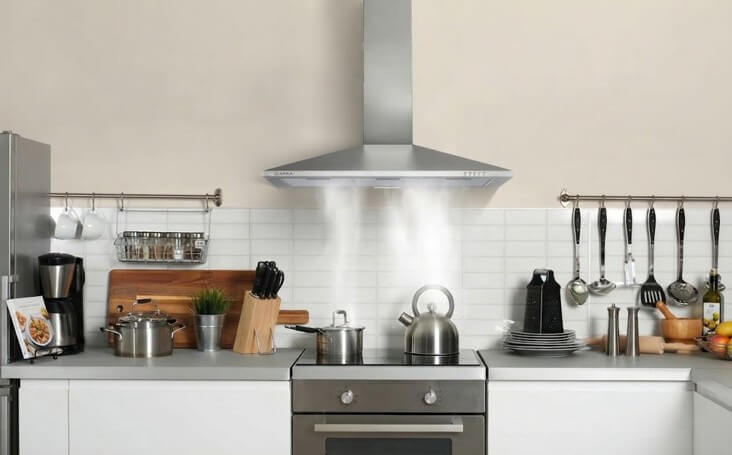
Does a Bigger Cooker Hood Actually Extract Better?
Not necessarily. A large cooker hood will have a larger capture space, which could help to stop steam, grease and smells rising or spreading beyond the rim of a cooking surface. This can come in handy if you have multiple burners or zones operating at the same time, or if you place pans on the sides of the hob.
However, width and extraction are not synonymous. A large (mis-sized, poorly designed, or poorly installed) hood with poor airflow can be less effective than a smaller hood properly designed and properly sized. The fan must move air efficiently, and the hood must be designed so airborne contaminants are entrained by the hood before they disperse throughout the room.
The size of the hood is therefore not to be regarded merely as a performance rating. Larger does not necessarily mean better extraction. One specification sheet measurement isn’t enough to make a whole ventilation system.
Why Cooker Hood Width Still Matters
While it’s not all about width, it is still a key factor when making a cooker hood selection. The hood should cover the cooking surface sufficiently for there to be a reasonable chance of the steam, smoke and grease being captured. If the hood is significantly smaller than the hob, emissions from pans that are away from the edges may leak past the hood before they can be captured.
For a wider cooking surface, a 90cm cooker hood may therefore provide more practical coverage than a narrower model, especially when several cooking zones are used. The benefit is not that 90cm automatically means more powerful extraction; it is that greater width can create a larger area over which the hood can capture cooking by-products.
Width is also important when designing and installing the hood. Different airflow and exposure to room currents between a wall-mounted and an island model can cause them to act differently. Therefore, width should be taken into account with the type of hood, the size of the hob, and the layout of the kitchen.
What Actually Determines Cooker Hood Extraction Performance?
Rather than one big headline spec, a number of related factors affect extraction performance. One of the most noticeable is airflow capacity; it shows how much air the fan can move under specific test conditions. But high airflow doesn’t mean every kitchen will have equally effective extraction.
Capture efficiency is also important. A hood must capture steam, grease, and odors up close to where they are generated so they don’t spread. A properly placed and sized hood with the right coverage may use the air it has more effectively than a large fan placed too high, too far forward, or not sized properly for the cooking area.
The hood’s performance also depends on its internal construction, filters, and fan system. Filters should be replaced regularly, as the buildup of gunk can lead to poor air circulation and cleanliness. There’s also the noise level: an irritatingly loud and technically advanced hood might be less worn than it would be otherwise.
| Factor | Why it matters |
| Hood width | Determines how much of the cooking area can be covered |
| Extraction airflow | Influences how much air the fan can move |
| Capture design | Helps contain steam, grease, and odors near the source |
| Ducting | Can affect how efficiently extracted air reaches the outside |
| Installation | Influences capture position and overall effectiveness |
| Maintenance | Helps the system continue operating as intended |
The important thing is that these factors are interrelated. When comparing just the wattage, fan speed, or maximum extraction, it can give a skewed perspective. It’s best for homeowners to think about the way the hood will function in the real kitchen, rather than what it sounds like on paper.
Why Ducting Can Matter More Than Hood Size
The cooker hood will not work properly if the extracted air pathway is not optimized. With an external vent, long duct runs, multiple bends, flow restrictions, and/or ducting size that is not appropriate can cause a rise in resistance to flow. This can result in less-than-optimal air delivery at the point of use.
This is important if replacing an existing hood. If the ductwork route in a home is too small or the system isn’t powerful enough, a homeowner may find it to be an upgrade that doesn’t provide much benefit. The limiting component of the system may become the ventilation path.
Recirculating hoods operate differently by filtering out the air and sending it back into the room instead of outside. The performance of these is thus largely dependent on filtration and maintenance of the filters. Hood size cannot be the only determining factor for either arrangement.
Before selecting a model, inspect the duct location, the duct’s straightness, and, if necessary, whether the installation requirements are feasible. If the ventilation path is inadequate, you may need a larger hood to address it, but the added cost may not solve the problem.
Does Kitchen Size and Layout Affect the Right Cooker Hood?
Kitchen size matters, but it’s not the only factor. Cooking fumes can quickly build up in a compact and enclosed kitchen as there is less space to spread. A large open-plan kitchen can allow contaminants to spread further into the dining and living space, and effective capture is more important.
It is also important that the hob be set at the proper height. The cooking area on an island is ventilated from multiple directions, whereas a hob mounted on a wall is ventilated differently. Air currents from doors, windows and ceiling fans will affect the direction of steam and odors.
Therefore, there is no single size that fits all for the hood. All of these factors must be taken as a whole – the cooking surface and layout of the room, as well as the arrangement and installation of ventilation. While kitchen size matters, it shouldn’t be the only factor when choosing extraction equipment.
Does Your Cooking Style Affect How Much Extraction You Need?
Your cooking style can also affect the ventilation you need, as much as the size of the cooking area. A household where someone is primarily cooking light foods or boiling water will have lower grease and steam production than a household where a significant number of foods are likely to get fried, seared, grilled or cooked at the same time.
Cooking at high heat may create higher plumes of heat, vapor, and airborne grease. These emissions can spread very rapidly, especially if pans are not covered or placed close to the end of the hob. The convenience of hood operation, and its reasonable quietness and maintenance, are additional requirements when cooking frequently.
Cooking surface can be significant also. Cooking with gas adds combustion by-products to normal cooking emissions, and electric and induction cooking present varying heat and airflow. Select extraction performance based on how one cooks; don’t assume a larger hood.
What Should Homeowners Check Before Choosing a Cooker Hood?
First, measure the hob/cooktop and decide how much area the hood needs to cover. Check cooking areas, positioning of pans, and whether multiple zones are used simultaneously. It isn’t wise to pick the largest hood possible that you can find; it should be the proper size for the cooking area.
Then look at the extraction specification; try to interpret it in conjunction with the rest of the installation. Determine if the hood is external extraction or recirculation and know the difference. Check the duct path first to see whether you can vent the hose/duct to the outdoors before deciding a stronger hood will solve the problem.
Another practical point to consider is the installation height. Apply the manufacturer’s recommended clearance, as clearances do affect capture and safe operation. When considering ductwork for your home, homeowners should also consider how seamlessly it operates, how easy it is to control, how the lighting works, and how easy it is to handle and remove grease filters.
Use this checklist:
- Match hood coverage to the cooking surface.
- Compare extraction performance rather than relying on size alone.
- Check the ducting route and ventilation arrangement.
- Follow the recommended installation height.
- Consider cooking habits and kitchen layout.
- Think about noise and ongoing filter maintenance.
If comparing individual models, evaluate the complete specification and installation requirements rather than choosing based on appearance alone. For example, when considering a model such as Ciarra One, the useful question is not simply whether it is large enough, but whether its coverage, extraction method, installation requirements, and features suit the intended kitchen.
When Does a Larger Cooker Hood Actually Make Sense?
If the cooking surface is large, many cooking areas are used, or there is a lot of grease and steam released during cooking, a larger cooker hood may be a good idea. It can be especially useful for families that cook using several pans or high temperatures.
In open-plan kitchens, there may also be reasons to consider more extensive coverage – when cooking is contained close to the hob, it is less likely for cooking fumes and airborne grease to spread to other parts of the home. Under these conditions, the extra capture area can be an asset.
However, a larger hood is not a substitute for effective installation. Increasing the size of the hood may give disappointing results if it is ducted, the hood is positioned poorly, or the kitchen’s ventilation arrangement is not conducive to the hood. The goal is an appropriately sized system and proper installation, not the largest system that fits on the job site.
The Bottom Line: Bigger Isn’t Always Better
As cooker hoods get larger, they can offer greater coverage, but this doesn’t necessarily mean they are more effective at extracting. Real-world performance is dependent upon the interaction of width with airflow, capture design, ducting, installation, kitchen layout, cooking practices, and maintenance.
The smartest approach is to choose a hood designed to complement the cooking area, kitchen needs, and the overall venting system. Size is a consideration, but not a deciding factor. When choosing a cooker hood, alongside these practical considerations, Ciarra Appliances’ cooker hood selection is worth considering. Look beyond size and consider how the home is used, how it’s covered, how it’s extracted, and any installation requirements.
FAQs
1. Does a bigger cooker hood always provide better extraction?
No. Several factors affect extraction capacity, including airflow, capture design, ducting, installation, and maintenance.
2. Should a cooker hood be wider than the hob?
In many cases, a hood that extends over the cooking area will improve capture, especially for multiple cook zones or pans near the edges.
3. What is more important, cooker hood size or extraction power?
Both should not be viewed in isolation. The effectiveness of extraction depends on proper hood coverage, airflow, proper hood design, and correctly installed ducting.
4. Does ducting affect cooker hood performance?
Yes. Long duct runs, too many bends, duct restrictions, or duct size can decrease the amount of effective airflow. If designed poorly, a powerful hood can then fail to function as expected.
5. Is a 90cm cooker hood better than a smaller hood?
Not automatically. The wider airflow, design, installation, and ventilation system of a kitchen will still determine the performance of a 90cm hood, which is useful in a larger hob or when cooking in multiple zones.
Popular on OTW Right Now!



About The Author

Gagan Bhangu
Founder of otechworld.com and managing editor. He is a tech geek, web-developer, and blogger. He holds a master's degree in computer applications and making money online since 2015.