
Amazon Product Ranking Factors: How the Algorithm Ranks Listings
Definition: Amazon product ranking factors are the algorithmic signals, performance metrics, and listing relevance attributes that Amazon’s search engine evaluates to position products on search engine results pages (SERPs).
TL;DR
Amazon’s ranking system exists to maximize Revenue Per Search (RPS). Unlike Google, which rewards informational dwell time, Amazon rewards immediate purchase intent and conversion velocity. The core ranking engine—driven by the A10 framework alongside AI models like COSMO and Rufus—weights recent sales velocity, unit session percentage (conversion rate), and fulfillment reliability above keyword frequency. To rank on page one, sellers must combine accurate backend listing attributes, competitive pricing, high stock availability through Fulfillment by Amazon (FBA), and targeted paid traffic. When you drive consistent sales through paid search and keep customer returns low, organic rank rises and stays defensible.
How Does the Amazon Search Ranking Algorithm Work?
The Amazon search ranking algorithm evaluates product listings to predict which item a shopper is most likely to buy immediately. It calculates a real-time score for every product catalog number (ASIN) by balancing keyword relevance, historical sales performance, and operational reliability.
Amazon’s primary goal is gross merchandise value (GMV). If two competing products match a search term like “ergonomic desk chair,” the algorithm places the product that generates higher revenue per click at the top of the search results page.
[Shopper Search Query]│
▼
[Amazon Search Engine (A10 + COSMO)]│
┌───────┴──────────────────────────────┐
▼ ▼
[Semantic Relevance & Intent] [Performance Signals]- Title & attribute matching • Unit Session % (CVR)
- Knowledge graph relationships • 7-14 Day sales velocity
- Backend search terms • Click-Through Rate (CTR)
└───────┬──────────────────────────────┘
│
▼
[Operational & Delivery Filters]- Regional FBA stock availability
- Prime delivery speed (1-2 days)
- Order Defect Rate & Buy Box %
│
▼
[Final Organic Search Rank (SERP)]The system operates across three distinct computational layers:
- Textual and Semantic Indexing: The algorithm reads listing titles, bullet points, backend attributes, and structured catalog fields to confirm product eligibility for a query.
- Behavioral Performance Analysis: The engine evaluates click-through rate (CTR), conversion rate (unit session percentage), and sales velocity over 7-day, 14-day, and 30-day windows.
- Intent-Based Knowledge Modeling: Machine learning systems analyze customer intent and common-sense relationships to match products even when search terms do not contain exact keyword matches.
What Are the Most Critical Amazon Product Ranking Factors?
Conversion rate and recent sales velocity are the two most powerful direct ranking factors on Amazon. Even if a listing contains every relevant keyword, the algorithm pushes it down the page if shoppers fail to click and buy.
Direct vs. Indirect Ranking Factors
│
┌─────────────────────────────────┴─────────────────────────────────┐
▼ ▼
[Direct Performance Signals] [Indirect Quality Signals]- Unit Session Percentage (CVR) • High-resolution secondary images
- Recent Sales Velocity (7-14 days) • Video demonstrations
- Click-Through Rate (CTR) • A+ Content brand modules
- Price competitiveness vs. market • Star rating average (≥4.2 stars)
Conversion Rate (Unit Session Percentage)
Unit session percentage measures the ratio of purchased units relative to total unique customer visits. While standard e-commerce websites convert at 2% to 3%, top-ranking Amazon listings routinely convert at 10% to 18% because buyers arrive with immediate purchase intent.
If Product A receives 100 visitors and generates 15 orders (15% CVR), Amazon assigns it a higher performance score than Product B, which receives 100 visitors but generates only 6 orders (6% CVR). Amazon promotes Product A because displaying it generates more revenue per search session.
Sales Velocity and Recency Weighting
Sales velocity refers to the total volume and dollar value of transactions an ASIN completes within a specific timeframe. Amazon weights recent sales data far more heavily than lifetime sales history.
A product that sold 50 units per day over the past 7 days outranks a legacy product that sold 200 units per day six months ago but slowed to 10 units per day this week. This recency bias gives new product launches an opportunity to compete against established category leaders if the new product drives rapid initial volume.
Keyword Placement and Catalog Field Hierarchy
Where you place a keyword inside Seller Central directly controls its indexing weight. Amazon’s indexing parser assigns priority to specific listing fields in a strict descending order:
- Product Title: The first 80 characters of your title carry the highest algorithmic weight because mobile search cuts off longer text strings on handheld screens.
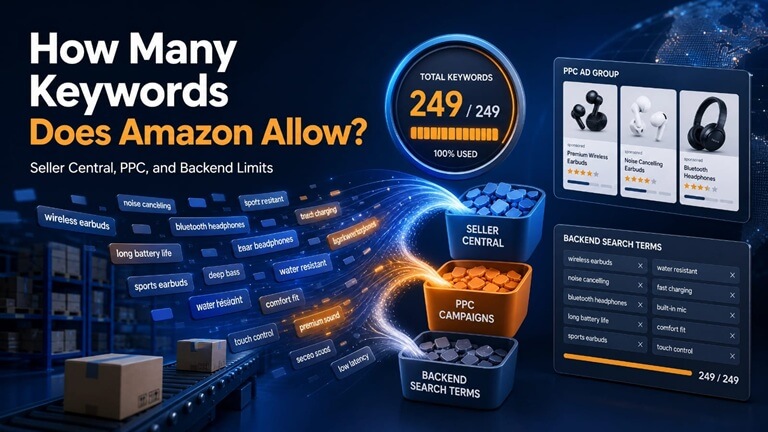
- Backend Search Terms: The 249-byte backend search term field allows you to index for high-volume synonyms, Spanish search terms, and common misspellings without cluttering customer-facing copy.
- Bullet Points (Key Product Features): The five bullet points provide contextual keyword depth that supports both keyword matching and conversion arguments.
- Product Description and A+ Content: Standard descriptions index for search queries, while A+ Content provides visual brand storytelling that lifts conversion rates by 5% to 10%.
Structuring these attributes correctly requires deep catalog experience. Partnering with an amazon seller central seo expert allows brands to identify missing category attributes, map high-intent root keywords, and prevent indexing conflicts across complex parent-child product variations.
How Do Operational and Fulfillment Factors Affect Search Visibility?
A product can have high conversion rates and optimized copy, but operational failures will immediately suppress its organic rank. Amazon protects its customer experience by demoting listings that carry delivery or inventory risks.
Fulfillment & Operational Scorecard
│
┌───────────────────────────────┼───────────────────────────────┐
▼ ▼ ▼
[Fulfillment Method] [Inventory Stability] [Customer Sentiment]FBA listings earn Prime Stockouts drop sales to zero High return rates trigger
badges and 1-2 day delivery and wipe out weeks of sales suppression; listings below
priority in local SERPs. ranking velocity. 4.0 stars suffer CVR drops.
Fulfillment Method (FBA vs. FBM) and Regional Delivery Speed
Products fulfilled through Fulfillment by Amazon (FBA) automatically receive the Prime badge, which qualifies them for fast delivery filters. Because over 65% of US Amazon shoppers filter search results exclusively by Prime eligibility, FBA listings gain higher baseline visibility than merchant-fulfilled (FBM) listings.
Amazon also personalizes search rankings based on the shopper’s delivery zip code. If your inventory sits in an FBA warehouse near Chicago, an Illinois shopper sees your listing near the top of page one with a “Next-Day Delivery” badge. If your stock is concentrated only in California, that same product drops several positions for Chicago shoppers because delivery takes three days.
Buy Box Ownership and Inventory In-Stock Rates
You must win the Buy Box (Featured Offer) to generate sales and maintain organic rank. If an unauthorized third-party seller takes your Buy Box or your listing loses the Featured Offer due to uncompetitive pricing, your organic ranking drops rapidly because your sales velocity stops.
Running out of stock is the fastest way to destroy months of ranking gains. When inventory hits zero, your product disappears from search results entirely. When you restock 30 days later, your historical sales velocity has decayed, forcing you to reinvest in paid ads to rebuild your organic rank from deeper pages.
Customer Feedback, Review Velocity, and Return Defect Rates
Customer feedback acts as both a direct algorithmic filter and a major conversion driver:
- Average Star Rating: Listings that drop below 4.0 stars experience sharp drops in organic rank because conversion rates decline and algorithm filters demote lower-rated products.
- Review Velocity: A steady flow of verified purchase reviews signals that a product remains popular and actively bought.
- Product Return Rate: High return rates—especially returns flagged for “item not as described” or “defective quality”—trigger listing warnings and algorithmic demotion.
What Is the Relationship Between Amazon PPC and Organic Rank?
Amazon PPC advertising and organic ranking work in a continuous feedback loop. While paying for an ad click does not buy organic position directly, the sales generated from that ad click pass full sales velocity credit to your organic ranking score.
[Targeted PPC Ad Spend]│
▼
[Paid Clicks on High-Intent Keywords]│
▼
[Immediate Unit Sales & Conversions]│
▼
[Algorithm Detects Increased Keyword Velocity]│
▼
[Organic Rank Increases on Target SERP]When you launch a new product, it has zero sales history and holds an organic rank on page five or deeper. By deploying structured amazon ppc advertising services, you can place your product at the top of page one using Sponsored Products and Sponsored Brands.
When shoppers click those ads and buy, the algorithm records those conversions as relevance signals for the target search terms. Over two to four weeks, that artificial velocity pushes your unpaid organic position up to page one, allowing you to reduce ad spend and collect profitable organic sales.
Applying strategic advertising tactics builds sustainable ranking equity:
- Top-of-Search Exact Match Campaigns: Bidding aggressively on 3 to 5 core root keywords concentrates sales volume where it creates maximum organic rank impact.
- Competitor ASIN Targeting: Running sponsored product ads on lower-rated competitor listings captures market share and funnels their sales velocity to your ASIN.
- TACoS Optimization: Tracking Total Advertising Cost of Sales (Ad Spend / Total Revenue) keeps ad spend profitable while your organic revenue share expands.
How Do AI Systems Like COSMO and Rufus Change Ranking Factors?
Amazon’s integration of AI discovery systems—specifically the COSMO algorithm and the Rufus shopping assistant—has modernized how the platform matches products to search queries.
Traditional Search vs. AI Discovery
│
┌─────────────────────────────────┴─────────────────────────────────┐
▼ ▼
[Traditional Engine (A9/A10)] [AI Discovery (COSMO & Rufus)]Matches literal keyword strings Interprets intent, use cases, and
(e.g., “stainless steel water bottle”). knowledge graphs (e.g., “bottle for
all-day hiking that fits bike cages”).
The COSMO (Common Sense Knowledge Generation) system is a semantic knowledge graph construction system based on customer behavior analysis. Rather than looking for the exact word ‘waterproof’, COSMO determines whether your listing meets the overall objective of the customer when they are looking for a product that will keep them dry in the rain, for example.
Rufus is a conversational shopping assistant that reads listing copy, customer reviews, and community Q&A and answers natural language questions. When a customer queries Rufus, “Is this sleeping bag warm enough for freezing winter camping?” Rufus responds by lifting certain temperature ratings from the bullet points and customer reviews to make a recommendation.
To position your listings for intent-based AI systems, follow these structural rules:
- Complete Every Category Attribute Field: Enter all the specific backend fields in Seller Central: material, dimensions, weight capacity, intended use.
- Write Bullet Points as Benefit Statements: Under each bullet point, make sure to state a customer outcome, then the technical feature that backs it up.
- Answer Common Customer Objections in A+ Content: Respond to compatibility questions, sizing information, and maintenance requirements directly from your visual text modules in A+ Content.
How to Systematically Improve Your Amazon Organic Rank
Improving your organic ranking requires a structured, multi-week execution plan. Avoid making erratic price swings or frequent keyword changes that reset your performance history.
The 4-Step Ranking Playbook
│
[Phase 1: Foundation Audit] ──► Fix backend attributes, 249-byte terms, and images.│
[Phase 2: Pricing & Launch] ──► Set competitive price & run coupons for high initial CVR.│
[Phase 3: Velocity Push] ──► Run aggressive exact-match PPC on top-volume root terms.│
[Phase 4: Retention & Def] ──► Protect FBA inventory flow & automate review requests.Follow this sequence to build ranking momentum:
- Conduct a Metadata and Indexing Audit: Make sure all main keywords are in the title and back-end search terms. Verify with Amazon Brand Analytics that your main root keywords get high search frequency ranks in your category.
- Set a Conversion-Focused Opening Price: On the opening day of that ranking push, post a 10% below the average price of that category or add a green 15% coupon badge to the product display. If the initial CTR and conversions are high, the ranking engine knows that the page is well performing.
- Execute an Aggressive PPC Velocity Campaign: Use SKAGs (single keyword ad groups) with Top-of-Search bid placements and top three high-intent keywords. Run these campaigns regularly over 14 days to build up good conversion velocity for the keywords.
- Monitor FBA Stock and Review Health: Configure the 45 days of supply automatic reorder point to prevent out-of-stock. Seller Central’s official Request a Review feature enables you to generate legitimate social proof on Amazon.
Frequently Asked Questions About Amazon Product Ranking Factors
How long does it take for a new Amazon listing to rank on page one?
If a listing gets a strong sales velocity right away, it can take anywhere from 14-30 days to get to page one. Targeted PPC advertising and initial promotional offers can help the seller get the conversions necessary to rise in the organic search results.
Does external traffic from Google or social media help Amazon rank?
Yes, traffic to Amazon that converts is a good ranking signal. Amazon gives the external customer acquisition credit for Brand Referral Bonus points and more organic visibility when you send traffic directly to your listing from a Google ad, TikTok, or email list.
What is the single most important ranking factor on Amazon?
The most important ranking factor is Unit session percentage (conversion rate) plus recent sales velocity. Amazon prioritizes products that will generate revenue per search, meaning that those that convert visitors into customers at a high rate are ranked higher in the organic search results.
How does product price affect keyword ranking on Amazon?
When the price is competitive, it boosts conversion rates and velocity of selling units, thus improving organic rank. If the price is much higher than your direct competitor and there’s no good reason to, your conversion rate will fall, which will result in loss of search visibility for the page.
Why did my product lose its organic ranking overnight?
The most common reasons for sudden rank loss are when you’re out of stock, when another seller secures the Buy Box, or when you are de-indexed. Review your Seller Central dashboard for policy warnings, catalog issues, or new negative reviews that are impacting conversions.
Do backend search terms have a strict byte limit in Seller Central?
Yes, Amazon has a limit of 249 bytes (not characters) for a search term in the backend. When you go past the 249-character limit, Amazon’s search engine won’t read the whole field, so the terms in it aren’t indexed. Punctuation, commas, and repetition of words should not be used in this section.
Next Steps to Build a Defensible Amazon Ranking Strategy
Ranking high on Amazon isn’t something that you can do once; it’s a process that you need to follow. It demands ongoing oversight of metadata, ad campaigns, and inventory logistics.
First, go to your Amazon Brand Analytics dashboard and check your Search Query Performance report. Find out the top 5 keywords that you have low Click Share on compared to your impression share. Update the main listing image and title to optimize for those terms.
Then, check your backend specifications in Seller Central and ensure all technical, dimension, and material fields are filled. To get your ads in front of the top four organic listings, spend your advertising money on campaigns that target keywords that you rank for organically between #5 and #15. If they’re executed consistently in terms of listing relevance and sales velocity, long-term organic dominance is achieved.
Popular on OTW Right Now!
-
 Business for Sale Las Vegas: The Ultimate Guide to Buying and Selling a Business in the Entertainment Capital of the World
-
 Top 5 Reasons Your Mac Randomly Shuts Down (And How to Fix It)
-
 Can an Image Prompt Be a Security Threat? Understanding Prompt Injection in AI Tools
-
 Why Enterprises Need Stronger Identity Verification Systems




About The Author

Gagan Bhangu
Founder of otechworld.com and managing editor. He is a tech geek, web-developer, and blogger. He holds a master's degree in computer applications and making money online since 2015.