
Big Tech Is Reshaping Who Sees The News And Who Gets Paid For It
Social media has become the main way Australians reach online news, while 77 per cent say they are concerned about telling real information from fake online. The shift gives technology companies greater influence over which stories readers see.
Social media has overtaken direct visits to news websites as Australians’ main route to online news, even as more than three in four say they worry about telling real information from fake online.
The shift gives technology companies greater influence over which stories readers see and whether they ever reach the publisher that reported them.
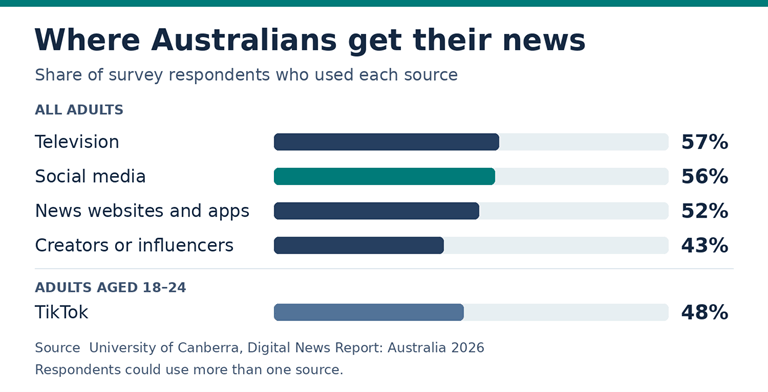
The University of Canberra’s Digital News Report: Australia 2026 found that 56% of Australians used social media for news, just behind television at 57 per cent and ahead of news websites and apps at 52%
Among 18 to 24-year-olds, 48 per cent used TikTok for news. Across all age groups, 43 per cent said they accessed news from creators or influencers. Respondents could use more than one source
Australians still seek out news regularly. The same survey found 56 per cent accessed it several times a day. What has changed is where they find it.
For a publisher, a story can reach thousands of people through a feed or a creator’s video while giving the newsroom little opportunity to build a direct relationship with those readers
AI search puts the answer before the article
Pew Research Center analysed the March 2025 browsing activity of 900 US adults and found that people clicked a traditional Google search result on 8 per cent of visits when an AI summary appeared, compared with 15 per cent when one did not appear.
A link inside the AI summary drew a click on just 1 per cent of visits where a summary appeared. The study covered searches across many topics and did not estimate the impact on Australian news publishers.
Google said in August 2025 that total organic clicks from its search engine to websites had remained relatively stable year on year, with traffic rising for some sites and falling for others.
Google was describing total click volumes across the web, while Pew measured how often people clicked on visits with and without an AI summary.
Each visit matters to a newsroom because it creates a chance to earn advertising revenue, attract a subscriber or bring a reader back for the next story.
Matthew Giannelis, CEO and editor of an Australian tech news website said search, social media and AI could help independent publishers reach new readers, while making it harder to build a relationship with them directly
“An independent newsroom can reach people through search and social media who would never have found it on their own,” said Giannelis
“But when readers get the whole answer in a feed or an AI summary, they may never see who did the reporting. That matters when you’re asking people to come back, subscribe or support the next investigation.” he said.
Australia has moved to address the commercial relationship between large platforms and publishers. The News Bargaining Incentive commenced on 27 August 2026 and applies from the 2025–26 financial year.
It establishes a charge and an offset for qualifying operators of significant search or social media services whose relevant Australian digital advertising revenue, together with that of related companies, exceeds $250 million annually.
The policy is designed to encourage commercial deals with news businesses
How spam turns into misinformation
The University of Canberra found that 77 per cent of Australians were concerned about what was real or fake online. About half distrusted news delivered through social media or AI platforms, at 51 per cent and 49 per cent respectively.
Yet 9% already used AI chatbots for news, and among those users, 49 per cent said they used the tools to explore stories in greater depth.
In June, Tech Business News reported on AI-generated press releases, questionable expert profiles and recycled research sent to journalists.
Giannelis reported that some search marketing campaigns sought links and brand mentions from trusted news websites.
“A pitch can arrive with a polished media release, a quote from someone described as an expert and a statistic that sounds plausible,”
“The reporter still has to establish who that person is, where the figure came from and who paid for the research,”
“If we publish a claim we can’t verify, it can travel through social feeds, search and AI summaries with our publication’s name attached,” Giannelis said.
Google’s search spam policies cover pages mass-produced to manipulate rankings and third-party material published mainly to exploit a host website’s established standing in search.
For publishers, the editorial risk is immediate. A fabricated quote or a misleading statistic can acquire credibility as soon as it appears under a recognised masthead
A compromised newsroom inbox can expose a source
The Australian Signals Directorate’s Australian Cyber Security Centre received more than 82,000 cybercrime reports in 2025–26, roughly one every six minutes, and responded to more than 1,500 cyber security incidents.
The figures cover the wider Australian cyber threat environment. The agency said AI was helping malicious actors make phishing attempts and scams more convincing and run them at greater scale.
For journalists, a compromised account can expose confidential correspondence and unpublished reporting.
In June 2025, Reuters reported that The Washington Post was investigating a possible targeted intrusion into the email accounts of some of its journalists. The incident illustrates what can be at stake for people who share sensitive information with a reporter
“Cyber security is part of the editorial job. A reporter’s inbox can contain the name of someone who has taken a serious risk to speak to the press,”
“If we promise that person confidentiality, we have a responsibility to protect the account, the documents and the conversations that could identify them,” Giannelis said.
The Australian survey found that 54 per cent trusted the news sources they chose for themselves, compared with 43 per cent who trusted news in general.
For publishers increasingly found through feeds and AI summaries, that gap gives them a reason to make the original reporting easy to find, show readers where the evidence came from and keep corrections visible after a story has travelled.
Popular on OTW Right Now!




About The Author

Gagan Bhangu
Founder of otechworld.com and managing editor. He is a tech geek, web-developer, and blogger. He holds a master's degree in computer applications and making money online since 2015.