
Core Pillars of Google Local Maps Optimization
To get your presence right you need to understand that Google’s local algorithm isn’t some black box. It’s designed to connect users with the most relevant, useful and trustworthy local businesses. Whether you are looking for a comprehensive guide to google local maps optimization, the foundation of your strategy will always rest on three pillars: relevance, distance, and prominence.
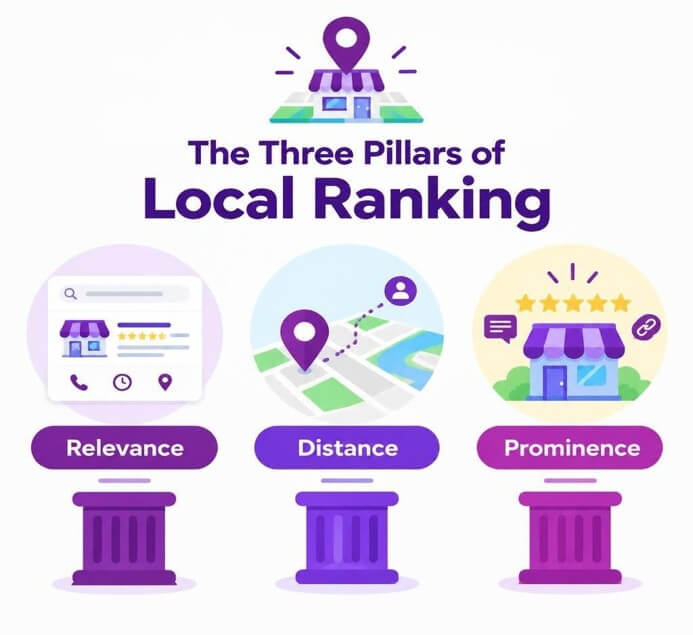
Understanding Relevance, Distance, and Prominence
- Relevance: Relevance is about how well your GBP matches what people are searching for. Having a profile is not enough. It has to be complete. You need to have detailed information about your services, your hours, and your business features so that Google knows precisely what you are. That’s what enables the algorithm to match you with the right, high-intent searches.
- Distance: Distance is the easiest factor to deal with. It’s simply a measure of how far your business is from the searcher’s location. You can’t move your business, but you can influence how Google perceives your service area. If you’re a business that serves a particular area then you need to make sure that your profile clearly defines that area. That way, you’ll be appearing in the right searches even if your address is not visible.
- Prominence: Prominence is what makes your business stand out. It’s essentially how well known your business is. Your reputation (as measured by the number and quality of reviews) and your authority (as measured by the number and quality of backlinks and mentions) both count. A business that is well known in its local area and has a good level of authority will often beat out a competitor that is geographically closer but has less local authority.
Local 3-Pack Mechanics vs. Traditional Organic SEO
It’s crucial to understand the difference between the local pack and the traditional organic results. Traditional SEO is aimed at a global audience and is all about long-form content and broad keyword targeting. Local SEO is very different and much more fluid. The map pack results will vary depending on where the user is when they do the search.
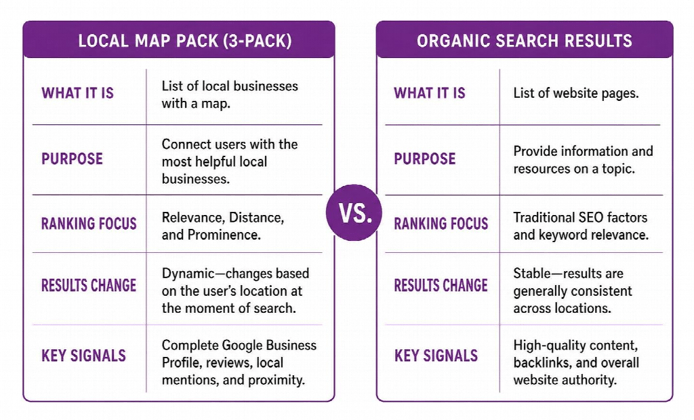
Organic rankings will generally stay the same; map pack rankings can change all the time. Someone on one side of the city may see a completely different map pack than someone just two miles away. That’s why your strategy should be about building up your local authority with Google rather than just trying to get your homepage into the top spots for a whole host of broad keywords.
Optimizing Your Google Business Profile Listing
Your Google Business Profile is your business’s virtual storefront. If it’s incomplete, it’s effectively like having your door locked. The New Merchant Experience (NMX) enables you to manage your profile right in Google Search, so you can keep your information up to date.
Firstly, just make sure your NAP (Name, Address, Phone number) is absolutely correct. A small thing like “St.” rather than “Street” can trip Google up and actually hurt your authority. Once you’ve got the fundamentals sorted, then use every attribute you can. Things like “wheelchair accessible”, “women-led”, “outdoor seating,” etc. will all help Google match your business to the right searches.
Primary and Secondary Category Selection
If there’s one ‘secret’ to local ranking, it’s picking the right category. Your primary category is by far the most important ranking factor. Pick the most specific one you can. If you run a pizza restaurant, pick ‘Pizza Restaurant’ rather than just ‘Restaurant’. You can add up to nine secondary categories to cover other relevant searches. Be specific. If you’re a law firm, pick your specific practice area rather than just ‘Attorney’.
Visual Media and AI Image Recognition in Google Local Maps Optimization
Google’s AI is getting better at recognizing your business. With visual search and the ‘Discover through photos’ feature, Google will look at the images you upload to learn what you do.
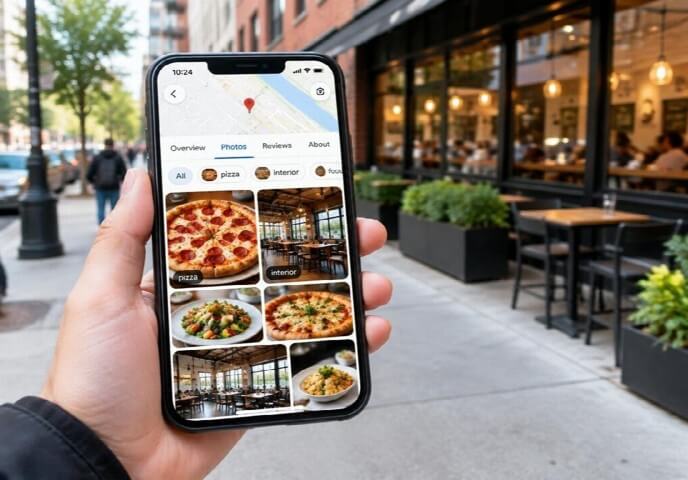
Do more than just upload a logo. Upload high-quality real photos of your team, your space, and your actual completed work. If you’re in the restaurant trade for instance, upload pictures of your best dishes. Google’s machine learning can spot those images and will show your profile to people searching for those items even if you don’t mention them in the text at all.
Review Velocity, Sentiment, and Owner Responses
Reviews are absolutely vital to local prominence. It’s not just about having a high star rating. Consistent, steady new reviews are far more important than a burst of 50 all at once and then nothing for months. Two or three per week is far better than 50 all at once. You must always respond to reviews. A considered, professional response to a negative review tells both potential customers and Google that you’re active and you care about the customer experience.
Technical Website Signals and Citation Management
Your GBP is your storefront, your website is your HQ. Your website needs to be supporting your local ranking objectives.
LocalBusiness Schema and Core Web Vitals
Adding LocalBusiness schema markup is a vital technical step. That structured data tells the search engines what your business is, where it is, and what you do. Combine that with a fast site (one that loads in under a second) to meet the Core Web Vitals. That gives the user a good experience and can help you get a better ranking on Google.
Building Localized Landing Pages and Citations
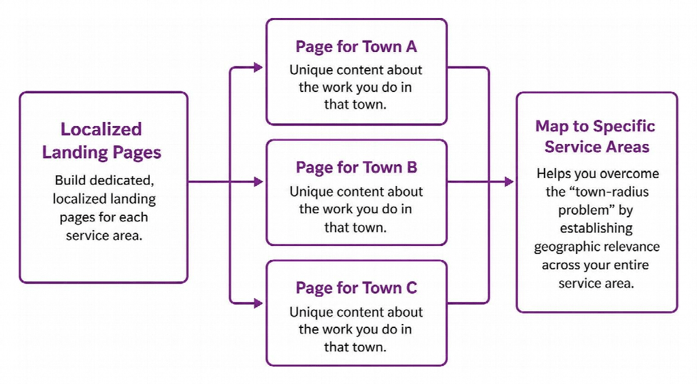
If you’re a business that serves more than one town, then don’t just have a single homepage. You need to have a separate local landing page for each town you serve. Each of those pages should have content specific to your work in that town, maps, and local testimonials. That way, you’re actually solving the ‘town radius problem,’ and you’re establishing local relevance across your entire service area.
Advanced Strategies and Future-Proofing for AI Search
With AI Overviews and conversational search, Google is now giving you answers rather than just a list of links. To stay on top of this you need to treat your GBP as the definitive source of accurate information for these AI tools.
Tracking Performance with UTMs and Geo-Grids
You can’t improve what you don’t measure. Add UTM parameters to your GBP links so you can see how much of the traffic is coming from your profile as opposed to your website. Use geo-grid rank trackers to see your rankings across your city. That will tell you where you’re strong and where you’ve got gaps so you can then focus your link building in those areas.
Navigating AI Overviews and Modern Google Local Maps Optimization
AI discovery is completely changing the way people go about finding local businesses. If you ask an AI assistant “Who’s the best plumber near me?” it will pull the information from your GBP and your website’s structured data. The cleaner, more detailed, and more active your presence is, the more likely you are to be the one that’s selected as the answer.
Frequently Asked Questions About Local Pack Rankings
How long does it take to rank in the Google local 3-pack?
There’s no fixed timeline. In less competitive areas, you can very much have a fully optimized profile delivering results in a matter of weeks. In more competitive markets, it can take many months of consistent review gathering, citation building, and technical work to build up the level of prominence required.
Can a service-area business rank without a physical storefront?
Yes, but it’s harder. If you don’t have a physical store, then you’ve got to hide your address in your GBP. That’s in keeping with Google’s rules, but it just makes you a bit less visible than a business that has a physical presence. You can compensate for that by doing an even greater amount of work on getting reviews and adding local content to your site.
How do customer reviews directly affect local map rankings?
Reviews are a major ranking factor. Google looks at what reviews say to better understand your business. If lots of people are saying “fast service,” for instance, that will make you more relevant for that term. Getting reviews is a big part of the equation, and having lots of positive reviews will help to boost your prominence and increase your chances of appearing in the 3-pack.
Conclusion
Optimizing for local maps is an ongoing process, not a one-off exercise. It’s all about relevance, proximity and prominence. Make sure your business information is accurate, and your online presence is compelling. That’s how you’re going to get the high-intent traffic that you’re after in today’s search landscape. You want to be the most useful, the most visible and the most trusted business in your locality. Start by having a look at your current profile and then keep the weekly updates coming.
Popular on OTW Right Now!



About The Author

Gagan Bhangu
Founder of otechworld.com and managing editor. He is a tech geek, web-developer, and blogger. He holds a master's degree in computer applications and making money online since 2015.