
Mentioned, Cited or Recommended? Reading What AI Assistants Say About Your Business
Quick Answer
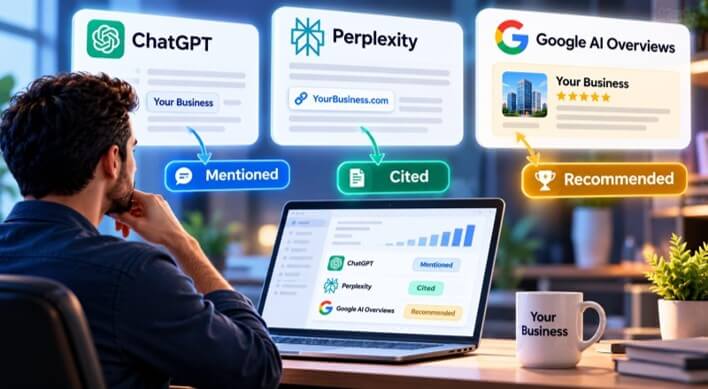
Ask ChatGPT, Perplexity and the Google AI Overviews the same questions that your buyers are asking. Record each answer as either mentioned, cited or recommended. Each one will require a different treatment.
A mention is hardly a endorsement in any case. Gartner themselves admit it doesn’t endorse the vendors featured in their own publications.
Key Points
- Answers from ChatGPT, Perplexity and the Google AI Overviews fall into three categories: mentioned, cited as a source and recommended as the buyer’s choice.
- In a July 2026 r/smallbusinessUS thread an agency commenter mentioned that one of their clients was on Perplexity 95% of the time and on ChatGPT 85% of the time for their core topics.
- A 2025 Early Adoptr podcast episode made the point that ranking is akin to an entry ticket. If a page doesn’t rank it may never be in the pool that ChatGPT or Claude would draw from.
Track what each AI assistant says individually and that’s the first step in working out whether you’re being mentioned, cited or recommended.
AI assistants will base their answers about your business on the sources they can access. Start there. A lot of the best company research is behind a login or has usage restrictions. The Cal Poly library guide will direct you to subscription databases and one major analyst firm will only allow its research to be quoted within the client’s own company. I would assume that ChatGPT, Perplexity and Google AI Overviews will be drawing on publicly available information (your website and the discussions/listings around it).
Trust works the same way. In a pilot project we created knowledge base topics directly from the product code. Each topic had to point to the actual files and lines of code that answered it and any topics that the code couldn’t support were simply excluded. Hold AI assistants to that same standard.
Below I break down what an assistant can do with your name into three states: a mention, a citation and a recommendation. Each of those states has different reasons for failing and will require different solutions.
If a customer says that ChatGPT recommended you, check what actually occurred. The assistant could have simply named you, could have cited your page as a source or could have actually told the customer to go and pick you. Those are three different things.
An assistant answering your buyer works from what it can read openly. A Cal Poly library guide lists nine subscription business databases and notes that “High quality business and market research is only available through expensive subscriptions,” with access limited to students, faculty and staff. Here is the trade-off I keep returning to: those databases are curated, though the guide warns their publishers may be biased, yet a buyer asking ChatGPT is unlikely to hear what sits behind a campus login. Your public record carries the load. Reading it correctly comes first.
Questions this article answers
- What’s the difference between being mentioned, cited and recommended by AI?
- Why does ChatGPT name my business and Perplexity doesn’t?
- How do I get AI assistants to recommend my business?
What is the difference between being mentioned, cited and recommended?
AEO Content has scored 11,000+ domains across 15 sectors and 28 categories. I read every AI answer about a business as one of three states: mentioned, cited or recommended.
Here is how to tell them apart on the page:
- Mentioned: your name appears on a list or as a side note, with no link and no reason at all for someone to have selected you.
- Cited: Your page appears as a linked source or the answer gives you credit for a particular claim.
- Recommended: You’re the answer they’re after.
Only the third state puts you on a shortlist. A mention shows the model knows you exist. A citation shows it trusts one of your pages enough to quote it. See citations that skip your brand.
Citations have their own rules. On a 2025 Early Adopter podcast one of the speakers made the point that ranking is effectively an entry ticket. If a page never ranks it may never make it into the pool that ChatGPT or Claude draw from. Once you’re in the pool then it’s all about clarity and quotability rather than position. A citation means your content has passed that filter, it tells you nothing about your brand at that stage.
Citations are also easy to miss. A commenter in a 2025 r/DigitalMarketing thread suggested following any answer with a request to cite sources, which returns the list of URLs behind it. With 26,577 AI-visibility audits behind my team, my advice is to run that follow-up every time and log the state, not just whether your name appeared. Combining 4 sources points to one rule: treat the name, the link and the endorsement as separate results. And the state you land in can shift the moment you switch assistants.
Why does one AI assistant recommend you while another ignores you?
Assistants use different training data and different retrieval systems so your status will vary between engines. Simply getting more mentions won’t fix the issue.
The original poster in a June 2026 r/ArtificialInteligence thread noticed that some companies appear consistently across assistants while others rarely show up, even when they seem equally relevant, and that results still vary significantly between models. The inputs that seemed to matter were community discussions, official documentation and mentions across trusted publications.
The engines also read different records. In a July 2026 r/smallbusinessUS thread, one commenter claimed Gemini is tied to your Google Business Profile “pretty directly since it’s a Google product,” while ChatGPT pulls from the open web. An agency commenter there reported one client at a 95% appearance rate on Perplexity and 85% on ChatGPT for its core topics. Same business, two engines, two results.
Lots of people assume that being the loudest online is the way to win. In the r/ArtificialIntelligence thread though a user saw the other side of the coin: the brands that were mentioned the most (in a rather spammy fashion) didn’t actually get any AI recommendations. Volume doesn’t equate to trust.
I read this as good news for smaller firms. A skipped company is often one the model cannot describe with confidence, and that is fixable. Test with your buyer’s real question, in every engine, which is exactly what tracking your AI visibility engine by engine is for. In my own category, that means prompts such as “What companies specialize in answer engine optimization (AEO)?” and “Which companies help brands get cited in AI-generated answers?”, where a name in one engine guarantees nothing in the next.
How do you move from mentioned to recommended?
Lead each key page with a direct answer, keep your business facts identical everywhere, and earn discussion on community sites. One quiet site went to 10 booked calls in 3 weeks.
In a May 2026 r/b2bmarketing thread the original poster noted that buyers will often ask a question like “what’s the best CRM for a mid sized manufacturing company?” and then go and contact the one that’s mentioned in the answer. The companies that get left out aren’t necessarily the ones that are the better product, it’s just that the model can’t quite form a clear picture of them.
So match the fix to the state you logged:
- Not mentioned at all: describe your business the same way on your website, LinkedIn, directories and review platforms, because assistants cross-reference all of them to decide what you are.
- Cited but not named: put your brand name and core value proposition inside the first 100 words of key pages, so the sentence a model quotes carries your name with it.
- Mentioned but not recommended: earn substantive answers and discussion on Reddit, LinkedIn and Quora that tie your name to the buyer’s exact problem.
The first two fixes live on pages you control. Recommendation is earned off your site.
Start with consistency anyway. I treat it as a systems job, not a writing task, and my team includes a full-stack engineer and content infrastructure architect with 20 years of building enterprise systems. AEO Content commits to getting clients named in AI answers in 90 days, or it works free until they are, and that result rests on the same consistency and direct-answer work.
Then re-run your prompts every quarter, because one directory listing that drifts out of step can pull you back down a state.
What should you do after you read the answers?
Record down each engine’s answer as mentioned, cited or recommended and prioritise the weakest state for fixing. In the years ahead recommendations will be what the buyer sees most.
Even the analyst firms draw the line. One of the major research firms has a content policy which states that inclusion in their reports is not an endorsement and vendors must not imply it is. A mention is a mention.
Precision is the habit that moves you from one state to the next. AEO Content’s pilot that drafts knowledge-base topics from a product’s code finished a two-topic study in about two minutes, tied each topic to one to four specific files and line ranges, and dropped a topic when the controls it would describe were not yet wired up. I want the same rule on every page you publish: describe only what is true and traceable. Then type your buyer’s real question into ChatGPT, Perplexity and Gemini this week.
Frequently Asked Questions
What else do people ask about checking AI answers?
The vast majority of the follow up questions are about trust of course. Does the answer stand up? Does existing SEO matter? How valuable is a single mention?
Can I see which prompts trigger my brand in ChatGPT?
In a 2025 forum thread marketers were saying they’d like to see ChatGPT with a Google Search Console type of report for it. There’s no indication that this is on the horizon at all. You’ll have to maintain your own log with the prompt, engine and state.
Can I trust ChatGPT’s account of its own sources?
Treat it as a lead. One source list shared in that thread was a self-report: the assistant describing where it looks, not observed citation data.
Does good SEO already get me into AI answers?
Sometimes. In the same thread, an agency practitioner said existing SEO already brought clients AI-driven traffic, while others credited third-party listicles and community threads instead. Check before you pick a camp.
Is an AI mention the same as an endorsement?
No. Gartner’s content compliance policy says it does not endorse any vendor depicted in its publications, and it bans wording implying a company was “featured,” “highlighted” or “spotlighted.” A passing mention from an assistant deserves the same restraint before it reaches your sales page.
Popular on OTW Right Now!
-
 AI-Powered Travel Planning: Can Algorithms Replace Travel Agents?
-
 From Tagline to Jingle: How Copywriters and Creative Directors Are Using AI to Make Their Words Sing
-
 From Research Paper to Publication-Ready Graphics: How AI Is Transforming Graphical Abstract Creation
-
 AI Quote and Proposal Automation: 10 Tools Compared


About The Author

Gagan Bhangu
Founder of otechworld.com and managing editor. He is a tech geek, web-developer, and blogger. He holds a master's degree in computer applications and making money online since 2015.