
The Threshold Rule: Stop Outdoor Debris at the First Indoor Surface
A rather large quantity of floor cleaning starts before anyone gets to the main section of the house.
Shoes carry dust over the threshold, the bags make contact with the floor, the pet’s paws move from outside to inside, the packages are placed down and wet or dusty footwear stops close to the entrance before going towards the kitchens, the hallways and the living areas.
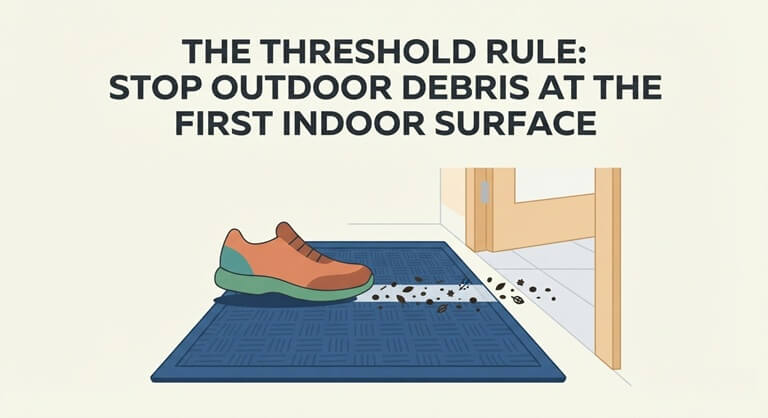
The initial indoor surface takes on all of that activity.
When the debris is kept there, the remainder of the house has less to cope with; but if it passes unimpeded, one small entry issue turns into a longer series of problems.
The threshold rule states that the first few feet within the door should be regarded as a filter, not merely as another part of the flooring.
Find the Actual Landing Zone
The landing zone doesn’t have to be the doormat all the time.
See exactly where people actually cease.
Some people take off their shoes as soon as they go through the door, while others walk a few steps towards a bench, a closet, or a chair. Children might put their bags down further in the hallway and a pet could enter and then turn towards a water bowl or into another room.
It is more important than the intended position of the entrance where the real stopping point was.
Based on actual usage, clean it.
Separate the Outside Side From the Inside Side
An entrance has two roles.
Before it passes the threshold, the outer side removes as much debris as it can.
The inner side catches all that still gets through.
By keeping those roles separate, the area becomes easier to manage.
If the exterior mat is holding loose soil, then you should sort this out before cleaning the indoor mat; otherwise, the following few entries will immediately cause the same debris to be carried back over the doorway.
Looking at the situation from the outside to the inside is the way in which the material is getting into the home.
Mats Need Cleaning Too
A mat cannot go on catching debris forever.
As time goes on, loose material ends up sitting either between the fibers or on the surface.
After that has occurred, shoes might pick up some of it rather than leave it behind.
Check mats regularly.
Look after them by shaking, vacuuming, washing, or using such methods as specified regarding the material and the manufacturer’s instructions.
You should also notice the floor under them.
Fine grit can act beneath the surface and stay concealed until the mat shifts.
Look at the Floor Just Beyond the Mat
The area which is most worth looking at is the strip that comes right after the mat finishes.
The entry system will be only partly effective in containing it if grit keeps on appearing there.
It’s almost as if that narrow part of the floor serves as a spillover area.
Clear it up before the debris spreads any further.
It isn’t necessary to go through the whole hallway each time; you can simply concentrate on the first few feet and this will disrupt the trail while it is still close to the door.
Shoe Storage Changes the Dirt Path
The location where shoes are taken off determines the area where debris accumulates.
Placing a shoe rack next to the doorway will cause the grit to become concentrated in one area.
A bench located a few feet away results in a longer path to walk.
When shoes are kept in a closet they can cause loose material to move around on the floor before they are put away.
Check the area underneath and surrounding any storage that is being used.
A rack that appears the cleanest can still have grit building up underneath it.
The storage furniture must be considered as forming part of the entry area and not as something separate from the floor.
The Threshold Can Be Read Like a Sample Strip
The initial indoor surface offers useful evidence.
When most of the debris stays on the mat and the part of the floor beyond that remains fairly clean, it means the threshold is carrying out its function. But if there is a visible trail extending into the hallway, then the containment point requires more attention.
That small strip can also guide Cleaning Services Seattle by showing whether grit is staying near the doorway or already transferring toward adjoining floors, baseboards, and nearby furniture edges.
The value is in the information that the area provides.
The flooring alone, if you take a few feet of it, shows just how far the outdoor material has been transported.
Corners Near the Door Need Their Own Check
It is not always the case that loose debris stays in the middle of the entrance.
Fine material can be pushed towards the corners by air movement, people walking around, sweeping, and by opening doors.
Check along the wall next to the doorway.
Look to the back of the door.
Inspect the seam where the floor meets the baseboard.
These small collection points can make an entrance look dusty even after the open floor has been cleaned.
Handle them before finishing the broader floor area.
Bags and Packages Create Secondary Contact Points
Outdoor material is not the only one that comes on shoes.
Items such as reusable shopping bags, backpacks, delivery boxes, sports equipment, and pet supplies may all come into contact with the ground before being taken inside.
When items are regularly placed on a single bench, floor section, or counter, that position becomes part of the threshold system.
What we want to achieve is not to sterilize each item that enters the house.
All one has to do is observe the places where objects that have been in contact with the outside repeatedly land.
Areas that get less contact might need attention earlier than those surfaces.
Pet Entries Often Extend the Zone
Pets have the ability to alter the size of the entry area.
A dog can go through the door and then keep going for a few feet before coming to a stop.
Paw prints, loose hair, or small amounts of outdoor debris may therefore be found past the usual point at which shoes are removed.
Stick to the real pet route.
A small towel or paw-care arrangement might be useful for containing some of the mess where it’s appropriate, though the floor around it still has to be checked.
If you clean only the human pathway then half of the entry pattern will remain unattended.
Wet Debris Needs Faster Attention
Dry grit can usually be either vacuumed or swept.
Wet material behaves differently.
Moist soil can smear.
Water can spread underneath the shoes.
Damp debris may get into the gaps in the floor or might be carried to more distant areas before anyone notices.
Address wet spots sooner.
Wherever possible, remove any loose material first and then clean the flooring that has been affected by using a method appropriate to that surface.
Do not apply the same quantity of water or the same product to every type of floor.
Do Not Push Entry Debris Deeper While Cleaning
It is possible that the cleaning method could inadvertently cause the problem to spread further into the house.
Taking a sweep from the doorway into the hallway causes debris to be sent in the wrong direction.
To drag a dirty mat through a number of rooms has the same effect.
Keep the material close to where it is produced.
Instead aim at establishing a collection point rather than forcing it into cleaner areas.
When it is necessary to remove a mat, lift it and carry it carefully to prevent loose grit from falling along the way.
The First Few Feet May Need More Attention Than the Rest
The floor in the entrance area tends to be changed more often than the floor beyond it.
That is normal.
That doesn’t mean that the whole adjacent room has to be cleaned at the same frequency.
Look at the first section on its own.
A quick inspection of the area just inside the door, the matting section, the shoe storage area, and the adjacent corners might be all that is needed between the larger floor cleaning sessions.
By treating the entrance as a separate small area for cleaning, the most heavily used section won’t cause excessive work to be carried out in all the other areas.
Recheck the Route After Busy Periods
The threshold is capable of changing rapidly following visits, deliveries, outdoor work, or days which involve multiple entries and exits.
A suitable time exists for a brief inspection.
Look at the mat.
Look at the first indoor strip.
Check the corners nearby and the area under the floorboards.
If the material is still there, deal with it before it gets spread out during normal movement.
A two-minute reset at the entry stage may, in some cases, stop a much bigger floor task from having to be carried out later.
Keep the System Simple Enough to Use
One does not need complicated equipment or a lengthy checklist.
The best arrangement is the one that people really will adhere to.
A practical mat.
If the shoes are taken away then there will be a clear area for them.
There is enough open floor so that you can clean around the storage.
A fast method of handling visible grit before it goes beyond the entrance.
The system is a success if the outdoor debris loses momentum close to the door.
Things that are too complicated will most likely be ignored when people arrive every day.
Protect the Rest of the Floor at the Boundary
The most clean hallway begins at the entrance and not at the middle of it.
Look at the point where the shoes end. Clean the mat before it is too full. Check under the storage area, look at the first section of the floor, and notice the corners where small amounts of debris gather.
The threshold makes up only a small portion of the house, but it has a large role to play.
It takes in anything that reaches it before the rest of the floor does.
Keep that first indoor surface under control, and less grit gets the chance to become a whole-house trail.
Popular on OTW Right Now!




About The Author

Gagan Bhangu
Founder of otechworld.com and managing editor. He is a tech geek, web-developer, and blogger. He holds a master's degree in computer applications and making money online since 2015.