
Before You Buy a Social-Media Tool or Service, Identify the Task You Actually Need Done
A shopkeeper who needs assistance in turning phone footage into a product video has a problem different from that of someone who already has finished videos but who frequently misses their posting times. In neither case is the problem necessarily overcome by buying more views.
Before comparing prices, identify what should be different when the work is finished. A usable video, a published post, a performance report and a customer enquiry are different outputs. Treating them as interchangeable makes even an inexpensive purchase hard to evaluate.
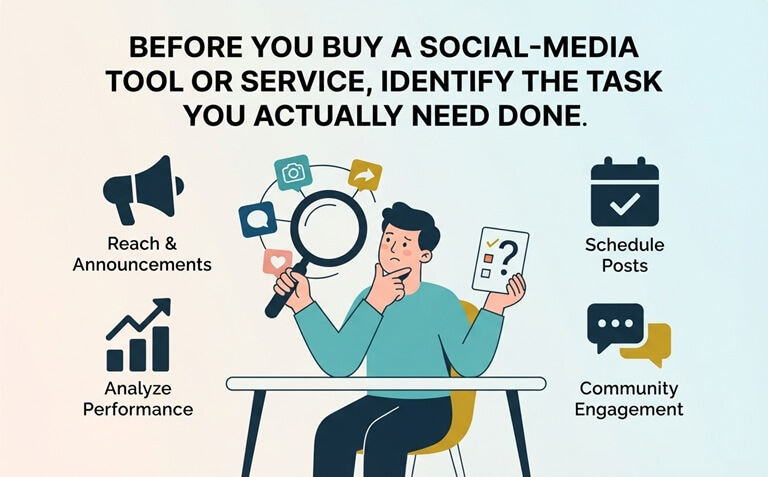
Start with a task, not a promise of growth
Write a one-sentence brief: “I need [specific output] for [account and format] by [date], with [approval requirement], and I will assess it using [measure].”
For instance, you could check that four product clips have been prepared from our footage, with the captions verified and one revision included; whereas ‘improve our social media’ leaves it up to the supplier to decide what is meant by improvement.
Split the output you are buying from the business outcome you want it to help achieve. It may be worthwhile to have faster editing even if there is no immediate rise in sales. However, higher visible engagement does not mean that people have asked about a product. Although one product can include a number of functions, you should check each function individually.
1. Content creation and editing: making the material
These tools can be used to create or alter images, videos, and text; for instance, Adobe’s official guide for the Express video editor talks about cropping, trimming, splitting the footage and downloading the result in MP4 format. However, such features relate to the production process and do not mean that viewers will buy something.
When making a purchase for editing, you must specify the file format, the orientation, the captions, the number of revisions allowed and whether or not you will receive the editable project files. You should also check the terms allowing the commercial use of the included music, images and templates. Although the same application provides separate scheduling features, the final file itself does not include publication or continued management.
The product may need to have photographs taken of it, footage made, a logo provided and correct prices given. With a task that only involves export, there is no need to hand over the password for the social account. In the case of cloud tools, it is necessary to find out what is uploaded and kept; customer details or any other personal information should be removed from the sample material.
2. Scheduling software: getting approved content published
A scheduler is responsible for dealing with timing and organisation. The useful outcome is an approved publishing plan and a practical path towards publication, not just a calendar containing drafts. It does not include the assurance that the content is persuasive or that anyone is handling replies.
The guide from Buffer on “Scheduling Instagram posts, reels, stories, and notifications” explains the difference between automatic publishing and notification publishing; in the case of notification publishing, a reminder is sent and it is then necessary for someone to complete the posting on Instagram, whereas automatic publishing depends on the type of account and on the features supported for posts, since a personal account is not equivalent to a professional account.
Before you subscribe, make sure that you know your exact account type, the type of post you’ll be making, the required features, your time zone and who is responsible for dealing with failures. You should test one typical post and verify that it actually shows up on the platform. In the case of automatic publishing, you can expect to have an account linked with the appropriate publishing permissions; different requirements apply if a reminder workflow is involved. Rather than assuming that every scheduler connects in the same way, you should read the permission request.
3. Analytics tools: understanding recorded activity
Analytics tools convert the data from accounts or campaigns into reports. First decide what question you want to answer: Are product demonstrations holding people’s attention? Which posts come before enquiries? How long does the process of reporting take? A dashboard is of any use only if the data it provides can help in answering your question.
Make sure you check the definition, the reporting period and the source for each metric. The YouTube Help page under ‘Understand your unique viewers data’ defines unique viewers as an estimate of audience size which takes into account repeat viewing; it is therefore not the same as the raw view count. You should not assume that metrics with the same name on different platforms are calculated in the same way.
A tool might need a professionally linked account, permission to read data from that account, or an exported report. Inquiries should be made as to the historical coverage and whether paid activity is included. Whenever possible, read-only access should be preferred since it is sufficient for the task in question. A report showing the number of views and likes does not allow sales attribution to be determined or identify which viewers went on to become customers; to find out those details, appropriate enquiry or transaction records are necessary.
4. Platform advertising: paying for distribution
Advertising is distributed via a platform’s advertising system. This is a different setup from buying a set amount of engagement from a separate seller, even if both are casually referred to as promotion.
The example given in YouTube’s official Promote documentation is as follows: the buyer chooses a goal and a video, sets the audience options, establishes a budget and end date, and uses a Google Ads account that has billing set up. The campaign thus produced will have its settings and spending records available for inspection. However, it still cannot guarantee that customer inquiries will be made or that profitable sales will result.
If somebody else is carrying out ads on your behalf, ask for a clear breakdown between the amount spent on the platform and their fee. Decide who is to be regarded as the owner of the advertising account, who has the authority to approve the creative content and who has the power to pause spending. The job might involve access to the advertising assets and to the billing settings. Separate decisions have to be made regarding customer list uploads or website tracking, and these details should not be handed over automatically.
5. Account-management services: assigning ongoing work
You are employing people to carry out the tasks that have been agreed upon; the contract could include planning, writing, publishing, responding to comments or preparing reports, but the various activities involved should not be assumed merely from the term “account management”. Advertising and content production can be charged for separately.
State the number and kind of posts, the deadlines for approval, the hours during which responses are to be given, the rules regarding escalation and the procedures for handover. Decide which people are authorised to deal with a complaint, to offer a refund or to alter a product claim. The fact that someone is paid for management does not mean that they take on the responsibility for business decisions or that a specific sales result is achieved.
Access should be based on the type of work being done. If someone is preparing captions they can be given the files for approval; if someone is responding to messages then they will need different access. The guidance on channel permissions provided by YouTube explains how named roles can give people access without requiring them to have the owner’s Google Account. Where your chosen platform offers equivalent delegated controls, use them and make sure you check the actual powers of the role.
6. Quantity-based engagement services: specifying a count
In this category the proposed deliverable is not a content file, report or a managed advertising campaign but rather a specific number of followers, likes or views. Increasing a count does not prove that there is genuine attention, local relevance, buying intent or customer enquiries.
Auj Store currently lists TikTok view and like packages and Instagram follower packages. These illustrate the specified-quantity engagement category; the listings should not be read as offers of analytics software, ad management or organic audience development.
In some cases, a post link or username is asked for instead of account access. You should check the requirements for the specific order, including any condition relating to a public account. The fact that a password is not required does not mean that the service is without risk or that it is allowed by the platform.
Platform rules need a separate check. YouTube’s fake engagement policy prohibits artificially increasing metrics and warns that a hired promoter’s actions can lead to content removal or a channel takedown. That is a YouTube-specific example: check the current rules of TikTok, Instagram or whichever platform the offer concerns. A seller’s replacement promise is not platform approval.
Treat access and data as part of the purchase
It is important to tell the difference between logging into a tool and authorising it to read data or carry out actions on your account. The guidance on sharing access provided by Google Account Help states that permissions may allow data to be viewed, copied or modified. The advice also given is to avoid giving a third-party application your Google Account password.
Wherever possible, use the platform’s built-in authorisation or invitation procedure. Before granting approval, verify the domain name and the permissions that are being requested. Turn down any requests for access to accounts, messages or billing that are not clearly explained. Make sure that you retain control over the owner account, the recovery information and two-factor authentication.
Before you connect, decide on your exit strategy. Google’s guidance states that taking away access does not always mean that data which has already been copied by an app is removed; in such cases, you may need to get in touch with the developer. Find out from the provider regarding retention, subcontractors, deletion and exports. Cancelling a subscription, revoking permissions and asking for deletion are all separate actions that should be verified.
Hypothetical example: a small homeware retailer
It is an imaginary situation, not a customer case study. A small shop that sells home goods has footage on phone of its products but is having difficulty in completing the videos and in publishing them consistently. The owner wishes to cut down on the amount of production work and to find out whether clear demonstrations of the products lead to useful questions.
Define the work and compare like-for-like offers
The owner states that, over a period of two weeks, four short product videos should be prepared from our existing footage and that the approved versions should be scheduled on our current Instagram professional account; we will provide the product facts, approve each video ourselves and deal with any messages ourselves.
An editing application would leave the owner responsible for carrying out the editing. Even a subscription that merely provides scheduling would still require the finished material. A freelancer’s editing quote could deal with the production task, whereas a management package would have to include specific responsibilities. The follower package would not provide any of the missing videos or the publishing work.
In this scenario the owner chooses a limited editing project and first checks if the existing publishing tools are adequate before deciding to get another subscription; the comparison takes into account the owner’s remaining work, not just the advertised price.
Agree on delivery, access and an exit
The scope document includes four completed files, the captions, one revision for each file, the approval dates and the total charge. The editor is given the footage and product information, not the account credentials. The owner carries out the publication trial using one approved clip and verifies whether any of the selected scheduling workflows require a phone reminder.
Before making the payment, the owner verifies the cancellation deadline, the renewal clause, the terms relating to incomplete delivery and access to the files after the assignment has ended. The response ‘Work starts within a day’ would not be accepted when answering the question ‘When will the finished files arrive?’
Measure the task and the business response separately
The owner keeps a record of the time taken for editing and also notes whether each post that has been approved is published. In the case of business responses, a qualifying enquiry is defined as a separate individual inquiring about price, availability or ordering—not including an emoji or a further message from the same person. Orders that are completed are recorded individually.
The owner draws a comparison between the current trial and a previous similar period, mentioning any changes in the offers, the stock, and the advertising. This is merely a practical review and not a controlled experiment designed to prove causation. In the example it is assumed that there will be no results: the time saved might be enough to justify the new workflow even if the number of enquiries does not increase, and simply having more views would not show that customer demand is greater.
A short checklist before paying
- Passwords: Do not send account passwords, one-time login codes or recovery codes to a seller. Ask why access is necessary.
- Permissions: Confirm the exact account, role and actions authorised, and how you can revoke them. Keep ownership under your control.
- Data handling: Ask what is collected, who can receive it, how long it is retained and how to export or delete it.
- Cancellation: Check renewal, notice periods, refunds, incomplete work and what happens once execution begins. Save the agreed terms.
- Delivery: Define the file, published post, report, campaign or count you are buying. Separate a start-time estimate from a completion commitment.
- Outcome: Track visible engagement apart from real product enquiries and orders. Check platform rules on your own, not just based on what the seller says.
Buy the missing step
Choose the smallest purchase that addresses the task you can name. Define delivery before paying, limit access to the work and decide how you will assess the result. A completed service and a useful business outcome are separate tests; a sound buying decision keeps both visible.
Popular on OTW Right Now!



About The Author

Gagan Bhangu
Founder of otechworld.com and managing editor. He is a tech geek, web-developer, and blogger. He holds a master's degree in computer applications and making money online since 2015.