
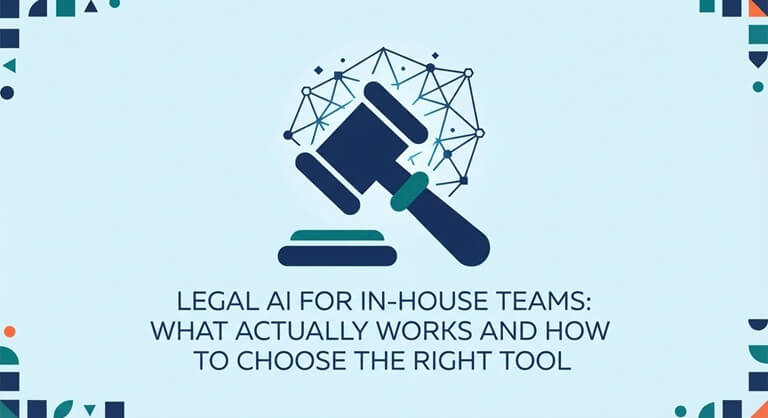
Legal AI for In-House Teams: What Actually Works and How to Choose the Right Tool
In-house legal teams have a volume problem. When a company grows, more deals are closed by sales, more vendors are added to the procurement list, HR carries out hiring in new countries, and each of these developments results in a contract, a policy question, or a compliance check ending up on the legal team’s desk. Recruitment seldom increases at the same rate. The outcome is the usual kind of bottleneck: legal becomes the department that all other areas have to wait on, even though the lawyers are working at full capacity.
Legal AI has rapidly progressed from being just a novelty to becoming a practical solution for that bottleneck. Although early reports mainly concentrated on law firms, in-house teams encounter a different kind of pressure, and the tools most suitable for them are designed with those differences in mind.
The guide examines the areas in which legal AI is providing real value to corporate legal departments, the areas in which it still falls short, and what one should look for when selecting a platform.
Why In-House Legal Is a Different Problem
A law firm is paid according to the time it spends on work. An in-house team, on the other hand, is a cost center and is evaluated in terms of speed, risk reduction, and the extent to which it supports the business. This is what alters the meaning of efficiency.
An AI that accelerates research can affect the way work is priced. In the case of a team that is employed by a company, achieving this speed means that a sales contract will be signed this week rather than next month, or a vendor data processing agreement will be approved before a product launch rather than having it delayed. The value is based on business outcomes, not on billable hours.
Internal teams also have to manage a more limited but more repetitive kind of workload. The same sorts of agreements keep reappearing—such as NDAs, master service agreements, vendor contracts, and data processing agreements, as well as employment documents. Each of these has to be checked against the company’s own standards, which are generally set out in a playbook, on a shared drive, or in the files of a few senior lawyers.
It is in the case of repetition that AI excels.
Where Legal AI Is Delivering for In-House Teams
The most important application at the moment is the initial review of a contract. If a legal AI tool is set up properly, it can read an agreement sent in by a third party, compare it with the company’s preferred positions, and highlight any clauses that differ. Common points of check include liability limits, indemnities, the governing law, the automatic renewal provisions, and the rights of termination.
The lawyer still makes the call. What changes is where they spend their attention. Instead of reading forty pages line by line to find three problem clauses, they start with the three problem clauses already highlighted, along with suggested fallback language. Platforms such as LEGALFLY AI are built for in-house legal and compliance teams around exactly this workflow, reviewing agreements against a company’s own standards instead of generic rules.
Triage of Low-Risk Agreements
All contracts do not require the same degree of examination. Nowadays, many teams make use of AI in order to classify incoming requests according to their level of risk. A standard mutual NDA containing no odd provisions can be given quick approval or even be dealt with by the business in accordance with the legal department’s guidelines. If a contract includes uncapped liability or has unusual language regarding IP assignment, it is sent to a more senior lawyer.
By using this method of triage, the most experienced members of the team can concentrate on the agreements that do involve risk.
Compliance and Data Protection Checks
Privacy regulations have made data processing agreements one of the most time-consuming kinds of documents for companies’ internal teams, in particular those which operate in or sell to Europe. The process of verifying that a DPA complies with GDPR requirements, checking the terms of any subprocessors, and confirming the international transfer mechanisms involves detailed and repetitive tasks.
Legal AI tools, which have been trained on these frameworks, are able to compare agreements with regulatory requirements and internal policy at the same time, thereby lowering the chance that something important will be overlooked during a busy quarter.
Drafting and First Versions
Starting from a blank page is a slow process. AI is able to produce an initial version of a standard agreement, a clause, or a policy summary by using templates that the team already has confidence in. Instead of writing from scratch, the lawyer edits. In the case of internal documents such as policy explainers or the FAQ responses to the business, this approach can save hours every week.
Answering Questions From the Business
Another benefit that is not often talked about is the ability to retrieve internal knowledge. For example, the sales department would like to know whether a certain term is acceptable, while procurement would like to find out which vendor contracts are due to renew next quarter. Rather than a lawyer having to search through a contract repository, the AI can identify the relevant clause, provide a summary of it, and attach the source document for verification.
Why General-Purpose Chatbots Fall Short
Many legal teams began by trying out general AI assistants and soon encountered limitations.
General chatbots are not familiar with a company’s playbook, its preferred positions, or its risk tolerance. Although they can generate answers that appear confident and reasonable, they fail to take into account the particular circumstances of a jurisdiction or industry. More seriously, many of them were not designed with legal confidentiality in mind, which means there are genuine concerns about where sensitive contract data ends up when it is uploaded.
Purpose-built platforms approach the problem differently. They are designed around legal workflows from the start, with features like playbook-based review, clause-level redlining, and strict data handling. This mirrors what has happened with AI in legal workflows at law firms, where the biggest gains have come from tools matched to specific tasks rather than one-size-fits-all assistants.
The situation is not merely one of accuracy; it’s about suitability. A tool that understands the way legal teams actually operate will be adopted, while one that forces lawyers to rewrite their prompts and have to go through everything from the beginning again will be abandoned within a few months.
The Security Questions You Cannot Skip
Contracts hold some of the most sensitive information that a company possesses, such as pricing, customer names, IP terms, personal data, and negotiating positions. So, before any legal AI platform comes into contact with that data, the team should have clear answers to a number of questions.
| Question | Why It Matters |
| Is our data used to train the vendor’s models? | Your contract terms should never become someone else’s training data. |
| Where is data stored and processed? | Data residency affects GDPR and other regulatory obligations. |
| Can sensitive information be anonymized before processing? | Reduces exposure if something goes wrong. |
| What certifications does the vendor hold? | Standards like ISO 27001 and SOC 2 signal mature security practices. |
| Who can access our documents inside the vendor? | Access controls should be as strict as your own. |
If a vendor cannot answer these clearly in the first conversation, that tells you most of what you need to know.
A Practical Adoption Plan
Rolling out legal AI works best in stages. Trying to automate everything at once usually leads to frustration and low adoption.
- Start with one document type. Choose a type that is commonly used and carries a low level of risk, for example, NDAs or standard vendor contracts. This will provide the team with quick successes and establish a clear benchmark against which to measure performance.
- Codify the playbook first. AI can only check against standards that are already in written form; if the positions you prefer are kept only in people’s minds, the rollout provides a good opportunity to document them. Simply going through that process usually leads to greater consistency within the team.
- Keep a human in the loop. Every AI output that leaves the legal team, whether to a counterparty or to the business, should be reviewed by a named lawyer. This protects the company and builds trust in the tool over time.
- Train the whole team, not just early adopters. If a tool is only used well by one lawyer, it won’t increase the department’s capacity. More effective than lengthy product demonstrations are short, practical training sessions based on actual documents.
- Expand based on results. Once the first use case is running smoothly, move to the next: DPAs, MSAs, or internal policy questions.
Measuring Whether It Is Working
In-house teams need to justify tools to finance and leadership, so it helps to track a few simple metrics from day one:
- Turnaround time for each contract type, before and after adoption
- Volume handled per lawyer each month
- Escalation rate, meaning how many agreements need senior review
- Business satisfaction, often captured through a short internal survey
The quicker turnaround is generally the first thing to be noticed. Eventually, the more significant change is that lawyers spend less time on routine reviews and more time giving advice to the business about the decisions that really matter.
What Legal AI Will Not Replace
It is worthwhile being straightforward about the limitations. Legal AI does not take the place of judgment since it cannot grasp the politics of a negotiation, cannot balance a commercial relationship against a legal risk, or understand why a particular customer should be given flexibility regarding a term which the playbook recommends rejecting.
What it achieves is to eliminate the repetitive tasks which prevent lawyers from applying their judgment where it matters. The in-house teams that are deriving the greatest benefit from AI are not those who are using it in the most aggressive way; rather, they are the ones who use it deliberately, on the appropriate tasks, with well-defined standards and consistent human oversight.
Final Thoughts
For years, internal legal teams have been requested to carry out more work with the same amount of resources, and legal AI is one of the first kinds of technology to actually alter this situation without replacing lawyers but instead returning to them the time that used to be taken up by routine reviews.
The essential point is to select tools that are designed with the way legal teams really work in mind, ensure that sensitive data is protected from the very beginning, and introduce them in a manner that fosters confidence rather than arousing skepticism. Those teams that achieve this will not only act more quickly but will also become a stronger strategic partner to the business they support.
Popular on OTW Right Now!


About The Author

Gagan Bhangu
Founder of otechworld.com and managing editor. He is a tech geek, web-developer, and blogger. He holds a master's degree in computer applications and making money online since 2015.