
Dynamics NAV to Business Central Migration
Executive Summary
- NAV support isn’t staying static; it is winding down; Microsoft’s focus is on Business Central.
- If you’re on an older or on-prem NAV version, start planning your migration in the next 12-18 months.
- It’s not just nice-to-have. Cloud access, Copilot AI and native Microsoft 365 integration are the real, everyday benefits.
- Auditing legacy customizations is often the hardest part of the migration, so do it early.
- Planning ahead is better than reacting later, as delayed migrations tend to cost more and cause more disruption.
- The right migration partner often determines how quickly you actually see ROI.
Introduction
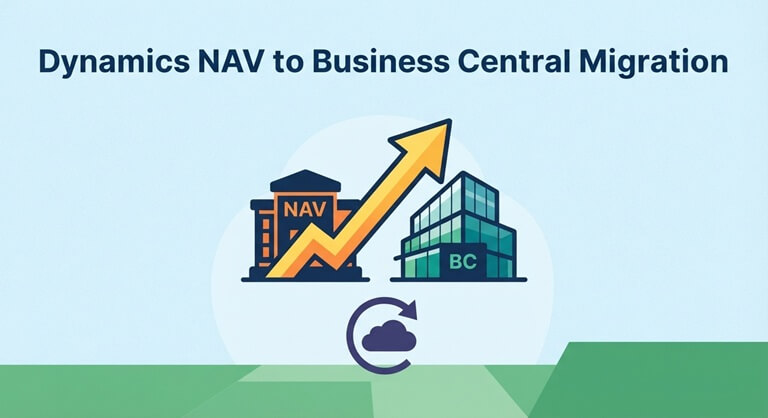
For years, Dynamics NAV has been running the back office of manufacturers, distributors, and retailers. In most environments, it is reliable and highly customized. However, Microsoft’s innovation and long-term investment have shifted to Business Central, making Dynamics NAV to Business Central Migration a strategic priority for organizations looking to modernize their ERP systems. This blog explores why NAV customers are migrating, what changes during the transition, and how the migration process works to help businesses prepare for a successful upgrade.
What Is Dynamics NAV and Why Is It Being Replaced?
Understanding Microsoft Dynamics NAV
NAV (formerly Navision) was developed as an on-premises ERP for small and mid-sized businesses. It was known for its flexible customization through C/AL code. There are still many businesses that operate NAV with a lot of customizations that have been developed over many years.
Microsoft’s Move from NAV to Dynamics 365 Business Central
Business Central is the cloud-native replacement for NAV, launched in 2018, running on Microsoft’s Azure infrastructure, and with a new extension model that’s more modern than using direct code changes. It’s the same basic logic NAV users know but wrapped in a platform that’s meant to be continuously updated rather than version-hopping.
Long-Term Implications & End of Support
Older versions of NAV have already left mainstream support, and Microsoft continues to wind down support for the remaining releases. Running unsupported ERP software means no security patches, no compliance updates, and it will get harder and harder to find partners willing to service the software. This is not a potential risk; this is a scheduling problem.
Top Reasons to Migrate from Dynamics NAV to Business Central
Remote Work and Access to the Cloud
Teams can access financial, inventory and operations data from anywhere, no VPNs or on-prem servers blocking access. This is particularly important for those businesses with more than one location, as the finance and warehouse team will need to view the same numbers, real-time, no matter where they log in from.
Microsoft Copilot: AI-powered Productivity
Copilot in Business Central can create financial reports, categorize cash flow and even suggest sales lines, which are simply not available in classic NAV. For finance teams up to their eyeballs in month-end reconciliation, that kind of support takes real hours out of routine work.
Less Maintenance and Automatic Updates
Business Central pushes updates continuously instead of multi-month upgrade projects every few years, so you are never behind several versions. It also means that the IT department no longer has to allocate resources to disruptive upgrade cycles and focus on projects that advance the business.
Enhanced Security, Compliance and Disaster Recovery
Microsoft takes care of patching, backups, and infrastructure security at the Azure level, so that internal IT teams are less burdened. Also, having built-in compliance certifications makes it easier to meet audits and industry regulations, versus trying to maintain that posture in-house.
Works Seamlessly with Microsoft 365, Teams, Power BI and the Power Platform
Business Central works well with Excel, Outlook, Teams, Power BI, and Power Automate to minimize manual data reconciliation. Sales and Operations teams can collaborate on the tools used daily without needing to switch back and forth between disjoint systems.
Improved Scalability for Expanding Businesses
Adding users, companies or entities is a licensing discussion, not an infrastructure project. Businesses that are looking to make an acquisition, move to a new location, or hire or fire staff will need flexibility, because if the business is on premises, hardware plans will need to be made.
Key Differences Between Dynamics NAV and Business Central
| Area | Dynamics NAV | Business Central |
| Deployment | On-premises | Cloud, hybrid, or on-premises |
| User Interface | Windows client, dated UI | Modern web-based UI |
| AI Capabilities | None native | Copilot built-in |
| Integrations | Limited, custom-built | Native Microsoft 365 & Power Platform |
| Licensing | Perpetual/CAL-based | Subscription (per user/tenant) |
| Updates | Manual, infrequent upgrades | Automatic, continuous |
| Customizations | C/AL code modifications | AL-based extensions |
| Reporting | Basic built-in reports | Power BI embedded analytics |
| Security | Managed internally | Microsoft-managed, cloud-grade |
| Scalability | Hardware-dependent | Elastic, cloud-native |
Step-by-Step Dynamics NAV to Business Central Migration Process
Step 1: Migration Assessment
Review your current version of NAV, size of your database, any customizations and any third-party add-ons. This sets the complexity and the time-line for migration. An upfront detailed assessment also shows you what customizations are still really being used, so you are not moving dead weight into the new system.
Step 2: Setup Environment
Create a Business Central sandbox environment that is as similar as possible to your production environment prior to accessing live data. This is your “sandbox” for the entire project, so it’s important to spend the time now and get this set up as much as you can like the production environment from the start.
Step 3: Data Migration
Depending on the volume and quality of data, move master data, transactions and historical data using Microsoft’s migration tools or a partner-assisted approach. It’s worth saving the rework later by cleansing data before the move, such as removing duplicate vendors or old item records.
Step 4: Migration of Extension and Customization
Migrate legacy C/AL customizations to AL extensions. This is usually the most time-consuming step, especially for heavily modified NAV installations. First, prioritize customizations that relate to core business processes as some minor customizations may be replaced by standard Business Central features.
Step 5: Test and Validate
Run side by side parallel testing, comparing NAV and BC output to ensure financial and operational accuracy before cutover. This isn’t always an IT-centric process, as end users will be the ones to discover gaps in processes that a technical test may not.
Step 6: Go-Live & Post-Migration Support
Plan a go-live when transaction volume is low and have hypercare support on hand for the initial weeks to address edge cases in a timely manner. Use this window to document known issues and resolutions, so your team has “partner knowledge” plus their own knowledge.
Why Work with a Microsoft Dynamics 365 Migration Partner?
A technical implementation partner has the expertise that is often hard to find in-house, particularly in respect to AL extension conversion and data cleansing. Partners have run dozens of similar migrations in the past, so faster timelines and fewer mid-project surprises. They also have the added benefit of risk mitigation. A poorly scoped migration could end up with weeks of reconciliation headaches or worse, bad financial data going live.
A good partner sticks around beyond go-live to optimize, so you actually use Copilot, Power BI and Power Automate, instead of just replicating legacy NAV workflows in a new interface. And it’s that ongoing relationship that usually determines whether that ROI shows up in month three or month eighteen.
Conclusion
Moving from Microsoft Dynamics NAV to Microsoft Dynamics 365 Business Central is much more than a software upgrade. It’s a move to a modern platform that Microsoft is constantly improving with cloud capabilities, AI features and integration options out-of-the-box. Most of the organizations that plan the migration, review their customizations and carefully test everything before they go live tend to have a smoother transition and a better visibility of the operations. If your NAV system is aging, you might want to start assessing your readiness now, before support is no longer available.
Frequently Asked Questions
Is Dynamics NAV still supported?
Some older NAV versions have already lost mainstream support, and Microsoft continues to phase out support for remaining releases. Check your specific version support lifecycle before assuming coverage.
How long does a Dynamics NAV to Business Central migration take?
If your NAV system is aging, you might want to start assessing your readiness now, before support is no longer available.
Can I migrate directly from older NAV versions?
Very old versions (pre-2016) usually require an intermediate upgrade step before moving to Business Central. A migration assessment will clarify your specific path.
Will my customizations work in Business Central?
Not automatically. C/AL customizations need to be rebuilt as AL extensions, which is why customization audits happen early in the assessment phase.
Popular on OTW Right Now!




About The Author

Gagan Bhangu
Founder of otechworld.com and managing editor. He is a tech geek, web-developer, and blogger. He holds a master's degree in computer applications and making money online since 2015.