
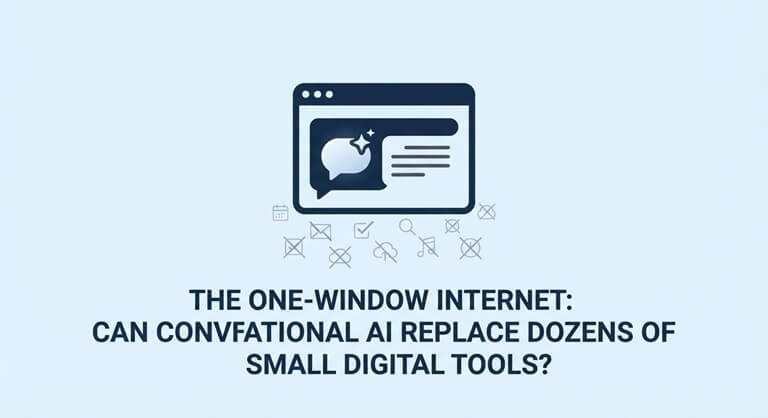
The One-Window Internet: Can Conversational AI Replace Dozens of Small Digital Tools?
The internet was supposed to make everyday tasks easier.
Instead, the modern user often has to navigate a small universe of websites and applications just to complete one simple project.
You might open a browser for research, a writing application for content, a spreadsheet for calculations, a separate AI assistant for brainstorming, an image tool for visuals, and another service to organize the result.
Every tool solves a problem.
Together, they can create another one: digital fragmentation.
This is where conversational AI becomes particularly interesting. Rather than adding another specialized application to the pile, a chat-based AI platform can potentially become the starting point for many different online tasks.
The Problem With Having a Tool for Everything
There is an obvious advantage to specialized software.
A dedicated application can be extremely good at one particular task.
But specialization creates a hidden cost: switching.
Consider someone trying to build a small online income stream. Their workflow might include:
- Finding a niche.
- Researching competitors.
- Creating content ideas.
- Writing articles.
- Preparing social posts.
- Analyzing results.
- Updating the strategy.
That could involve six or seven different services.
The subscription fees matter, but the bigger issue may be the constant transfer of information between platforms.
The Hidden Cost of Copy and Paste
Copying text from one application into another seems trivial.
Do it fifty times a day and the pattern becomes different.
Information loses context. Files become duplicated. Browser tabs multiply. Users have to remember where something was created and which tool should be used next.
The result is a strange contradiction:
The internet offers more tools than ever, yet completing simple projects can sometimes feel more complicated.
What If the Workflow Starts With a Question?
Conversational AI introduces another model.
Instead of opening an application because you know what function you need, you begin by explaining what you are trying to accomplish.
For example:
“I want to research a niche for an online business. Help me identify the questions I should investigate before spending money.”
That conversation can lead naturally into market research, competitor analysis, content planning, and experimentation.
The AI does not necessarily perform every action.
It helps structure the thinking that comes before those actions.
Use AI and the “Digital Workbench” Idea
This is where Use AI reviews become relevant to a broader discussion about conversational software.
Use AI is positioned as a chat-based AI platform. Rather than requiring users to approach every problem through a separate specialized interface, the conversational model allows them to describe questions and refine the result interactively.
For someone experimenting with online business, Android or Windows workflows, content creation, or internet research, this can be an interesting alternative way to think about AI.
The important point is not that one platform can magically replace every other application.
It cannot.
The more useful idea is that AI can become a digital workbench: a place where users clarify a problem before deciding which tools they actually need.
AI Can Be a Map Before It Becomes a Tool
Imagine that you want to make money online but have no clear business model.
Opening ten websites and searching for “best online business ideas” will probably produce an overwhelming collection of generic suggestions.
A conversation can begin differently.
Step 1: Define the Constraints
Tell the AI what resources you have, what skills you understand, and how much time you can invest.
Step 2: Generate Possibilities
Explore several business models without committing to any of them.
Step 3: Challenge the Ideas
Ask what assumptions could make each model fail.
Step 4: Identify the Cheapest Test
Instead of building an entire business, find the smallest experiment that could provide useful evidence.
Step 5: Use Specialized Tools Only When Necessary
Once the task becomes specific, bring in the appropriate software.
This is a subtle but important change.
AI does not necessarily replace the software ecosystem.
It can help users navigate it more intelligently.
The New Skill: Knowing What Not to Automate
There is a temptation to automate everything.
But not every task benefits from automation.
| Task | AI assistance can help | Human judgment remains important |
| Keyword research | Organizing ideas | Evaluating actual demand |
| Content creation | Drafting and restructuring | Accuracy and originality |
| Business ideas | Generating possibilities | Selecting viable opportunities |
| Troubleshooting | Suggesting solutions | Testing them safely |
| Productivity | Building workflows | Deciding priorities |
| Online research | Summarizing information | Checking sources |
The distinction matters because AI can produce plausible answers even when the underlying information is incomplete.
The faster technology becomes, the more important verification becomes.
The One-Window Internet Has a Catch
A single conversational interface sounds attractive, but consolidation has its own risks.
If users depend too heavily on one system, they may stop exploring original sources. They may also accept generated answers without checking whether they are correct.
There is another danger: false productivity.
Generating a perfect five-step plan feels productive.
Executing the first step is productive.
The difference is enormous.
AI should therefore reduce friction, not create an endless loop of planning.
A Useful Rule: Conversation Must Lead to Action
A practical workflow is:
Ask » clarify » verify » act » measure.
If the process ends after “ask,” the technology has become entertainment.
If it reaches “act” and “measure,” it becomes a useful digital tool.
Why This Matters for Making Money Online
Online entrepreneurship rewards experimentation.
A person can test a website idea, publish content, launch a small digital product, experiment with affiliate marketing, or build a niche service without requiring the infrastructure of a traditional company.
But experimentation also requires research and iteration.
Conversational AI can potentially make the early stages less intimidating by helping users turn vague ideas into concrete questions.
That does not guarantee income.
No AI platform can.
What it can do is reduce some of the friction between “I have an idea” and “I have a testable hypothesis.”
From Tool Collector to Workflow Designer
The next stage of internet productivity may not belong to people who own the largest collection of applications.
It may belong to people who know how to combine a small number of tools effectively.
Chat-based platforms such as Use AI represent part of that transition.
Their value is less about replacing every website, application, or online service and more about giving users a flexible place to think, research, organize, and decide what should happen next.
The future internet may therefore become less about opening more windows and more about reducing the distance between an intention and an action.
And perhaps the most useful question to ask about any new AI tool is not:
“What features does it have?”
but:
“How many unnecessary steps does it remove from something I actually want to accomplish?”
Popular on OTW Right Now!
-
 How AI Floor Plan Tools Are Reshaping the Way We Design Spaces
-
Ways in Which the AI Client Intake System Works Better in Law Practice Than the Traditional System!
-
Top 5 AI Gateways for Managing MCP Costs at Scale
-
 Smart Signage and AI: Leveraging Intelligent Design Tools for Physical Business Collaterals



About The Author

Gagan Bhangu
Founder of otechworld.com and managing editor. He is a tech geek, web-developer, and blogger. He holds a master's degree in computer applications and making money online since 2015.